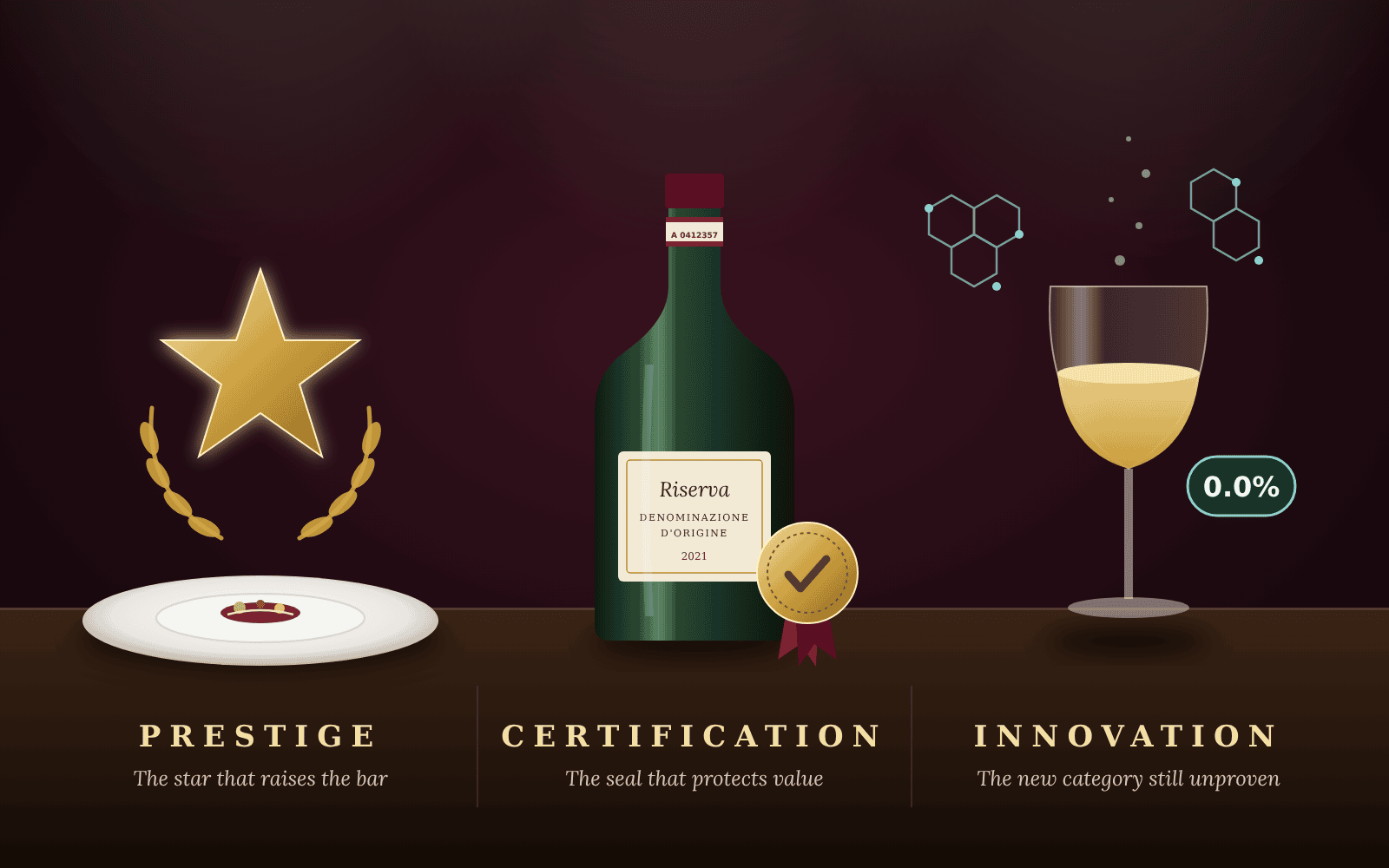
What Michelin stars, Italian appellations, and no-alcohol wine reveal about the economics of differentiation
By Angelo A. Camillo, PhD, MBA
Associate Professor, Wine Business Institute, Sonoma State University
Restaurants chase Michelin stars. Wineries pursue DOC and DOCG status, organic certification, and sustainability seals. Producers invest in new categories such as dealcoholized wine. Each is a bet on differentiation: pay now to stand apart, and collect a premium later (Porter, 1985).
The evidence increasingly shows that the first half of that bet is easier than the second. Achieving excellence and monetizing it are different problems. In all three cases, the investment is certain and immediate; the return is conditional on factors the investor does not control. Table 1 summarizes the three paths.
Table 1
Three Paths to Differentiation and the Conditions Under Which They Pay
| Dimension | Prestige | Certification | Innovation |
| Example | Michelin star | DOC/DOCG; Equalitas; organic | No/low-alcohol wine |
| Who grants it | Independent third party | Consortium, state, or auditor | The market |
| Up-front cost | Kitchen, staff, service, design | Compliance, audits, yield limits | Equipment, R&D, new SKUs |
| Recurring cost | Unannounced inspections; rising expectations | Annual audits, testing, seals | Marketing; category building |
| Pays when | Higher prices outrun higher costs | Consumers know and trust the label | New consumers or occasions, not substitution |
| Key evidence | Sands (2025); Li et al. (2025) | Di Chiara et al. (2025); Radicioni et al. (2026) | Dogru & Peyrefitte (2022); IWSR (2024) |
Why Distinctions Are Supposed to Pay
Fine dining and fine wine are experience and credence goods. Buyers cannot judge quality before purchase, and sometimes not even after (Akerlof, 1970). Stars, appellations, and certificates exist to close that gap. They are costly signals that low-quality competitors cannot easily imitate (Spence, 1973); they confer status that shapes how markets value a producer (Podolny, 1993); and they let a seller earn a price premium as a return on reputation (Shapiro, 1983).
The theory carries a hidden condition. A signal pays only if buyers notice it, trust it, and value it more than it costs to maintain. When any link in that chain weakens, the distinction becomes a fixed cost with uncertain revenue.
Factor One: The Prestige Paradox
Michelin evaluates the plate, not the balance sheet. Its inspectors assess product quality, technical mastery, the chef’s personality, value for money, and consistency across visits. Labor ratios, rent, and debt are not on the list. Earlier research showed that starred restaurants follow very different business models, and recognition alone does not guarantee profit (Johnson et al., 2005), even though expert awards are associated with higher menu prices (Gergaud et al., 2015).
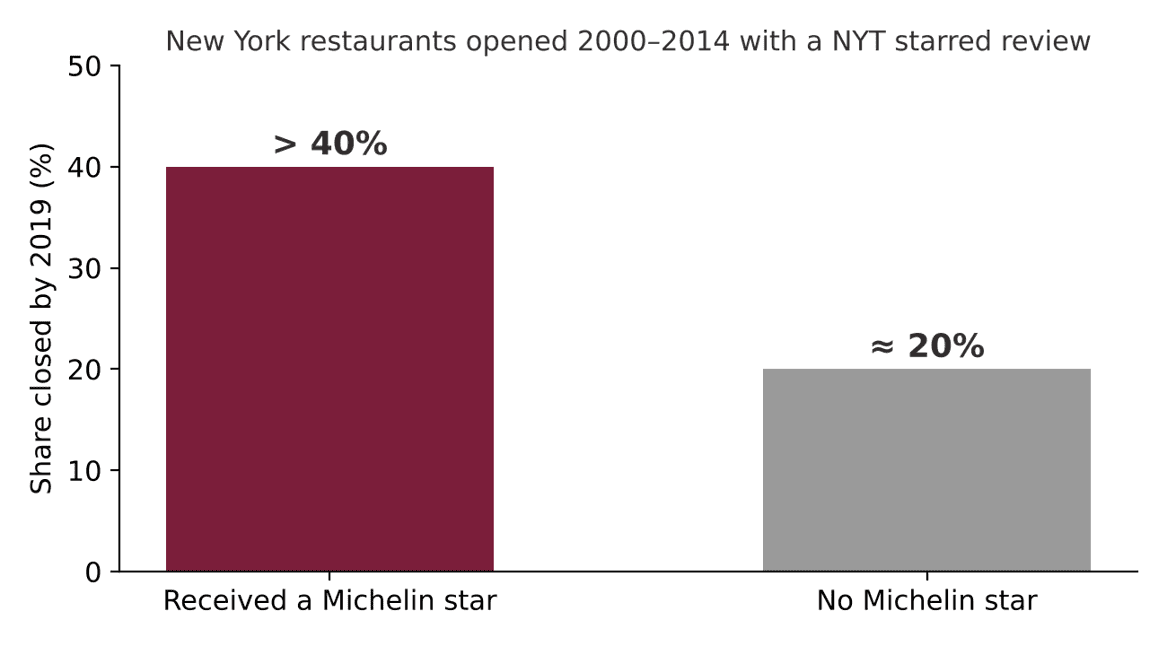
The strongest recent evidence comes from Sands (2025). Studying two decades of elite New York openings, he found that receiving a Michelin star corresponded to a higher likelihood of closure. As Figure 1 shows, more than 40% of starred restaurants had closed by 2019, compared with roughly one in five comparable unstarred restaurants (Jennings, 2024; Sands, 2025). His mechanism is reactivity (Espeland & Sauder, 2007): suppliers, landlords, staff, and guests all change their behavior toward a starred restaurant, raising costs and expectations faster than prices can follow.
Figure 1
Closure Rates of New York City Restaurants by Michelin Status
Expectations matter as much as costs. Li et al. (2025) examined a decade of British and Irish Michelin data and found that restaurants that lost stars received better online reviews afterward. Lower expert ratings lowered diner expectations, and diners became less demanding about value and service. A star, in other words, raises the bar for every guest who walks through the door.
Recent cases fit the pattern (Table 2). Osito in San Francisco won its star in December 2022, about a year after opening, and closed in May 2025; its chef-owner said the restaurant was busier than ever, yet the numbers no longer worked (KTVU, 2025; SFGate, 2025). Atelier in Chicago earned a star in its first year, doubled its seating in a 2025 move funded partly by guest investors, and closed in May 2026 under financial strain (Restaurant Hospitality, 2025; WBEZ, 2026).
The costs are not only financial. In 2017 Sébastien Bras asked Michelin to drop Le Suquet, a three-star restaurant since 1999, citing the “great pressure that results inevitably from the distinction of the three stars” (NPR, 2017); Michelin granted the request for its 2018 guide (Associated Press, 2018). Marc Veyrat took the opposite route. After losing his third star in 2019, he sued Michelin; the court dismissed the case partly because he showed no material damage, and Veyrat himself said business had risen 7% (Agence France-Presse, 2019; Courthouse News Service, 2019). Losing the star hurt the chef far more than the business.
Table 2
Selected Michelin Cases, 2017–2026
| Restaurant | Location | Recognition | Outcome | Source |
| Le Suquet (S. Bras) | Laguiole, France | Three stars since 1999 | Asked to leave the guide in 2017; omitted from 2018 edition | NPR (2017); AP (2018) |
| La Maison des Bois (M. Veyrat) | Manigod, France | Third star 2018; lost 2019 | Lawsuit dismissed 2019; no material damage shown | AFP (2019) |
| Osito (S. Stowaway) | San Francisco, CA | One star, Dec. 2022 | Closed May 11, 2025, while busy | KTVU (2025); SFGate (2025) |
| Atelier (T. Lacey) | Chicago, IL | One star, first year (2023) | Expanded Oct. 2025; closed May 2026 | Restaurant Hospitality (2025); WBEZ (2026) |
Factor Two: The Certification Dilemma
Italy’s appellation system is a collective reputation scheme. Producers in a zone share a name, follow a production code, and submit to testing, tasting panels, and numbered DOCG seals. A shared name carries information that no single small winery could build alone (Landon & Smith, 1998; Tirole, 1996).
The hedonic price literature confirms that appellations can carry a premium. Studies of Italian red wine find a significant DOCG effect, particularly in specialty retail (Benfratello et al., 2009; Brentari et al., 2011, 2015), and a meta-regression of wine price studies confirms that reputation signals move prices (Oczkowski & Doucouliagos, 2015). However, the effect varies sharply by market and segment.
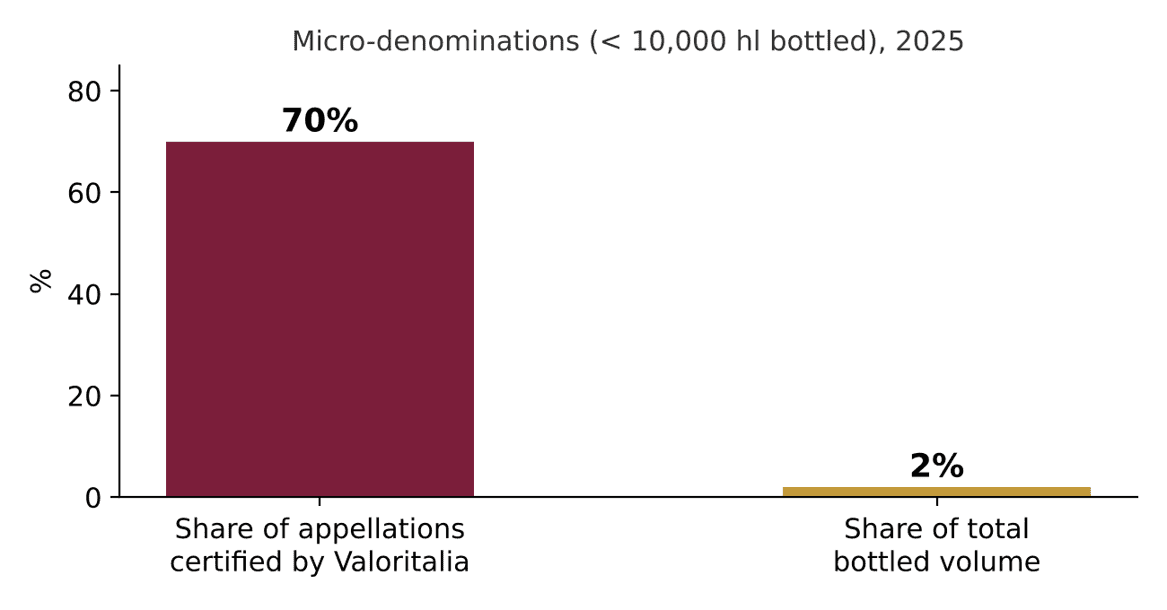
The system’s size helps explain why. Italy counts 77 DOCG, 333 DOC, and 119 IGT designations (Figure 2). Valoritalia’s 2025 certification data show that micro-denominations, those bottling under 10,000 hectoliters, make up 70% of the 219 appellations it certifies but only 2% of certified volume (WineNews, 2026; Figure 3). When a label appears on too few bottles, consumers never learn what it means, and the signal cannot pay.
Figure 2
Italian Wine Designations by Tier
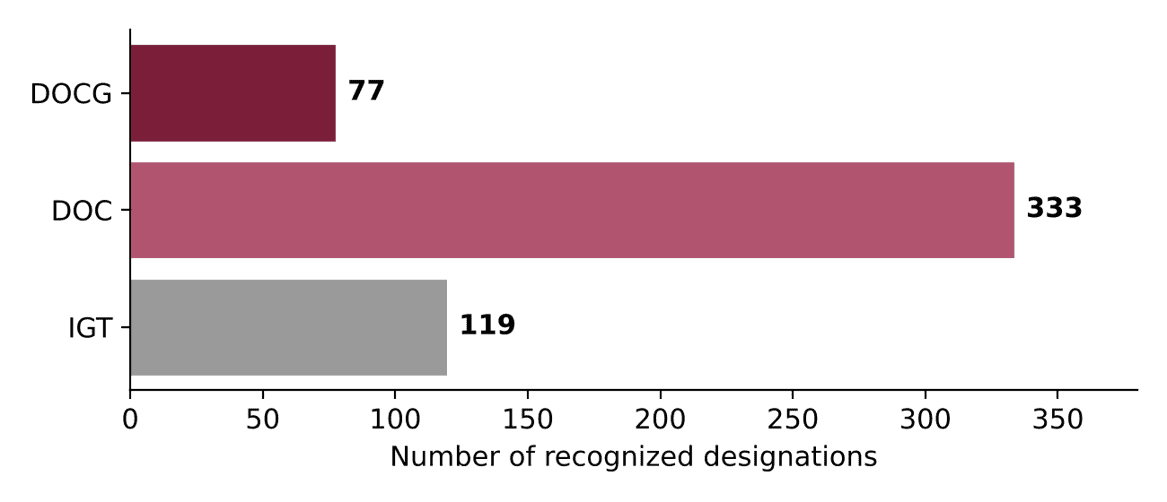
Figure 3
The Weight of Italy’s Micro-Denominations, 2025
Voluntary sustainability certification is a separate economic good, and the evidence is more encouraging than many laments suggest (Table 3). Di Chiara et al. (2025) compared 631 Italian firms from 2018 to 2023 and found that Equalitas certification produced no significant short-term effect on profitability or liquidity, positive or negative. Wineries in an Emilia-Romagna consortium viewed territorial certification as a tool for both economic performance and collective reputation (Ceccacci et al., 2025). On the demand side, environmental attributes command the highest willingness to pay while social attributes have little measurable effect (Radicioni et al., 2026); more knowledgeable consumers tend to pay smaller premiums (Sellers-Rubio & Nicolau-Gonzalbez, 2016); and in Chile only about one consumer in five would pay a premium for sustainable wine (Valenzuela et al., 2022).
Table 3
Selected Evidence on Certification and Price
| Study | Setting and design | Key finding |
| Di Chiara et al. (2025) | 631 Italian firms, 2018–2023; difference-in-differences | Equalitas certification had no significant short-term effect on profitability or liquidity |
| Ceccacci et al. (2025) | Emilia-Romagna consortium; survey, factor and cluster analysis | Certification viewed as enhancing performance and collective reputation |
| Radicioni et al. (2026) | Meta-analysis of willingness-to-pay studies | Environmental attributes earn the highest premium; social attributes have little effect |
| Sellers-Rubio & Nicolau-Gonzalbez (2016). | Contingent valuation; Heckit model | Premium falls as consumer wine knowledge rises |
| Valenzuela et al. (2022) | 526 Chilean consumers; survey | About 19% would pay a premium for sustainable wine |
| Benfratello et al. (2009); Brentari et al. (2011) | Hedonic price models, Italian wine | DOCG carries a premium, strongest in specialty retail |
The regret some producers voice is therefore real but often misdiagnosed. Certification rarely destroys value. It simply does not create pricing power by itself.
The Super Tuscan Lesson
The Super Tuscans show where value comes from. Sassicaia, Tignanello, and Ornellaia were built outside the classification rules of their day and were sold as humble table wine before the IGT category existed. Demand and brand came first; the system followed. Sassicaia, first sold commercially with the 1968 vintage, became a subzone of Bolgheri DOC in 1994 and, in 2013, Italy’s only single-estate DOC. Tignanello, still labeled Toscana IGT, sells for roughly US$150 to US$200 a bottle depending on vintage (Wine Decider, 2026) and has climbed the Liv-ex fine-wine classification (Liv-ex, 2021).
Certification can protect value. It does not manufacture it.
Factor Three: The Innovation Gamble
Innovation pays off on average. Dogru and Peyrefitte’s (2022) meta-analysis of 76 wine-industry studies found a moderate positive correlation (r = .29) between innovation and financial performance (see also Canavati, 2022). Averages, however, hide dispersion: measuring national wine innovation systems, Amatucci et al. (2024) found that some countries efficiently convert innovation inputs into market performance while others do not.
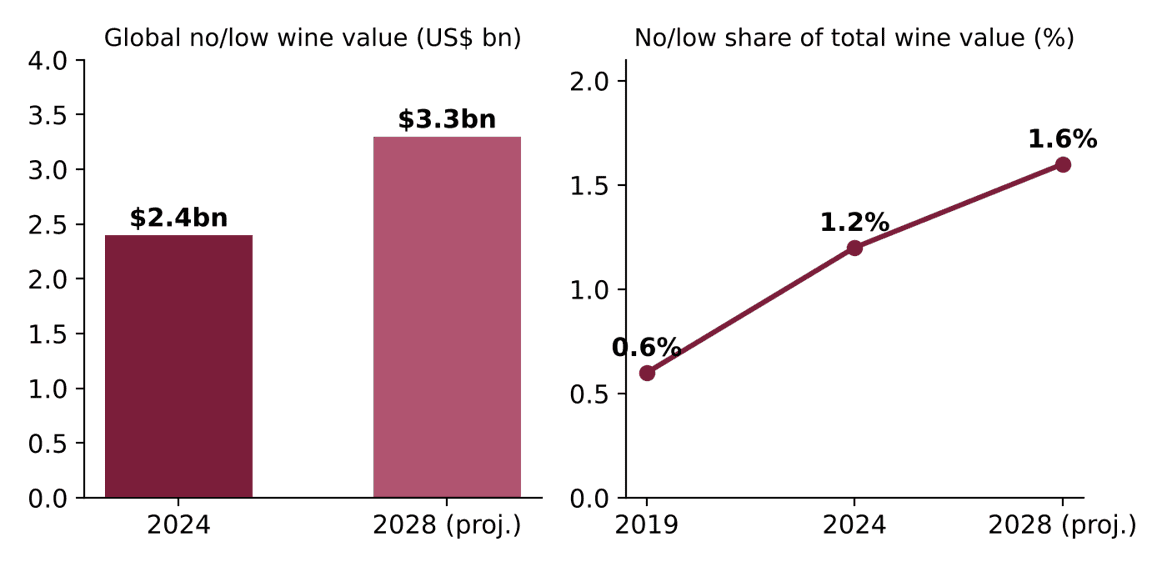
No- and low-alcohol wine is the clearest current test. The UIV-Vinitaly Observatory, using IWSR data, values the global category at about US$2.4 billion, growing to US$3.3 billion by 2028 (Gambero Rosso, 2025). That is still only about 1.2% of world wine value, rising to roughly 1.6% (WineNews, 2025), as Figure 4 shows. Italy’s own domestic market was estimated at just €3.3 million.
Figure 4
Global No/Low-Alcohol Wine: Value and Share of the Wine Market
Cannibalization is the strategic question.
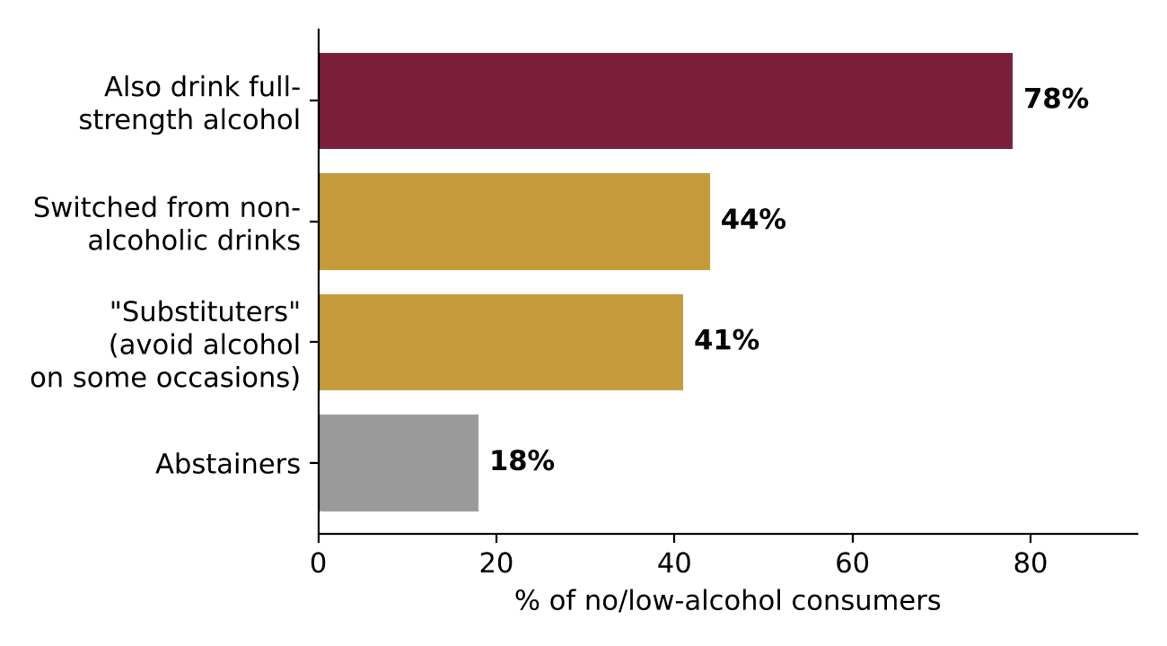
IWSR finds that 78% of no/low consumers also drink full-strength alcohol, yet 44% say they switched to no-alcohol drinks from soft drinks, water, tea, or coffee rather than from wine (IWSR, 2023, 2024; Figure 5). In the United States, seven in ten no-alcohol wine drinkers also drink conventional wine (Gambero Rosso, 2025). The category creates new occasions and attracts new consumers, and each producer’s mix will differ.
Figure 5
Who Buys No/Low-Alcohol Drinks
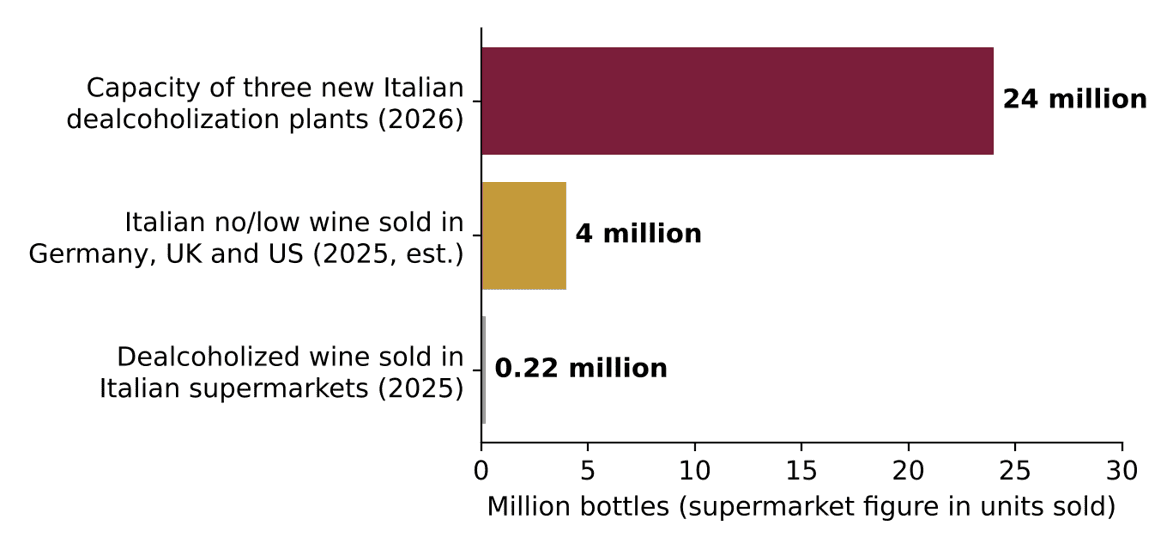
Supply may be outpacing demand. Three new Italian plants alone can dealcoholize about 24 million bottles a year, while Italian supermarkets sold roughly 220,000 units of dealcoholized wine in 2025 (Casagrande, 2026), as Figure 6 shows. The UIV-Vinitaly Observatory found that 94% of Italian non-drinkers had bought no alcohol-free product in the previous six months and that 71% of restaurateurs had no interest in listing one (Vinetur, 2026). Forecasts have cooled as well: IWSR (2026) now expects no-alcohol beer, the category’s strongest performer, to reach only 4% of global beer volume by 2033. Export hopes carry their own friction; in the United Arab Emirates, products at the EU’s 0.5% threshold are reportedly taxed as alcohol (Casagrande, 2026).
Figure 6
Italian Dealcoholization Capacity Versus Sales
Where the Paths Collide
Italy offers a twist that sharpens the whole argument. The ministerial decree signed in December 2024 finally allowed dealcoholized wine production but excluded DOCG, DOC, and IGP wines (Gambero Rosso, 2024; Quotidiano Nazionale, 2025). Production then stalled for a year over excise rules until the finance and agriculture ministries signed the fiscal decree on December 29, 2025 (Il Sole 24 Ore, 2025). Meanwhile, Italian brands produced abroad and captured shares of zero-alcohol wine sales in the United Kingdom and Germany.
For an Italian producer, then, the certification path and the innovation path are not parallel options. The appellation that anchors a winery’s reputation is precisely what bars its flagship wine from the fastest-growing category.
What the Three Paths Share
Each requires heavy, front-loaded investment. Each raises expectations from guests, trade buyers, or regulators. Each pay only when it converts into “consumer willingness to pay” that exceeds its upkeep. Prestige, certification, and innovation are conditions for competing at the top. None is a business model.
The practical lesson for restaurateurs and vintners is to budget for distinctions as you would for capital projects. Model the recurring cost of maintaining the star, the seal, or the new line. Identify which customers will pay more and how you will know. Recognizing that brand, built patiently, is what turns recognition into margin. Success has never been more attainable. Making it pay for itself has rarely been harder.

About the Author
Angelo A. Camillo, PhD, MBA, is an Associate Professor at the Wine Business Institute in the School of Business at Sonoma State University, where he teaches strategic management, hospitality management, international business, wine business, the wine supply chain, and global wine business, and leads the study abroad program. He has more than 35 years of international hospitality management experience, having worked and lived in ten countries on four continents, and has taught concurrently since 1991. He is Editor-in-Chief of the Wine Business Journal, Founding Editor-in-Chief of IJTHMDA, Education Chair of the American Culinary Federation San Francisco Chapter, and a former F. Korbel and Bros. Professor of Wine Business. A Certified Executive Chef, Certified Culinary Educator, Certified Food Executive, and award-winning home winemaker, he studied at the Heidelberg Hotel Management School, San Francisco State University (MBA), and Oklahoma State University (PhD). He earned executive certificates from Cornell University and Harvard University. He has published over 100 Articles in academic journals, trade journals, and conference proceedings; authored 8 books, including the forthcoming textbooks Winery Hospitality Management: Strategies for the Global Wine Experience Economy (Ethics Press) and The Emerald Handbook of Wine Business Production, Operation, and Distribution. He consults for hospitality businesses in the United States and abroad. https://aacamillo.wixsite.com/mysite/books
Media Contact
Angelo A. Camillo, PhD, MBA · Wine Business Institute, Sonoma State University · Rohnert Park, California · USA camillo@sonoma.edu
References
Agence France-Presse. (2019, December 31). French chef fails in Michelin lawsuit over lost star. CTV News. https://www.ctvnews.ca/lifestyle/french-chef-fails-in-michelin-lawsuit-over-lost-star-1.4749288
Akerlof, G. A. (1970). The market for “lemons”: Quality uncertainty and the market mechanism. Quarterly Journal of Economics, 84(3), 488–500. https://doi.org/10.2307/1879431
Amatucci, A., Ventura, V., & Frisio, D. (2024). Performance and efficiency of national innovation systems: Lessons from the wine industry. Wine Economics and Policy, 13(1), 63–80. https://doi.org/10.36253/wep-14637
Associated Press. (2018, January 30). Michelin allows top French chef to relinquish stars. KSL. https://www.ksl.com/article/46249219/michelin-allows-top-french-chef-to-relinquish-stars
Benfratello, L., Piacenza, M., & Sacchetto, S. (2009). Taste or reputation: What drives market prices in the wine industry? Estimation of a hedonic model for Italian premium wines. Applied Economics, 41(17), 2197–2209.
Brentari, E., Levaggi, R., & Zuccolotto, P. (2011). Pricing strategies for Italian red wine. Food Quality and Preference, 22(8), 725–732.
Brentari, E., Levaggi, R., & Zuccolotto, P. (2015). A hedonic price analysis for the Italian wine in the domestic market. Quality & Quantity, 49, 999–1012.
Canavati, S. (2022). Innovation in the wine industry: Taking stock and moving forward [Editorial]. Wine Business Journal. https://wbj.scholasticahq.com/article/32588
Casagrande, G. (2026, October 21). Ma è già scoppiata la bolla dei Nolo e dei Low Alcol? [Has the No-Lo and low-alcohol bubble already burst?] [Article]. LinkedIn.
Ceccacci, A., Camanzi, L., Rota, C., Fiorentini, R., & Malorgio, G. (2025). Enhancing wineries’ sustainability through territorial certifications: A case study in Emilia-Romagna, Italy. International Journal of Wine Business Research, 37(1), 87–112.
Courthouse News Service. (2019, December). French court to rule on Michelin star dispute. https://www.courthousenews.com/?p=535827
Di Chiara, V., Cei, L., & Pomarici, E. (2025). Is there any economic penalty for sustainability? A difference-in-differences analysis of Italian wineries. Sustainability, 17(22), Article 10162.
Dogru, A., & Peyrefitte, J. (2022). Investigation of innovation in wine industry via meta-analysis. Wine Business Journal, 5(1), 44–76. https://doi.org/10.26813/001c.31627
Espeland, W. N., & Sauder, M. (2007). Rankings and reactivity: How public measures recreate social worlds. American Journal of Sociology, 113(1), 1–40.
Gambero Rosso. (2024, December 23). Historical breakthrough: Italy will also produce dealcoholised wines. Lollobrigida signs the decree. https://www.gamberorossointernational.com/?p=537828
Gambero Rosso. (2025, April 8). I vini no e low alcol arriveranno a 3,3 miliardi di dollari entro il 2028. https://www.gamberorosso.it/notizie/vino/vini-no-low-alcol-previsioni-crescita/
Gergaud, O., Storchmann, K., & Verardi, V. (2015). Expert opinion and product quality: Evidence from New York City restaurants. Economic Inquiry, 53(2), 812–835.
Il Sole 24 Ore. (2025, December). Decree approved for the production and taxation of dealcoholised wines in Italy. https://en.ilsole24ore.com/art/go-ahead-for-italy-production-of-dealcoholised-wines-AILqbrc
Il Sole 24 Ore. (2026). Wine, top 5 wineries produce 18% DOC and IGT: Evidence of concentration? https://en.ilsole24ore.com/art/wine-proof-concentration-top-5-wineries-produce-18-per-cent-doc-and-igt-AIuFEcOB
IWSR. (2023). No- and low-alcohol category value exceeds US$11bn in 2022 [Press release]. https://www.foodbusinessmea.com/no-and-low-alcohol-category-value-exceeds-us11bn-in-2022-projected-to-have-7-growth-by-2026-iwsr/
IWSR. (2024). Who is winning from the moderation trend? https://www.theiwsr.com/who-is-winning-from-the-moderation-trend/
IWSR. (2026, June 11). Global beverage alcohol to drop further before recovering [Press release]. https://www.theiwsr.com/insight/press-release/global-beverage-alcohol-to-drop-further-before-recovering/
Jennings, L. (2024, October 4). The dark side of earning a Michelin star. Restaurant Business. https://www.restaurantbusinessonline.com/marketing/dark-side-earning-michelin-star
Johnson, C., Surlemont, B., Nicod, P., & Revaz, F. (2005). Behind the stars: A concise typology of Michelin restaurants in Europe. Cornell Hotel and Restaurant Administration Quarterly, 46(2), 170–187.
KTVU. (2025, May). Michelin-star restaurant, Osito, shuts down due to “SF economy.” https://ktvu.com/news/michelin-star-restaurant-osito-shuts-down-due-sf-economy
Landon, S., & Smith, C. E. (1998). Quality expectations, reputation, and price. Southern Economic Journal, 64(3), 628–647.
Li, X., Deng, Y., Manchanda, P., & De Reyck, B. (2025). Can lower(ed) expert opinions lead to better consumer ratings? The case of Michelin stars. Management Science. Advance online publication. https://doi.org/10.1287/mnsc.2023.04302
Liv-ex. (2021). Tignanello rises to the 2nd tier of the Liv-ex Classification. https://www.liv-ex.com/?p=49747
NPR. (2017, September 21). Three-star chef asks Michelin Guide to leave him out: “I will be able to feel free.” https://www.npr.org/sections/thetwo-way/2017/09/21/552691774/
Oczkowski, E., & Doucouliagos, H. (2015). Wine prices and quality ratings: A meta-regression analysis. American Journal of Agricultural Economics, 97(1), 103–121.
Podolny, J. M. (1993). A status-based model of market competition. American Journal of Sociology, 98(4), 829–872.
Porter, M. E. (1985). Competitive advantage: Creating and sustaining superior performance. Free Press.
Quotidiano Nazionale. (2025, April 9). Vino dealcolato: La produzione è autorizzata anche in Italia. https://www.quotidiano.net/economia/vino-dealcolato-italia-6f51c7c1
Radicioni, E., Dominici, A., Casini, L., & Boncinelli, F. (2026). Understanding the willingness to pay for sustainable wine: A meta-analytical approach. Journal of Cleaner Production, 561, Article 148428. https://doi.org/10.1016/j.jclepro.2026.148428
Restaurant Hospitality. (2025, December 3). Chicago’s Michelin-starred Atelier funded its move into a larger space with investment from fans. https://business.lincolnsquare.org/news/details/chicago-s-michelin-starred-atelier-funded-its-move-into-a-larger-space-with-investment-from-fans-and
Sands, D. B. (2025). Double-edged stars: Michelin stars, reactivity, and restaurant exits in New York City. Strategic Management Journal, 46(1), 148–176. https://doi.org/10.1002/smj.3651
Sellers-Rubio, R., & Nicolau-Gonzalbez, J. L. (2016). Estimating the willingness to pay for a sustainable wine using a Heckit model. Wine Economics and Policy, 5(2), 96–104.
SFGate. (2025, May). “Doesn’t make financial sense”: Michelin-starred SF restaurant calls it quits. https://www.sfgate.com/food/article/sf-osito-restaurant-set-to-close-20316091.php
Shapiro, C. (1983). Premiums for high quality products as returns to reputations. Quarterly Journal of Economics, 98(4), 659–679.
Spence, M. (1973). Job market signaling. Quarterly Journal of Economics, 87(3), 355–374.
Tirole, J. (1996). A theory of collective reputations (with applications to the persistence of corruption and to firm quality). Review of Economic Studies, 63(1), 1–22.
Valenzuela, L., Ortega, R., Moscovici, D., Gow, J., Ugaglia, A. A., & Mihailescu, R. (2022). Consumer willingness to pay for sustainable wine: The Chilean case. Sustainability, 14(17), Article 10910.
Vinetur. (2026, April 14). Italy’s no-alcohol wine production is set to surge. https://www.vinetur.com/amp/2026041498939/italys-no-alcohol-wine-production-is-set-to-surge.html
WBEZ. (2026, May 28). Why Chicago’s Michelin-starred Atelier in Lincoln Square suddenly shut down. https://www.wbez.org/food-drink/2026/05/28/atelier-chicago-restaurant-closure-lincoln-square-michelin-star-small-business
Wine Decider. (2026). Antinori Toscana Tignanello 2022 [Price listing]. https://www.winedecider.com/en/find/antinori-toscana-tignanello/2022/us/USD
WineNews. (2025). “No-Lo” wines in 2024 are worth 2.4 billion dollars (1.2% of total) in world. https://winenews.it/?p=554955
WineNews. (2026). Bottling of Italian wine in 2025 at -2.1% in 2024. https://winenews.it/?p=582682