Why Americans pay luxury prices for coffee every morning but hesitate over a $40 bottle of wine
Coffee turned a commodity into an everyday luxury. Wine, priced from $5.99 to more than $60,000 a bottle, still makes consumers nervous. The difference is not the product. It is the habit.
By Angelo A. Camillo, PhD, MBA
Every weekday morning, millions of Americans hand over $6.75 for a signature latte without a second thought. A few hours later, many of the same people stand in a wine aisle, or study a restaurant wine list, and hesitate over a $40 bottle. Ounce for ounce, the latte is often the more expensive indulgence.
That paradox is the core of what I call the Invisible Luxury Principle: consumers embrace luxury when it is embedded in routine. Coffee has mastered this. Wine has not, and the timing could hardly be worse. U.S. off-premise wine sales fell 6% by volume in 2025, and wholesaler depletions fell 9%, according to Terrain’s spring 2026 Winescape report.
So the useful question is not why consumers resist expensive wine. It is how they came to embrace equally expensive coffee without noticing, and what wine can borrow from that.
The arithmetic nobody does
Priced by the ounce, a premium espresso costs as much as a $76 to $200 bottle of wine. Consumers simply never run the numbers.
There is no legal U.S. standard for an espresso shot, but the industry norm is clear. A single shot yields about 1 fluid ounce; a double (doppio) yields about 2. Most American specialty cafés now build every latte, cappuccino and cortado on a double shot by default. A 750 ml bottle of wine holds 25.4 fluid ounces.
| Purchase | Serving | Price | Cost per fl oz | Equivalent 750 ml bottle |
|---|---|---|---|---|
| Single espresso, premium café or fine dining | ~1 fl oz | $4 to $8 | $4.00 to $8.00 | $101 to $203 |
| Double espresso (doppio) | ~2 fl oz | $6.00 | $3.00 | $76 |
| Signature latte, Las Vegas specialty café | ~2 fl oz espresso, plus milk | $6.75 | $3.38 per oz of espresso | $86 |
| Everyday supermarket wine | 25.4 fl oz | $5.99 | $0.24 | $5.99 |
| The bottle shoppers hesitate over | 25.4 fl oz | $40 | $1.58 | $40 |
| Domaine de la Romanée-Conti, Romanée-Conti Grand Cru | 25.4 fl oz | $24,005 | $947 | $24,005 |
| Domaine Leroy, Musigny Grand Cru | 25.4 fl oz | $61,596 | $2,429 | $61,596 |
Grand cru prices are Wine-Searcher global average retail prices, 2026 ranking. A latte’s price also covers milk, labor and the café itself; the comparison is about how the purchase feels, not what it costs to make.
The habit adds up. A $6.75 latte five days a week comes to $1,755 a year. That buys nearly 44 bottles at $40, or 293 bottles at $5.99. Few latte drinkers think of themselves as spending a fine-wine budget on coffee, yet many do.
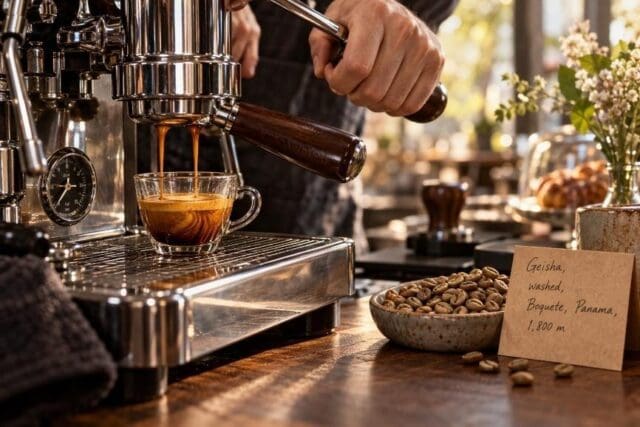
Image: AI-generated illustration.
A commodity that learned to sell luxury
Coffee is still a commodity. Green arabica is graded to a standard and traded on futures exchanges alongside crude oil, wheat and corn. In the cup, however, it has become something consumers buy by name.
Specialty drinkers now talk about origin, elevation, varietal and producer. Jamaica Blue Mountain, Hawaii’s Kona and Panama’s Geisha highlands function much like Bordeaux, Burgundy and Napa Valley. At the 2025 Best of Panama auction, a 20-kilogram lot of washed Geisha from Hacienda La Esmeralda sold to Dubai’s Julith Coffee for $30,204 per kilogram, or $604,080 in total. It remains the highest price ever paid for a single lot of coffee.
The top end keeps rising. At Hacienda La Esmeralda’s own August 2026 auction, 12 nanolots averaged $5,745 per kilogram, more than triple the estate’s 2024 average.
Wine has its own stratosphere. In Wine-Searcher’s 2026 ranking, Domaine Leroy’s Musigny Grand Cru averaged $61,596 a bottle, and even the 10th-ranked wine cost more than $13,000. The difference is that coffee lets everyone taste a sliver of its luxury tier for $6.75. Wine’s luxury tier stays behind glass.
Coffee and wine both depend on agriculture, climate, terroir, craftsmanship, scarcity and storytelling. What separates them is not the product. It is how people buy it, how often they buy it and how they feel when they do.
Why the latte feels safe and the bottle does not
Four drivers shape willingness to pay: frequency, familiarity, confidence and perceived risk. Coffee wins on all four.
| Driver | Coffee | Wine |
|---|---|---|
| Frequency | Bought daily, often hundreds of times a year | Bought occasionally, often for a special event |
| Familiarity | The same order, the same barista, the same cup | A wall of unfamiliar labels, regions and grapes |
| Confidence | Ordering is effortless; there is no wrong answer | Many buyers fear choosing badly or overpaying |
| Perceived risk | A $6.75 mistake is forgotten by lunch | A $40 mistake is shared with guests or a date |
Coffee drinking is widespread. According to the National Coffee Association’s spring 2026 data, 66% of U.S. adults drank coffee the previous day, and 58% had a specialty coffee in the past week. A purchase repeated that often stops registering as a luxury at all. It becomes part of the day.
Wine carries social risk that coffee does not. Consumers worry about looking uninformed in front of a server, a sommelier or a guest. Coffee roasters, meanwhile, turned complexity into friendly stories about farms and families, and made the ritual itself the reward. People rarely judge a beverage’s value by volume. The setting of the purchase matters more than the arithmetic.
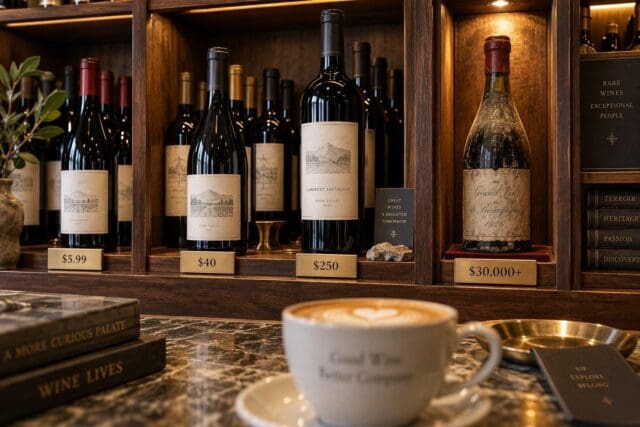
Image: AI-generated illustration.
Italian-American coffee terminology: a vocabulary made in America
Much of the American coffee menu sounds Italian. Some of it is. A good part was coined in the United States, or borrowed from other languages and given an Italian feel. This is not a comparison of coffee cultures. It is a lesson in naming.
Howard Schultz came back from a 1983 trip to Italy inspired by its espresso bars and opened Il Giornale, using Italian-style cup sizes: short, tall and grande. Starbucks later added venti and trenta, the Italian words for twenty and thirty. The Frappuccino was coined in 1992 at Boston’s Coffee Connection and came to Starbucks when it bought that chain in 1994.
Even “cortado” is a borrowing, but from Spanish rather than Italian. It comes from cortar, “to cut,” because warm milk cuts the espresso. In Italian, corto means “short,” and a caffè corto is a short, concentrated espresso with no milk at all. The closest Italian drink to a cortado is the caffè macchiato.
| Term | Where the word comes from | What it means in Italy | What it means on a U.S. menu |
|---|---|---|---|
| Italian words, used as in Italy | |||
| Espresso | Italian | A short, concentrated coffee; Italians usually just order “un caffè” | A single or double shot; the base of most drinks |
| Doppio | Italian, “double” | A double espresso | The same; the default base in most specialty cafés |
| Ristretto | Italian, “restricted” | A short, concentrated shot, also called caffè corto | The same |
| Lungo | Italian, “long” | A longer pull of the same shot | The same |
| Cappuccino | Italian | Espresso with steamed milk and foam in a small cup, about 5 to 6 oz | The same drink, often served at 12 to 20 oz |
| Americano | Italian (caffè americano) | Espresso lengthened with hot water | The same |
| Affogato | Italian, “drowned” | Gelato “drowned” in a shot of espresso | The same |
| Barista | Italian | The person who works behind the bar | The same, now a professional title |
| Italian words, given a new meaning | |||
| Latte | Italian for “milk” | A glass of milk; the coffee drink is a caffellatte | Espresso with plenty of steamed milk |
| Macchiato | Italian, “stained” or “marked” | Espresso marked with a spot of milk foam | Often a large, sweetened latte; Starbucks’s Caramel Macchiato is vanilla-flavored milk marked with espresso and caramel |
| Grande | Italian for “large” | An adjective, not a cup size | Starbucks’s medium, 16 oz |
| Coined or sized in America | |||
| Frappuccino | Coined in 1992 at Boston’s Coffee Connection from frappé and cappuccino; a Starbucks trademark since 1994 | Not an Italian word | A blended, iced coffee drink |
| Tall | English | Not used | Starbucks’s small, 12 oz |
| Venti | Italian for “twenty” | A number, not a size | 20 oz hot; 24 oz iced |
| Trenta | Italian for “thirty” | A number, not a size | 30 oz, for certain iced drinks |
| Borrowed from other languages | |||
| Cortado | Spanish, from cortar, “to cut” | Not an Italian term; the closest drink is the caffè macchiato | Espresso cut with about an equal amount of warm milk |
| Mocha | The Yemeni port of Mocha, once a center of the coffee trade | Not used on Italian bar menus; the nearest is the marocchino | Espresso, chocolate and steamed milk |
| Flat white | Australia and New Zealand, which both claim it | Not used | Espresso with a thin layer of velvety milk |
Sources: Food Republic (Starbucks sizes), Boston Magazine (Frappuccino), Wikipedia (cortado).
None of this vocabulary is a mistake. It is marketing, and it works. Customers learn a handful of new words in a week, use them every morning and feel like insiders. The language lends a paper cup a touch of Italian craft at almost no cost.
Wine has the opposite problem. Its vocabulary of appellations, crus and classifications is authentic, but it makes many buyers feel like outsiders. Wine marketers do not need to invent foreign words. They can give customers a small, friendly vocabulary that rewards them for learning it: named pour sizes in the tasting room, simple style tiers on a wine list, a house name for the reserve tier.
Five lessons from the coffee bar
The goal is not to simplify wine. It is to simplify taking part in it.
- Put people before product. Consumers connect with growers and families far more than with technical specifications. A tasting room or wine list that tells whose hands made the wine sells more than one that recites pH and barrel regimes.
- Lower the perceived risk. Guided recommendations, staff who ask “what do you usually enjoy?” and low-cost entry points such as tasting flights, half-bottles and generous by-the-glass lists build confidence before the big purchase.
- Build rituals, not just occasions. Coffee owns the morning. Wine can claim recurring moments too: a Friday glass program, a monthly club pickup that feels like a gathering, a standing “wine with dinner” offer at a neighborhood restaurant.
- Sell reward and experience. A latte is priced as a small daily reward, not as milk and espresso. Wine priced and presented as an experience justifies its premium in the same way.
- Make premium wine an accessible luxury. Coffee lets anyone taste its top tier for a few dollars. Wineries and restaurants can offer a single pour of a reserve or library wine, so the luxury tier invites rather than intimidates.
From the classroom to the tasting room
I apply the same thinking in my wine sensory training at Sonoma State University’s Wine Business Institute. Instead of rote tasting notes, I teach through analogy. Analogies help students remember what a wine tasted like and recognize how other wines are similar or entirely different, without ranking one as better than another.
The art of tasting is taught once. What follows is experience, and experience turns into passion. That is exactly what coffee has created: memorable experiences in which the taste of a great cup is remembered long after the price is forgotten.
Wine does not need to become cheaper to win back consumers. It needs to become a habit again. When a $40 bottle feels as safe and familiar as a $6.75 latte, its price will become just as invisible.
Sidebar: What Americans pay for an espresso drink
Espresso-based drinks priced above $6 on published U.S. menus, compiled November 2026. Prices vary by location and exclude tax and tip; the list is illustrative, not exhaustive.
| Venue | Location | Drink | Price |
|---|---|---|---|
| Cibo Espresso | U.S. menu listing | Iced Mocha | $7.20 |
| Savor Coffee | Las Vegas, NV | Palm Latte (signature) | $6.75 |
| Savor Coffee | Las Vegas, NV | Toffee, Lavender, Vanilla, Honey Vanilla, Mocha and Dirty Chai lattes | $6.75 each |
| Hot Shot Espresso | Carlsbad, NM | Bananas Foster Cold Brew; Nutty Heaven Cold Brew | $6.50 each |
| Starbucks | U.S. menu listing | Pumpkin Spice Frappuccino | $6.25 |
Most U.S. specialty cafés build these drinks on a double shot of 18 to 22 grams of coffee, yielding about 1.5 to 2.5 fluid ounces of espresso. At fine-dining restaurants, a $6 to $10 espresso is usually still only 1 to 2 ounces; the premium pays for service, setting and often a petit four, not more coffee.
About the author
Angelo A. Camillo, PhD, MBA, is an associate professor at Sonoma State University’s Department of Business Administration and the Wine Business Institute, where he teaches strategic management, hospitality management, international business, wine business, and wine supply chain management, and leads the study abroad program. He has more than 35 years of international hospitality management experience in 10 countries on four continents. He is editor-in-chief of the Wine Business Journal and founding editor-in-chief of IJTHMDA, a Certified Executive Chef, Certified Culinary Educator and Certified Food Executive, and an award-winning home winemaker. He has written eight books, including Winery Hospitality Management: Strategies for the Global Wine Experience Economy (Ethics Press).
Contact: camillo@sonoma.edu | aacamillo.wixsite.com/mysite
Sources
- Best of Panama auction sees world record price, Global Coffee Report (2025 record lot).
- Boquete Geisha sets a record average price at the 2026 Esmeralda auction, Casa Solution, August 2026.
- Leroy Musigny Grand Cru tops Wine-Searcher’s 2026 ranking, Vinetur, Oct. 1, 2026.
- National Coffee Association, National Coffee Data Trends, spring 2026 (via Daily Coffee News, April 14, 2026).
- Terrain / American AgCredit, Winescape, spring 2026 (via Vinetur, June 10, 2026).
- The reason Starbucks doesn’t call its coffee sizes small, medium or large, Food Republic.
- The story of the Frappuccino, Boston Magazine.
- Cortado, Wikipedia.
- Menu prices: published menus of the venues listed in the sidebar, accessed November 2026.
- Conversions: 750 ml = 25.4 fl oz; single espresso about 1 fl oz, double about 2 fl oz.