The tasting room used to be the heart of the winery business model. Walk-ins became club members. Club members became brand ambassadors. Revenue flowed predictably, and the formula worked.
That’s changing.
Visitation to wine regions is softening and tasting room traffic that wineries once counted on is declining. The cohort that’s most noticeably absent? Millennials and Gen Z, the consumers who should be building the next generation of wine loyalty.
For many wineries, the drop-off has been gradual enough to rationalize. Blame the economy. Blame changing drinking habits. Blame competition from craft beer and cocktails.
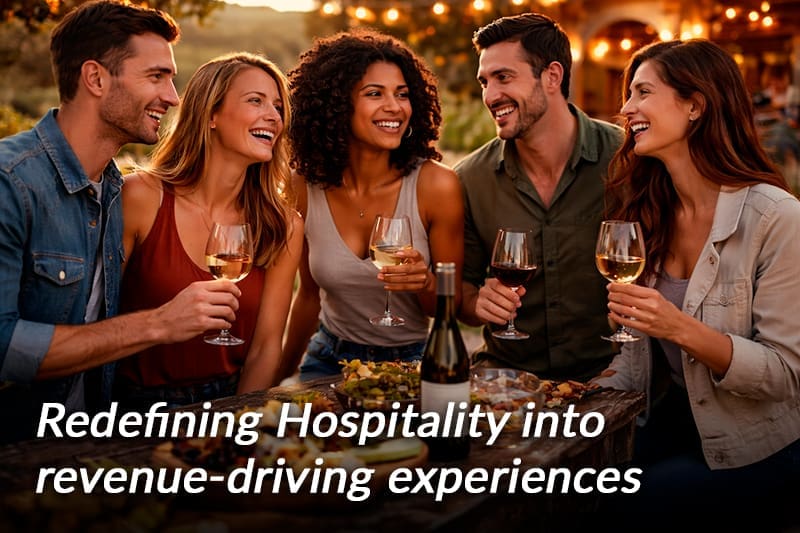
But the reality is harder to swallow: younger consumers aren’t avoiding wine country because they don’t like wine. They’re avoiding it because the traditional tasting room experience no longer competes with how they want to spend their time and money.
And if wineries don’t adapt, they risk becoming relics of an industry that waited too long to evolve.
The Real Problem: Wine Isn’t Enough Anymore
Twenty years ago, offering great wine in a beautiful setting was sufficient. Guests arrived curious, left educated, and often joined the club.
Today, wineries aren’t just competing with each other. They’re competing for a slice of consumers’ total “fun budget” which is the same budget that includes destination dining, immersive travel experiences, live entertainment, and cultural events that didn’t exist a generation ago.
“Walking into a quiet tasting room with a scripted presentation about soil types isn’t exactly the adrenaline rush younger consumers are looking for,” says Susan DeMatei, president of Wine Glass Marketing and a speaker at Wine Industry Network’s upcoming Annual 2026 Wine Sales Symposium. “Millennials and Gen Z want experiences that feel social, shareable, and worth their time. Wine as a status symbol simply doesn’t inspire them the way it did previous generations.”
The stakes are high. Tasting rooms that fail to evolve risk becoming what younger consumers already suspect they are: stuffy, expensive, and irrelevant.
But here’s what makes this moment both challenging and opportunistic: some wineries are cracking the code. They’re drawing in exactly the consumers others have lost. They’re creating loyalty where skepticism used to live. And they’re doing it by fundamentally rethinking what a tasting room can be.
What’s Working (And Why It Matters)
The wineries seeing success aren’t just tweaking their tasting fees or updating their furniture. They’re reimagining hospitality from the ground up.
Candace MacDonald, co-founder and managing director at marketing firm Carbonate will lead a session on hospitality concepts at the Wine Sales Symposium and has watched this shift happen in real time.
“The deadly combination of high cost and high formality is what’s killing traditional wine country,” MacDonald says. “Younger consumers don’t want to feel like they’re walking into an intimidating masterclass. They want to feel welcomed into a space where they belong.”
Some wineries have responded by lowering the barrier to entry. Others have elevated the experience to compete with luxury hospitality. A few have done both, depending on the audience.
The common thread? They’ve stopped treating wine as the sole attraction and started treating it as one part of a larger, more compelling story.
DeMatei points to examples like Aperture Cellars, which launched a “Collage Tasting Experience” pairing rare wines with food from Michelin-starred chefs. It’s not a tasting. It’s a curated event that feels exclusive, shareable, and worth the investment.
McClain Cellars took a different approach: creating themed playlists that guests listen to while tasting specific wines. Pair Chardonnay with a jazz playlist that mirrors the wine’s smooth, layered character. Suddenly, opening a bottle becomes a “vibe-driven” experience—not just a drink.
But these are just glimpses of what’s possible. The full playbook on how to design these experiences, how to price and market them, and how to measure their success requires a deeper dive
The Shift From Product to Experience

What separates the wineries that are thriving from those that are struggling?
According to MacDonald, it comes down to understanding what younger consumers actually value.
“They don’t want to spend money unless they know what they’re getting,” she says. “And they don’t want to feel like they have to be on their best behavior just to taste wine.”
Programs like Sonoma Sips, which offered $15 tastings at over 40 wineries last year, brought in waves of first-time visitors and lapsed wine country tourists. This year, 50 wineries have signed up. The appeal? Accessibility without sacrificing quality.
Meanwhile, wineries like Bella Union from Far Niente Wine Estates have created “third spaces” where guests can drop in casually, order wine by the glass, and hang out without committing to a formal tasting. It’s low-pressure, high-engagement and it works.
Then there are the wineries creating aspirational experiences that feel less like a tasting room and more like a private club or boutique hotel lounge. Intentional design. Thoughtful storytelling. A strong sense of place.
“You see this at properties like Ashes & Diamonds, which offers members pool access at local luxury resorts and hosts cinema nights with wine and food available for purchase,” DeMatei says. “It’s not about the wine alone. It’s about the lifestyle the wine represents.”
These strategies aren’t random experiments. They’re deliberate responses to a marketplace that has fundamentally changed and they’re working.
But implementing them requires more than inspiration. It requires a roadmap.
What Comes Next
The good news? Wineries have incredible raw material to work with.
“Wineries have incredible raw material to work with: beautiful landscapes, fascinating stories, craftsmanship, and hospitality,” DeMatei says. “When those elements are brought together thoughtfully, wine country can still be one of the most memorable experiences people have. The question is whether wineries are willing to rethink how they deliver that experience.”
The answer to that question will determine which wineries thrive in the next decade—and which ones fade into irrelevance.
At Wine Industry Network’s Annual 2026 Wine Sales Symposium on May 13 in Rohnert Park, California, industry leaders like Susan DeMatei and Candace MacDonald will unpack exactly how wineries can make this shift.
DeMatei’s session, Beyond the Bottle: How Experience, Identity, and Access Are Redefining Visitation in Wine Country, will explore how to build hospitality strategies that attract and retain younger consumers.
MacDonald’s session, Creating Hospitality Concepts That Attract the Next Generation of Drinkers, will provide a framework for designing tasting experiences that feel accessible, aspirational, and profitable.
The Symposium is designed for winery owners, sales leaders, marketing executives, and decision-makers who are serious about adapting to a marketplace that no longer rewards “business as usual.”
Other sessions will address the role of artificial intelligence in brand visibility, evolving wine club retention strategies, shifting distribution dynamics, and more.
Early bird registration is $295 and includes full access to all sessions, lunch, and a networking social. Day-of pricing is $395.
The wineries that figure this out will own the next generation of wine consumers.
The ones that don’t will be left wondering where everyone went.