By Alex Caffarini
Most wineries don’t lose wine club members overnight – they lose them slowly, months before cancellation formally happens. As wine sales continue to decline, wineries are doubling down on retention – especially in their wine clubs, which often account for a quarter of total revenue and represent their most valuable customers.
It’s crucial to reach members before they cancel because once membership lapses, it’s difficult, if not impossible, to win it back.
But how do you know which members will cancel? And when?
If you can answer those two questions, you can prevent a significant share of cancellations before they happen. And, fortunately, there are ways you can predict member churn. I will share methods that can help you identify at-risk members so that you can intervene and prevent them from cancelling.
The Warning Signs: How Members Tell You They’re About to Cancel
Across wineries I’ve worked with, the same patterns show up repeatedly – members rarely cancel out of nowhere. In most cases, they gradually disengage – skipping shipments, ignoring events, or letting their payment details lapse. Some might register complaints about their shipments or call to inquire about renewal dates.
One practical way to predict which members are at risk of cancelling is to select a random sample of lapsed club members and examine their transaction behavior six months to a year before cancelling. Were any of them exhibiting any of the above behaviors?
Once you spot patterns among lapsed members, you should examine your active members to see whether any are showing those same patterns. If so, they may be getting ready to cancel.
You should also consider the members’ age at cancellation, when they joined, and how they joined. These could reveal interesting patterns. Members may have cancelled because they’ve aged out. Or they may have entered a new life-stage and their priorities or discretionary income has changed. Also, a member who signed up at a tasting in the presence of friends might be likelier to churn than a member who signed up after making several prior individual purchases.
There are also sophisticated analytical tools that can help you predict a member’s likelihood to cancel based on specific criteria, but those are best suited to clubs that have moderate to high monthly signups and cancellations.
The Timeline of Churn: When Members Are Most at Risk
Knowing when members will cancel is just as important as knowing who will. Members typically follow similar customer journeys, and churn is heavily driven by the customer lifecycle.
Common milestones during which cancellation is likely include:
- After the first shipment, when the member quickly assesses the value.
- At renewal time, when members formally reassess their membership.
- During involuntary events, such as expired credit cards or failed payments.
If you track just these three signals, you’ll already be ahead of most wineries – and in a much stronger position to intervene before a member cancels.
Retention Curves: Your Compass to Retention Risks
Of course, your winery’s membership retention challenges will differ from those of others, but you can get a feel for when your members are most at risk of cancelling. One way to spot cancellation risks is to plot a retention curve.
A retention curve is a chart that tells you how many members lapse over time. This single chart can change how you manage – and retain – your wine club members. In practice, this is one of the first analyses I conduct for wineries.
Retention curves show you what percentage of your customers remain at certain points after sign-up, so you can quickly determine where revenue is leaking.
Creating a Retention Curve for Quick Analysis
This is a simplified approach, but it’s often enough to reveal where your biggest cancellation risks are. Start by looking at all club signups in the last three to five years and tracking how long each member stayed before cancelling (their tenure). Group the cancellations into six-month intervals and calculate the number of members remaining at each interval. You can then plot your winery’s retention curve.
As an example, let’s assume a winery examines club member signups and cancellations over the last 36 months. It had a total of 1,000 signups during those three years. Its retention at six-month intervals is shown in the following table:
| Month (Intervals) | Cancellations (During Interval) | Total Members | Retention Rate |
| 0 | 1,000 | 100% | |
| 1-6 | 150 | 850 | 85% |
| 7-12 | 250 | 600 | 60% |
| 13-18 | 100 | 500 | 50% |
| 19-24 | 80 | 420 | 42% |
| 25-30 | 60 | 360 | 36% |
| 31-36 | 50 | 310 | 31% |
Out of these 1,000 members, 150 cancelled within the first six months, indicating that the winery’s 6-month retention rate was 85%. Within another six months, 250 more members lapsed, resulting in a total of 400 lapsed members since sign-up, resulting in a 12-month retention rate of 60%. Finally, by 36 months, just 31% of members remain.
The winery then plots these numbers into its retention curve:
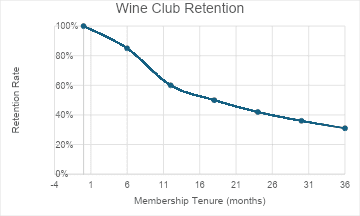
The retention curve makes it clear – and urgent – that the steepest drop happens in the first year; and this is where most wineries lose the most members.
This winery might meet its Year 1 retention risk head-on by sending new members a newsletter with wine pairing tips and recipes that pair well with its wine. Or it might host complimentary new member events. It can also send preview samples of upcoming shipments to build anticipation. Whatever the winery chooses to do, what matters most is that the retention curve tells it clearly when it must act.
More advanced approaches look at each signup group (e.g., sign-ups from events, tasting rooms, etc.) separately, but even the simple approach outlined above can uncover powerful insights.
Identify Risks Early and Take Action
The wineries that win aren’t the ones that react to cancellations – they’re the ones that see them coming. By paying attention to how members behave, how they join, and where they are in their lifecycle, you can identify risk early and take action when it matters most.
Because in the end, retention isn’t just about saving a membership – it’s about protecting long-term customer relationships and the revenue that comes with them.

Alex Caffarini is the founder and president of CompassDTC, a strategy and analytics consultancy that helps small and midsized food and beverage brands — including wineries — unlock growth through strategic DTC marketing. With over 30 years of experience in marketing analytics and data science, Alex has developed customer acquisition and retention predictive models for banks, catalog retailers, membership organizations, and tech companies, and has built segmentation models for premium California wineries. He specializes in developing predictive models that identify high-value customers and optimize promotional performance. Reach Alex at alex.caffarini@compassdtc.com.