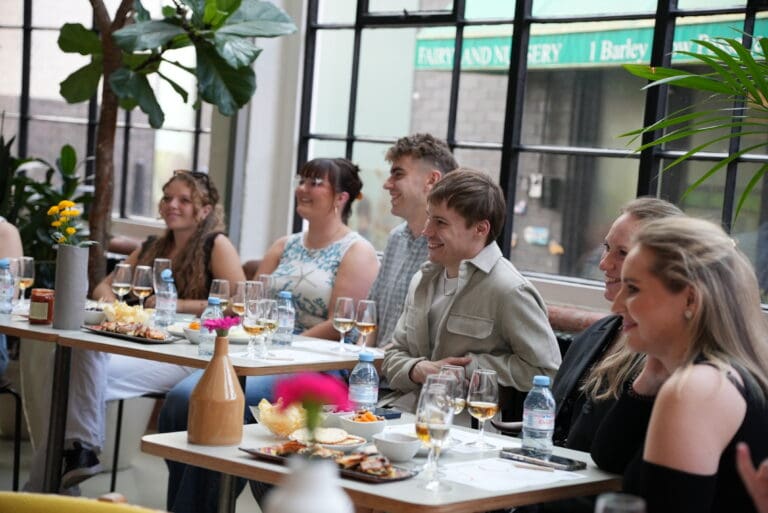
Some simple considerations toward staff and visitors can make a difference to your bottom line.
By Craig Root
When I conduct a design review with owners and architects for a new or remodeled tasting room, I have a list of practical and aesthetic dynamics to address. One of these is sun and wind patterns. For example, I have seen outdoor tasting spaces where the wind blows the glasses or flutes off the table. The solution, of course, is to install easy-to-clean glass walls around the perimeter of the outdoor area — but wouldn’t you want to take that into account before you have customers?
I know of a very popular tasting room where, at certain times of the year, the sun is in the customers’ faces at the tasting counter. Worse yet, it’s broiling the backs of the staff when they are interacting with guests. This is hardly conducive to sales and repeat business. I advised them to install retractable awnings to solve the problem. Guess what? I dropped by on my own a year later and no awnings.
Owners, managers and architects sometimes forget that these people are the front line sales reps. For most small- and medium-sized wineries, the biggest source of income is the tasting room and wine club. Do you really want employees to be uncomfortable while they’re representing your brand?
I believe most staff arrive with a “full tank” of enthusiasm and sales energy. Anything you can do to keep that tank full — not at 10 a.m. but (more important) at 3 p.m. — equates to more profits for you. So put up the awnings or invest in wind barriers. Whatever it takes to eliminate staff and visitor irritation.
Walk the floor
Another employee comfort factor is flooring. Simply put, “tired feet don’t sell well.”
Working on hard surfaces for any length of time kills your feet. I’ve worked with young people forced to sell while working on concrete or tile with skimpy mats. Despite being in the prime of life, by the second or third day, their feet constantly hurt.
How that affects your operation is apparent in the following scenario. The customer decides to buy wine totaling $328. At this point, your staff person should say, “By the way, if you join our wine club, I can save you $60 on your purchase.” If your feet hurt, you’re less likely to say that. You just ring up the sale costing the company all the revenue from a potential wine club member. (By the way, notice that the staff person said $60, not 20%. I find that to be more effective; 20% is amorphous, but every customer “gets” $60.)
If you’re creating a tasting room, I recommend using wooden floors and thick mats behind the tasting counter. Wood is warmer and adds a nice feel to your tasting room. Yes, wooden floors will need to be resurfaced every 5 to 7 years (particularly in high traffic areas). But I believe that painful feet cost you 3-5% per year and, on a million dollar tasting room, that is $30-50,000 annually, which more than pays for resurfacing.
If you already have hard surfaces use the best mats you can get — maybe even double them on top of each other. Also limit the time spent working in areas that don’t have mats. Where I started, we took care of 150,000 visitors per year. The top floor had carpet and the bottom sales floor had tile. My feet definitely noticed if I had been downstairs all day.
Yes, I said carpet because people think you can’t have carpets in a tasting room: wrong. There are grades of carpet that look great and are stain resistant in food and beverage businesses all over the world.
I can’t hear you
Another common drag on sales is acoustics. How do you feel when you go out to dinner with your friends or family and the restaurant is so noisy that you have to shout to be heard all evening? Do you want to go back? I doubt it.
Repeat business is crucial for your tasting room. Make sure that your room is not too noisy during peak times and, if it is, address the problem. Carpets that are secured to the floor to prevent tripping can help. Tapestries liven up a room, add elegance and can dampen sound. There are brands of acoustical tile that are not industrial and look great.
Visitors, for the most part, don’t like noise — but how about the staff? If you have been shouting all day to be heard, how full is that cheerful sales tank at 3 p.m.? This can be a real problem. I even know of places that were so loud that a few full-time staffers developed tinnitus.
Right now sales are off and visitor counts are down, so use every competitive advantage you can. Tasting room design and functionality can be a crucial part of your efforts towards greater profitability and repeat business.
_____________________________________________________________________

Craig Root
Craig Root has more than 30 years experience working with tasting rooms. For more than 13 years, he was first staff and then a successful manager. In the last 20 years, he has consulted with more than 150 tasting rooms (including over 90 start-ups, mostly in the United States but also in China, Canada and France). He is the only person who lectures on tasting room design and management at UC Davis in its continuing and professional development division.