Why Williamson Act vineyards need to make sure the county has the right information
After my recent article, “Vineyard Values Have Fallen. Has Your Property Tax Assessment?”, I heard from a number of industry colleagues who added helpful perspective. One of them was longtime vineyard valuation expert Tony Correia, who pointed out something I had not addressed in the article.
As Tony put it: “You missed one important piece. Many, if not most, vineyards are enrolled in Ag Preserve contracts — the Williamson Act. Under those, assessments are based on vineyard income, not comparable sales. Those will automatically get devalued as vineyard incomes decline, and owners are asked for their income and expense data each year.”
That comment gets to the heart of an important issue for vineyard owners: not all vineyard properties are assessed the same way.
My first article focused on Proposition 8. In simple terms, Prop 8 may allow a temporary reduction in assessed value when a property’s current market value falls below the taxable value the county has been carrying forward under Proposition 13.
The practical advice in that article was straightforward: if you believe your vineyard’s market value has declined, contact your local county assessor and ask whether a Prop 8 review may be appropriate.
Napa County Assessor John Tuteur reduced 97 vineyard, winery and hospitality properties by a total of $300 Million in assessed value. These parcels were purchased between 2021 and 2025 when the Proposition 13 base year values were established. For this article Tuteur added “the job of the assessor is to be fair, not to raise revenue. We adjust values when warranted by market conditions.”
Tony’s comment does not change that advice. It adds an important second layer.
If your vineyard is enrolled in the Williamson Act, the conversation with the assessor may be different.
The Williamson Act generally applies to land that is restricted to agricultural or open-space use. For those properties, the county does not rely on comparable vineyard sales to value the agricultural land. Instead, the restricted assessment is based on the land’s agricultural use and ability to generate income.
That sounds technical, but the practical point is simple: if your vineyard is under the Williamson Act and your grape income has fallen, that decline may be relevant to your property tax assessment.
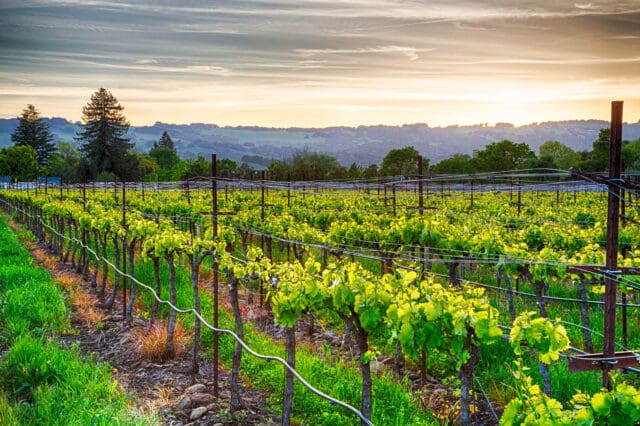
Here is a simplified example. Assume a 40-acre vineyard is enrolled in the Williamson Act. For years, the vineyard had strong grape contracts, healthy prices, and reliable income. The fruit sold each year, the economics worked, and the vineyard produced meaningful agricultural income.
Now the market has changed. Grape prices are lower. Contracts are harder to secure. In some cases, fruit may not be sold at all. Farming costs remain high, but the vineyard is producing far less income than it did a few years ago. Tuteur pointed out that the income analysis uses multi-year weighted averages for certain factors which means that income and production changes will not impact restricted values immediately. In Napa County the assessor adjusted the per-acre average value of vines downward to reflect the new market reality. This adjustment did have an immediate impact on values.
The owner should not assume the tax bill has automatically adjusted to reflect the new reality.
Under Williamson Act contracts, the county may already be reviewing the vineyard’s agricultural value each year, often using income, expense, and production information provided by the owner. That means a vineyard owner may not need to start with the same Prop 8 request process discussed in the first article.
But that review is only as accurate as the information the county receives.
If the owner’s income and expense information is late, incomplete, or does not reflect this year’s lower grape income, the assessment may not fully reflect current conditions.
The owner of land under contract should ask the assessor two questions:
Has the lower income from my vineyard been reflected in my Williamson Act Assessment?
Has my lower vineyard income been reflected in the agricultural value used for my Assessment?
For a vineyard not enrolled in the Williamson Act, the question should be:
Has my property’s current market value fallen far enough below my Proposition 13 base year value to support a Prop 8 review?
John Tuteur reminded me that the entire value of the property is considered in the Prop 8 review. “If there is a home, a winery or other improvements other than vineyard,” Tuteur explained, “the drop in vineyard value may not be enough to reduce the value of the property below its current market value, especially if the property has a lower Proposition 13 base year value from before 2021.
Those are different questions, but both require the owner to be proactive.
That matters today because many vineyard owners are dealing with lower grape prices, weaker contracts, unsold fruit, and higher farming costs. If a vineyard is producing less income — or no income — that may be important information for the assessor to understand.
It also explains why two vineyards that look similar from the road can have very different property tax situations. One may be enrolled in the Williamson Act, while another may not.
The larger point is simple: vineyard property taxes are not one-size-fits-all.
Before assuming your vineyard assessment is too high — or assuming nothing can be done — start with one simple question:
How is my vineyard being assessed today?
Then take the next step: contact your county assessor and make sure the current economics of your vineyard are being considered.
The answer will tell you far more than the tax bill itself.

George Christie is a Vineyard & Winery Specialist with Golden Gate Sotheby’s International Realty (CA DRE #02282499). He has spent more than 30 years in the California wine industry, with experience spanning winery management, vineyard operations, grower relations, sales, marketing, distribution, and executive leadership. He is the founder and President/CEO of Wine Industry Network and co-founder/managing partner of Saini Vineyards in Dry Creek Valley. Today, George specializes in vineyard, winery, and wine country real estate, with a focus on helping owners and families navigate important property and business transitions. Learn more about George’s background by visiting his full bio. This article is provided for informational purposes only and should not be considered tax, legal, or financial advice.