New Vintage Labs Founder & CEO Stephen Mok says the biggest opportunity for wineries may not be adopting another AI platform; it may be rethinking what their teams are capable of doing in the first place.
For years, wine industry conferences have talked about the importance of data. Wineries have collected more of it, bought more software to manage it, and created more digital touchpoints with consumers. And yet, turning all of that information into something genuinely useful has remained frustratingly hard.

Stephen Mok, Founder & CEO of New Vintage Labs, believes artificial intelligence is beginning to change that — not because data suddenly became more important, but because sophisticated ways of working with it are becoming accessible to people who previously would have needed specialized technical skills or significant resources.
Mok sees that shift happening most clearly in marketing.
“The marketers that I’m seeing and working with in this industry, they’re unlocking literally new ways of working throughout their day that they just didn’t have before, and it’s saving them a ton of time.”
For Mok, that’s where the AI conversation becomes much more interesting for wineries.
From Data Access to Data Capability
The challenge wineries have faced hasn’t necessarily been collecting information. It’s been connecting systems, understanding how they work together, and having the technical and marketing expertise required to turn the resulting data into action.
AI is beginning to lower that barrier.
Today’s tools can help users work across systems, customize reporting, conduct deeper analysis, perform research, and automate recurring tasks. The underlying capabilities aren’t all entirely new, Mok points out. What’s changing is who can access them and how easily they can put them to work.
That distinction matters enormously for smaller winery teams.
Work that once might have required manual processes, no-code automation, or software engineering can increasingly be accomplished by someone who understands the business problem and learns how to work effectively with AI.
The immediate benefit may simply be time.
But what wineries choose to do with that newly available time and capability could be far more consequential.
The Wineries That Benefit Most May Be the Ones Willing to Experiment
Mok is also quick to temper the AI hype.
Simply subscribing to an AI platform doesn’t suddenly transform a winery. Getting meaningful results requires experimentation, learning, and a willingness to understand where the technology fits within the way a particular business operates.
For some wineries, hesitation is understandable. Technology has promised transformation before, and not every investment has delivered.
But Mok sees another risk in waiting for someone else to completely figure AI out first.
“I don’t think this is one that you can kind of sit on the sidelines and wait. I think you just have to lean in because the upside of advantages are huge.”
That doesn’t necessarily mean making an enormous investment. Mok suggests that even dedicating an hour each week to experimenting with the technology can begin building organizational competency. Reporting, analysis, segmentation, marketing workflows, content, and operational efficiency can all provide places to start.
And that learning itself may ultimately prove more valuable than mastering any particular AI product.
The Bigger Mistake: Treating AI Like Another Software Purchase
This is where Mok’s argument becomes much more provocative.
He doesn’t believe winery leaders should primarily think about AI as a vendor-selection exercise.
Instead, he describes AI as a new capability — and potentially a reason to reconsider how work gets done throughout an organization.
Rather than beginning with Which AI tool should we buy?, Mok suggests beginning with the business itself:
- What outcome are you trying to improve?
- What actually drives that outcome?
- What workflows contribute to it?
- What steps are people currently taking to accomplish that work?
Only then does the question become: Where could AI make this process better?
That exercise can expose opportunities for improvement before AI even enters the conversation. Once leaders understand the workflow, they can determine where automation, analysis, or additional intelligence can remove bottlenecks or expand what their teams are capable of accomplishing.
Don’t Build a Five-Year AI Plan
That same logic applies to how wineries plan for AI over time.
Mok cautions against approaching AI like a traditional technology investment because it’s moving too quickly. He points to meaningful improvements arriving every few months. In that environment, a highly detailed multi-year technology roadmap can become obsolete before an organization has finished implementing it.
Instead, the more durable investment may be developing people who know how to experiment with AI, evaluate new capabilities, and determine where they can create business value.
As those employees become more comfortable with the technology, they aren’t simply executing an AI strategy handed down by leadership. They begin identifying opportunities themselves.
That creates something much harder for competitors to buy: organizational capacity to adapt.
What If People Were No Longer the Constraint?
Perhaps Mok’s most interesting question for winery leaders is also one of the simplest.
For most businesses, what can be accomplished has always been constrained by available human resources. There are only so many people, hours, and competing priorities.
AI doesn’t eliminate that reality — but it begins to change the assumption behind it.
Mok suggests leaders look at an important workflow and ask:
If we suddenly had 10 — or even 50 — more people available to help us do this, what would we do differently?
Where would bottlenecks disappear? What analysis would become possible? What customer interactions could become more personalized? What work could happen that simply doesn’t happen today because no one has time to do it?
From there, the question isn’t whether humans or AI should do the work. It’s how the two can work together differently.
And that may ultimately be the most important AI decision wineries make — not which platform they choose, but whether they’re willing to reconsider what their organizations are capable of doing.
See AI in Action at WIN Expo
If Mok’s argument resonates — that AI’s biggest opportunity is reconsidering what winery teams can actually do — the next step is seeing it demonstrated in practice.
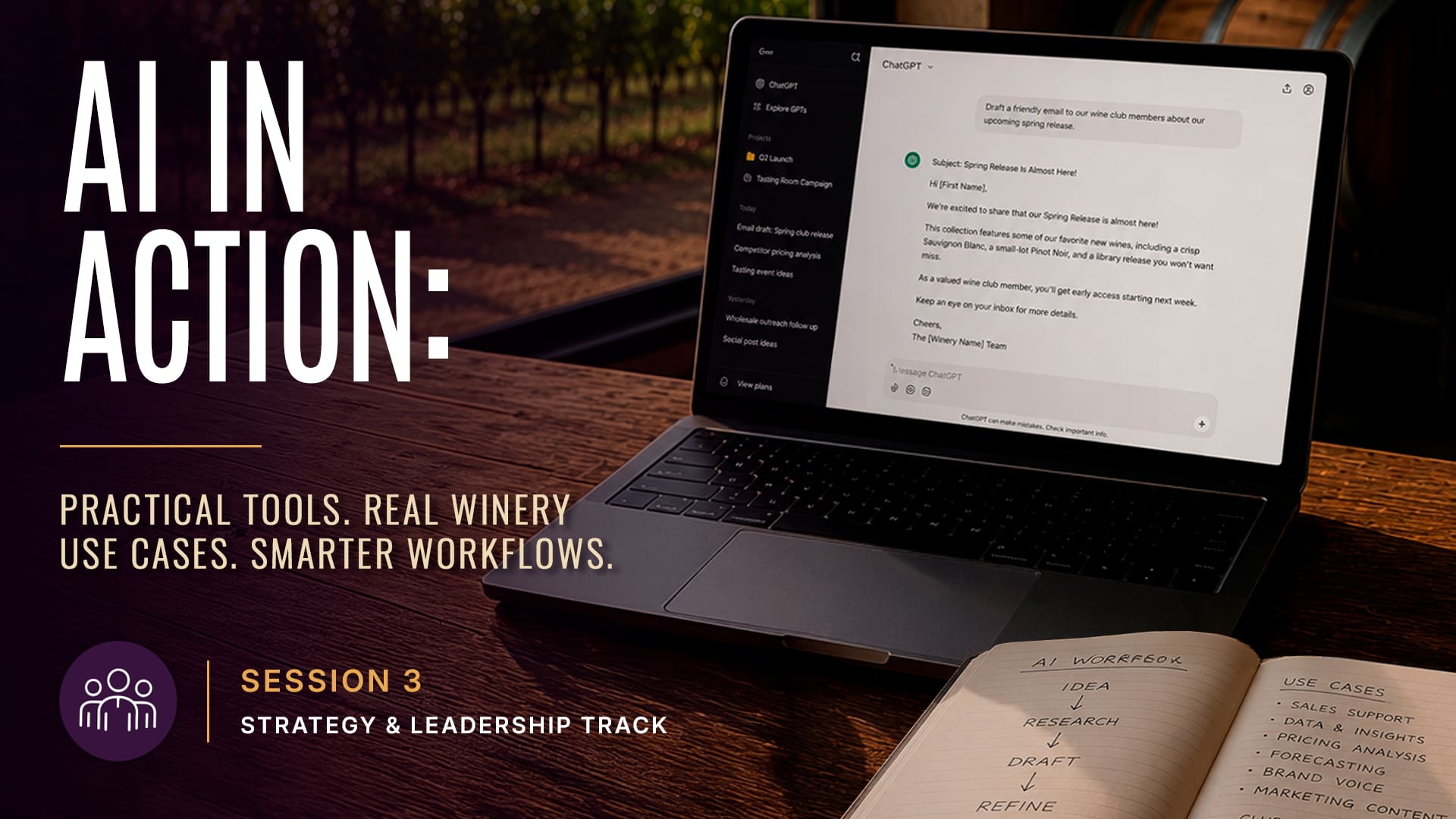
Stephen Mok will join Ed Feuchuk of Farm Collective Napa Valley, Nadia Kinkade of PEJU Winery, and Andrea Savaiano of VintageIQ for AI in Action: Practical Tools, Real Winery Use Cases & Smarter Workflows at the 2026 WIN Expo. Rather than another high-level discussion about AI’s potential, the interactive workshop will use live demonstrations and real winery examples to explore how AI can support data analysis, sales, marketing, competitive insights, and everyday workflows.
December 3, 2026 | Sonoma County Fairgrounds, Santa Rosa
Click here to lo learn more about the event, conference program, speaker line-up, and more!