By Dario Latrofa
The most expensive project is not the one built badly. It is the one where the owner loses control before it even begins.
It happens more often than the industry admits. An owner with a clear vision brings in architects and consultants. The concept takes shape. Construction moves forward. Three years later, the numbers do not work — underused spaces, inconsistent events, unclear returns.
The problem is not the design.
The problem is that no one clarified, early enough, what decision was actually being made. And by the time experts were involved, the owner had already given up control.
This is not just a missing phase.
It is a loss of control.
How control is lost
When an owner enters the market of experts without a structured framework, each party introduces their own perspective. The process moves forward, but decisions are made without a clear reference point. The owner ends up validating solutions before defining the questions.
A winery hospitality project is not just an investment decision. It is a transformation of a place — spatial, operational, and identity-driven. And this is where an architect-led feasibility approach differs from any other type of preliminary analysis.
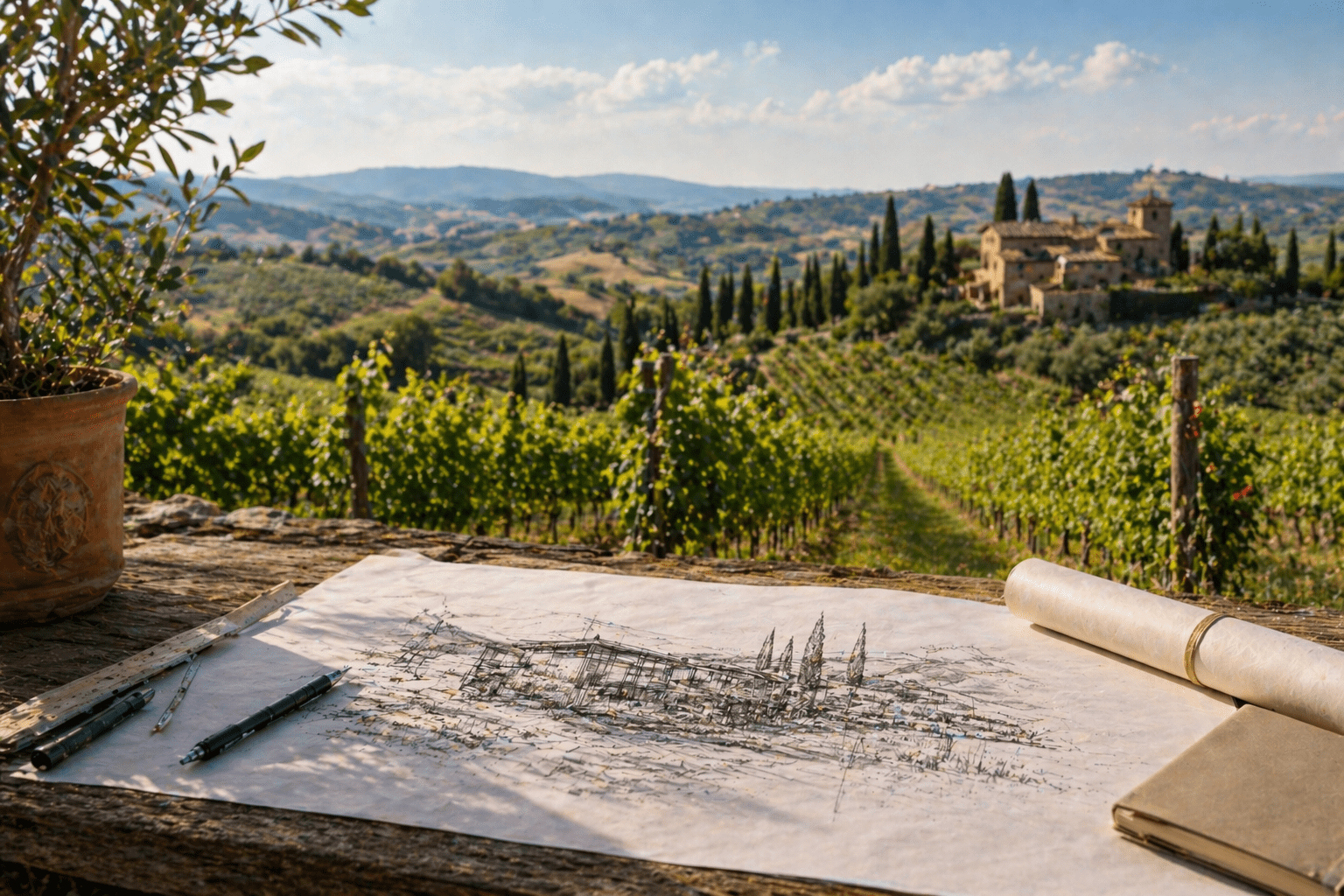
A market consultant reads demand. A financial advisor builds projections. An architect reads the place as a physical system — existing structures, construction history, materials, spatial flows, and transformation potential that is not visible to those who cannot read a building — and translates all of this into concrete, governable scenarios.
When a generic solution is applied— a standard spa, a visitor center that could exist anywhere — the project may function, but it does not create differentiation. Value emerges when the experience is rooted in what exists only in that place: its production, its landscape, its history, its rhythms.
This is not a design preference.
It is an economic decision
Five questions to answer before committing capital
What is this investment supposed to do?
Direct-to-consumer sales, wine club growth, events, overnight stays, brand positioning — these are not interchangeable goals. Each implies a different format, a different operational model, and a different definition of success.
If the answer is “all of the above,” it is a signal to slow down, not speed up.
What does this place already tell you?
This is the question only an architect can properly address. What structures exist? What physical constraints? What unrealized opportunities?
The question is not what you want to build, but what this place actually allows. A winery with strong character already contains its project. The role is to reveal it, not to impose something generic on top.
What format fits this specific estate?
Not market trends. Not competitors. This place — its structure, its scale, its identity.
A tasting room designed for 200 visitors a day in a winery that realistically attracts 40 is not an asset. It is fixed cost. And in hospitality, fixed costs compound quickly.
What technical, regulatory, and operational constraints come with it?
Permits, accessibility, visitor flows, separation from production, construction phasing compatible with ongoing operations. These are not execution details — they are part of feasibility.
Discovering a constraint after capital is committed is always more expensive than discovering it before.
What architectural scenarios are possible — and what does each cost?
Not a final design. Three concrete directions — for example: reuse of existing structures, partial transformation, phased full development — each with spatial, construction, and economic implications.
Order-of-magnitude costs for each scenario — not precise to the last dollar, but clear enough to support real decisions before signing any contract.
Restoring control to the owner
An architect-led feasibility process does not slow a project down. It reduces the number of irreversible decisions made too early.
It allows the owner to sit at the table with architects and consultants with a defined vision — not to be guided, but to guide. Not to react to proposals, but to shape them.
Phasing becomes a strategy, not a compromise. Building in alignment with the character of the place creates value that competitors cannot replicate.
It does not require months of analysis.
It requires the right questions, asked in the right order, by someone who can read — simultaneously — the place, the constraints, the potential, and the cost, before the first drawing is made.
Conclusion
Before asking what to build, winery owners should ask what needs to be proven — and what makes that place specific and impossible to replicate elsewhere. That is often the difference between a hospitality asset and a costly detour.
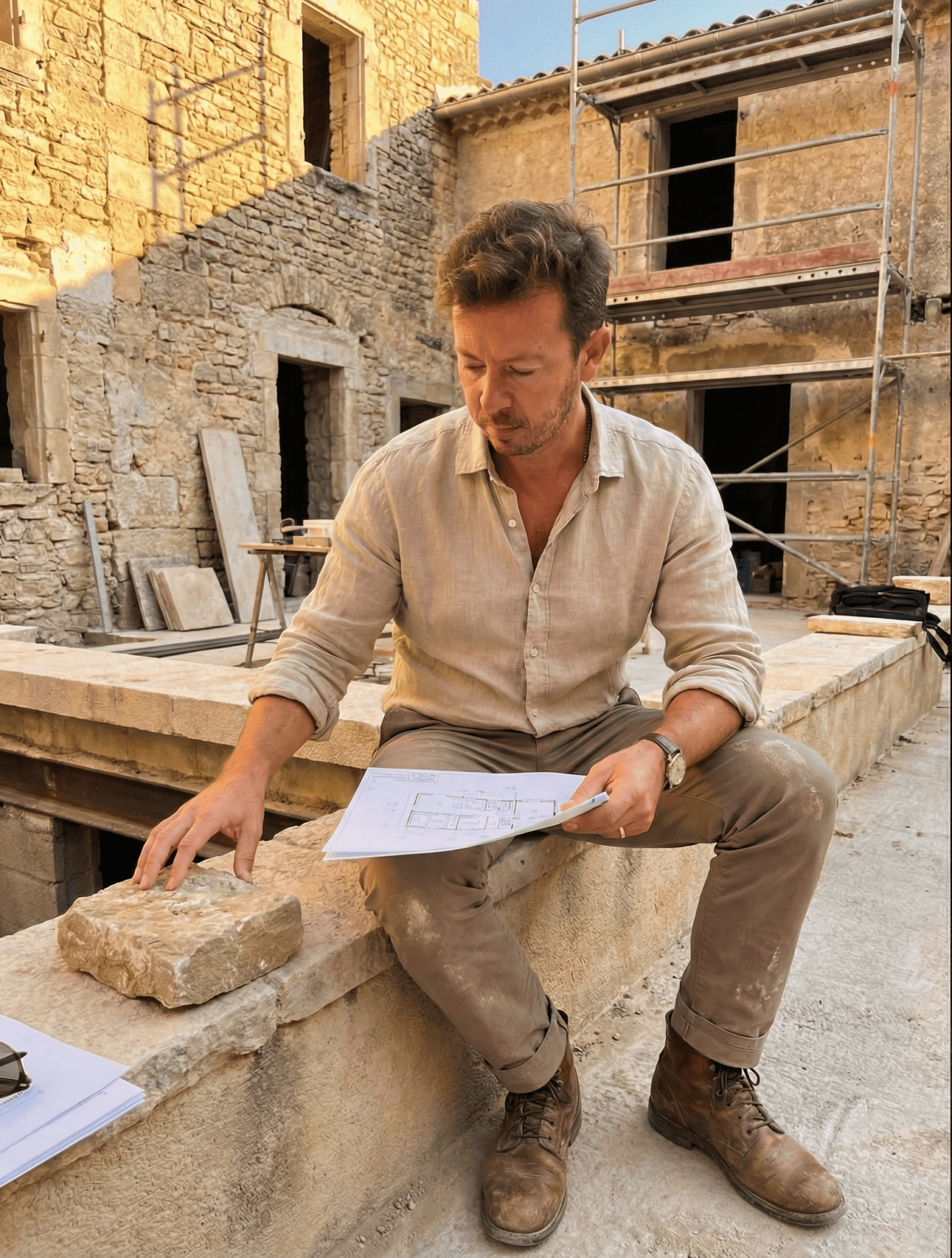
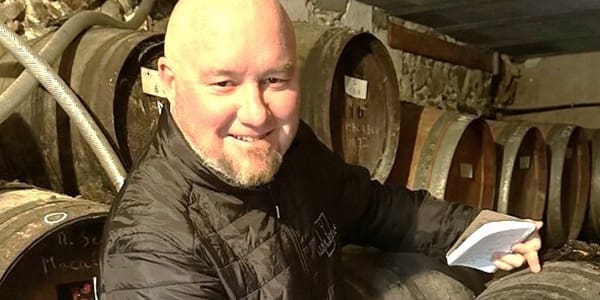
Dario Latrofa is an Architect and Engineer, founder of Daimon Design, a Franco-Italian architecture studio based in Grasse on the French Riviera. His work focuses on strategic feasibility and the development of hospitality, wine estates and heritage projects across France and Italy. He works with owners and investors to define viable development scenarios before committing to design and capital. His work on strategic feasibility in luxury hospitality was published by Journal des Palaces (2026).