The expansion of wine grape cultivation in Arizona and Colorado represents
both economic opportunity and resource management challenge.
By Gabe Racz and Mike Laszlo
The rapid expansion of winegrape cultivation in Arizona and Colorado presents a complex intersection of water law, agricultural policy and economic development that demands immediate attention from policymakers and industry stakeholders. Both states face mounting pressure to balance agricultural growth with increasingly scarce water resources, creating regulatory challenges that test the limits of existing legal frameworks.
Arizona’s Groundwater Depletion and Regulatory Response
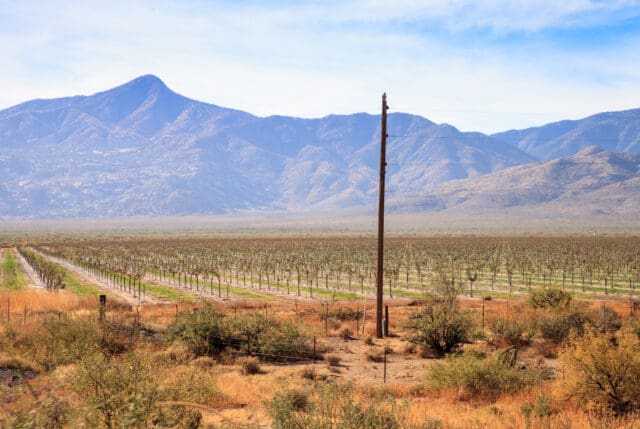
Arizona’s wine industry has experienced remarkable growth, expanding from approximately 75 licensed wineries in 2015 to 159 as of 2023, producing more than 700,000 gallons of wine (according to 2023 TTB data). However, this expansion occurs against the backdrop of severe groundwater depletion, particularly in the state’s most productive wine regions. The Willcox Basin, home to the established Willcox American Viticultural Area (AVA), exemplifies the regulatory tensions facing the industry.
Recent hydrological data reveals the severity of the crisis: the Willcox Basin’s water table has dropped more than 400 feet since the 1940s, with water being extracted at 3.5 times the natural recharge rate. Land subsidence of up to 11.5 feet has occurred, with continuing annual sinkage of 3.5 inches. These conditions prompted Governor Katie Hobbs to initiate proceedings for an Active Management Area (AMA) designation, despite local opposition exceeding 60% in a 2022 special election.
The proposed AMA represents a fundamental shift in water governance that directly impacts vineyard operations. Under Arizona’s groundwater management framework, AMA designation would impose mandatory conservation requirements, restrict new irrigated acreage, and establish pumping limitations based on recent historical use. Wine growers have raised substantial concerns that AMA restrictions would “stifle growth” without addressing the underlying causes of overdraft, creating an asymmetric regulatory burden on agricultural expansion while existing industrial operations continue unrestricted pumping.
From a legal perspective, Arizona’s approach to agricultural water rights creates particular vulnerabilities for vineyard development. The state’s current grandfathered rights system and capital investment exemptions provide temporary protection for existing operations, but new vineyard development faces regulatory uncertainty. The recent extension of the capital investment exemption deadline to September 2024 created a narrow window for vineyard operators to establish rights, but applications are evaluated case-by-case without guaranteed approval.
Colorado’s Water Allocation Challenges
Colorado’s wine industry, relying largely on surface water supplies under the prior appropriation doctrine, faces different but equally complex challenges. Colorado’s approximately 160 wineries, concentrated in the Grand Valley and West Elks AVAs, must navigate a water rights system where “first in time, first in right” governs allocation during shortages. Colorado’s high-elevation viticulture, operating between 4,000 and 7,000 feet, requires careful water management in a semi-arid climate where vineyard water requirements range from 25-75 centimeters annually.
Colorado’s agricultural sector already experiences significant water supply gaps, with current unmet demand reaching 20% of total agricultural water needs. The 2019 Technical Update to the Colorado Water Plan projects average annual agricultural gaps of 2.4 to 3.9 million acre-feet, doubling during critically dry years. For vineyard operators, this scarcity environment creates both regulatory and economic pressures, as municipal water providers increasingly seek to purchase agricultural water rights for urban use. Furthermore, since Colorado’s wineries are concentrated in the Gunnison and Colorado River Basins, the industry is particularly vulnerable to the uncertain supply in the Colorado River basin as water levels in Lakes Powell and Mead drop and the Colorado Basin states approach a precipice to resolve disagreements about the river management agreement.
The state has lost 32% of irrigated agricultural land since 1997, with water courts frequently adjudicating transfers from agricultural to municipal use. For vineyard operators, this creates a complex calculus: while water rights transfers can provide significant financial returns, the regulatory process is unpredictable and expensive. The Colorado Water Court system’s case-by-case approach to water rights changes creates substantial transaction costs and legal uncertainty for agricultural operations seeking to modify their water use patterns.
Regulatory Framework Deficiencies
Both states’ regulatory frameworks reveal significant gaps in addressing the specific needs of vineyard operations. Arizona’s Farm Winery licensing system, recently reformed in 2016 to require onsite production from at least five acres of owned or leased land, creates agricultural use requirements without corresponding water rights protections. The state’s liquor licensing framework operates independently of water allocation decisions, creating potential conflicts between development permissions and resource availability.
Colorado’s approach through the Colorado Wine Industry Development Board provides industry support but lacks direct authority over water allocation decisions. The state’s collaborative water sharing agreements (CWSAs, f/k/a ATMs) and agricultural water conservation programs offer some flexibility, but these mechanisms have proven insufficient to address the scale of water supply challenges facing agricultural operations.
The expansion of wine grape cultivation in Arizona and Colorado represents both economic opportunity and resource management challenge. Without coordinated policy responses that address the fundamental tensions between agricultural growth and water scarcity, both states risk undermining the long-term sustainability of their emerging wine industries while exacerbating broader water resource conflicts. The current regulatory frameworks, developed for different agricultural and hydrological conditions, require substantial modification to address the unique challenges of vineyard water management in an era of increasing scarcity.
***
This article is intended for general informational purposes only and does not constitute legal advice or a solicitation to provide legal services. This information is not intended to create, and receipt of it does not constitute, a lawyer-client relationship. Readers should not act upon this information without seeking professional legal counsel. The views and opinions expressed herein represent those of the individual authors only and are not necessarily the views of Clark Hill PLC. Although we attempt to ensure that articles are complete, accurate and up-to-date, we assume no responsibility for their completeness, accuracy or timeliness.
_____________________________________________________________________

Michael J. Laszlo and Gabe Racz
Michael J. Laszlo, is a wine lawyer and Member in Charge of Clark Hill’s Boulder office. His clients include wineries, distilleries, breweries, importers, wholesalers, restaurant groups and retailers. He represents businesses in all aspects of the alcohol and hospitality industries including corporate and commercial matters, litigation, complex liquor licensing and three-tier issues, and alcohol franchise laws.

Gabe Racz is a Member in Clark Hill’s Boulder office, focusing his practice on state and federal environmental, water quality and water rights issues. He advises and represents a range of clients, including food and beverage, municipalities, agriculture, mining and utilities organizations in public hearings, compliance matters and litigation.