By Markus Rienth, Cécile Laurent, Thibaut Scholasch
WIA thanks International Viticulture and Enology Society (IVES) for permission to reprint this article.

Assessing vine water status is crucial to optimising cultural practices, including irrigation strategies, to guarantee environmentally and economically sustainable viticulture in a context of increasing water shortages and global warming. Vine water status can be assessed indirectly, via soil-based or atmospheric-based methods, or directly via plant-based methods. This brief review aims to provide an up-to-date perspective on findings in the literature comparing plant-based methods. Scientific advances regarding hydraulic regulation in vines are outlined and applied to discuss the strengths and limitations of direct methods for assessing vine water status, particularly in the context of drought and/or high vapour pressure deficit (VPD). Finally, the methods are compared according to operational criteria that should help in choosing a tool to assess the vine water status for day-to-day decision making, especially in irrigation.
Description of the methods
Visual observation
The loss of turgor, first noticeable in tendrils and followed by the slowing down of vegetative growth, is among the earliest visual symptoms of a plant sensing water stress. This slackening of shoot growth can be primarily noticed by simply observing the shoot apical meristem or apex of vines. However, this method cannot be applied for determining irrigation needs after shoot growth ends or once the meristem is cut. Observing visual symptoms after this date often leads to a misperception of the vine’s water status, particularly as the effects of nitrogen deficiency, drought or high vapour pressure deficit are not distinguished. In addition, visual observation is highly operator-dependent and therefore not very reproducible. However, methods (e.g., the apex method applied during vegetative growth) and associated tools such as smartphone applications to facilitate their use (e.g., Apex Vigne) have been developed to support the use of visual observations.
Water potential measurement
Vine water potential (Ѱ) is the tension (i.e., negative pressure) under which the water circulates, mainly through the xylem vessels, from the roots to the leaf air interface where it gets vaporised. Water potential can be measured at stem level (SWP) or petiole level to reflect leaf (LWP) using a pressure bomb. SWP is measured after enclosing a leaf in an aluminum foil bag for 45-120 minutes prior to the measurement, so that the leaf is assumed to reduce its transpiration rate and equilibrate its water potential with the stem water potential.
LWP measurements can be performed at noon (midday leaf potential) or just before sunrise (predawn leaf potential). At solar noon on a well-exposed adult, LWP measurements provide an indication of the ‘worst case’ vine water status. The drawback of this measurement protocol is that the value reading can vary rapidly as a function of environmental conditions, such as passing clouds or high VPD. Before sunrise, it is generally assumed that LWP and soil water potential have reached an equilibrium overnight. However, this assumption has been recently challenged since LWP remains affected by nighttime transpiration and VPD (1). Thus, predawn LWP reflects a soil water refilling effect on xylem potential, but does not necessarily reflect the amount of soil moisture available at the root level.
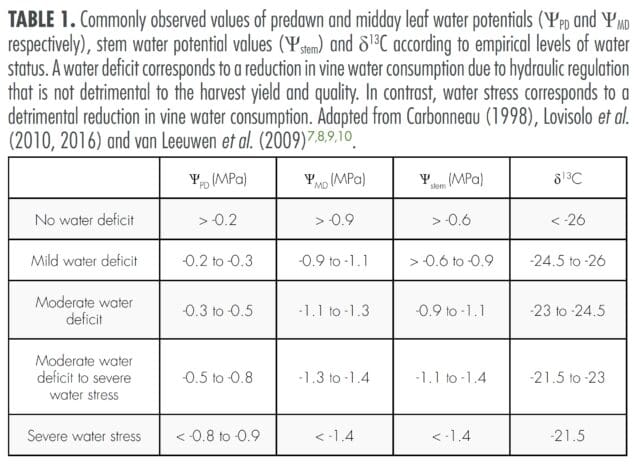
Commonly observed values of vine LWP and the associated empirical water status estimation are summarised in Table 1. However, it should be kept in mind that SWP or LWP measurements may overestimate the water stress really experienced by the vine under drought or high VPD events. Indeed, the tension of the water column inside the vine usually increases from soil-root to leaf-air interfaces (i.e., the water potential value gradually decreases from root to leaf) to maintain a continuous water flow from the roots to the leaves. When xylem tension gets too high at the leaf-air interface, air bubbles can form inside the xylem vessels. This phenomenon is called cavitation and results in leaves becoming gradually disconnected from the shoot and progressively dehydrating in relation to the atmospheric demand (VPD). In other words, leaves can act as hydraulic fuses, which causes SWP or LWP to become lower than the shoot water potential when the VPD is high. Therefore, picking one of the leaves during measurements with a pressure bomb may lead to an overestimation of the vine’s actual water stress.
Carbon isotope discrimination
Two different stable carbon isotopes of CO2 are present in the atmosphere, with 12C being highly predominant over 13C. Therefore 12C is preferentially picked up by the enzymes involved in photosynthesis, but the ratio 13C/12C tends to increase as the vine undergoes a water or nitrogen deficit. Hence, an index called δ13C that is based on the 13C/12C ratio is measured on sugars in the plant organs, berries, must or wines. It reflects the water and nitrogen uptake regimes before the measurement date. Thus, it is not well-adapted for day-to-day irrigation or agronomic management, but can typically be performed at the end of the growing season for a posteriori considerations about the effect of previous season management strategies on carbon assimilation in relation to nitrogen and water deficits. Commonly observed values of vine δ13C and the associated empirical water status estimation are summarised in Table 1.
Sap flow measurement
Sap flow corresponds to the movement of water mainly through the xylem vessels from the roots to the leaves, where it is transpired through the stomata. It provides an assessment of water use at the whole vine level. Two methods of measurement exist.
The thermal dissipation probe method
This method uses probes inserted as needles into the vine. One needle is used as a reference and the other one provides continuous heating. The measure is based on the principle that the temperature difference between the heated and the reference needle declines when sap flow increases. A careful placement to avoid any contact of the needles with non-conductive tissues is required. Moreover, it has been shown that circumferential and radial variation of sap flow can lead to both under- and over-estimations of sap flow. Therefore, the thermal dissipation probe method is not used for commercial application.
The stem heat balance method
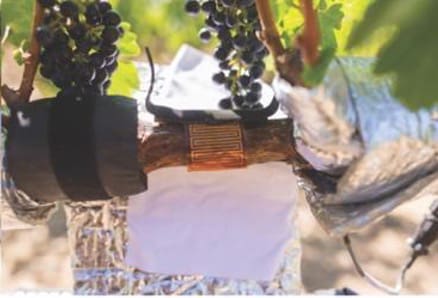
This method uses a non-intrusive sleeve equipped with a heating resistor flanked by two thermocouples. The sleeve is wrapped around the stem and maintains a snug fit between the stem and the thermocouples during stem diurnal contractions (Figure 1). Heat is provided uniformly and radially across the whole stem section to avoid disturbance due to the contact with non-conductive tissues and to integrate any circumferential and radial variation of the sap flow.
Selection criteria for plant-based methods based on their practicality to support irrigation decision-making in the field
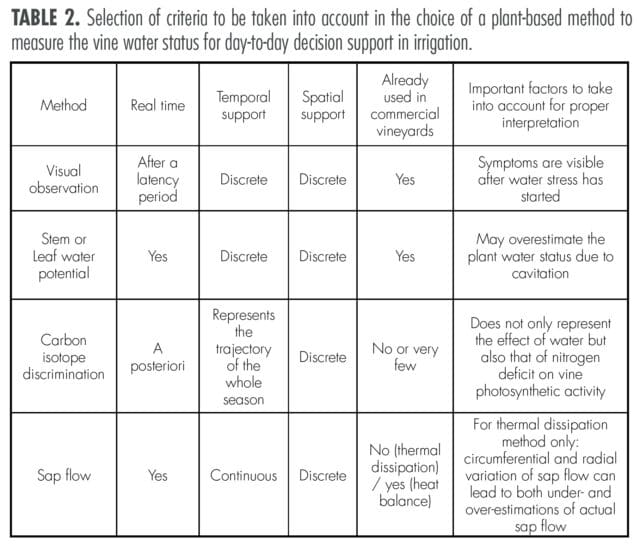
Irrigation scheduling must be responsive, precise and pre-emptive to optimise the rotation and duration of irrigation in all the blocks of a large vineyard. Measurements that support the irrigation decision-making process should provide real-time, almost continuous (intervals of less than a day) and spatially representative information of vine water status. Table 2 positions the methods presented in this article according to these three criteria.
Discrete temporal support methods (Table 2) are laborious and typically infrequent. Continuous measurement avoids missing stress episodes and buffers biological and environmental variation but requires semi-permanent or permanent installations.
All the methods presented in this article are performed on only a few plants which means that they are prone to spatial sampling issues (i.e., discrete spatial support). The challenge is to select measurement sites that are representative of the whole vineyard to be able to expand the chosen method to all the blocks.
Table 2 also outlines limitations in the interpretation and application of the different methods. Visual symptoms appear after the onset of water stress (2) when it is too late to make informed irrigation decisions. Water potential measurements may be affected by cavitation and not be representative of the water stress the vine is experiencing (3). Carbon isotope discrimination measurements integrate the effects of water and nitrogen deficits from the start of the season to the date of measurement (4) and therefore do not inform of specific irrigation events. Finally, sap flow measurements greatly support irrigation scheduling. Thermal dissipation methods are, however, prone to circumferential and radial variation of sap flow, while non-intrusive heat balance methods are not (5).
In general, plant-based methods do not provide a direct measurement of soil moisture or air water content (VPD), but rather show the response of the vine to these two factors at the time of measurement. Consequently, plant-based measurements allow us to determine the actual vine water status, but they should be interpreted jointly with either soil water content or VPD to adapt irrigation decisions. However, because it is not possible to determine whether vine water needs are being satisfied from soil moisture measurements (6), weather data and particularly VPD should always be analysed in conjunction with plant-based measurements to keep irrigation to a minimum.
________________________________________________________
References
1 Rogiers, S.Y., Greer, D.H., Hutton, R.J., Landsberg, J.J., 2009. Does night-time transpiration contribute to anisohydric behaviour in a Vitis vinifera cultivar? Journal of Experimental Botany, 60, 3751–3763. doi.org/10.1093/jxb/erp217
2 Lebon, E., Pellegrino, A., Louarn, G., Lecoeur, J., 2006. Branch Development Controls Leaf Area Dynamics in Grapevine (Vitis vinifera) Growing in Drying Soil. Annals of Botany, 98, 175–185. doi.org/10.1093/aob/mcl085
3 Charrier, G., Torres-Ruiz, J.M., Badel, E., Burlett, R., Choat, B., Cochard, H., Delmas, C.E.L., Domec, J.-C., Jansen, S., King, A., Lenoir, N., Martin-StPaul, N., Gambetta, G.A., Delzon, S., 2016. Evidence for Hydraulic Vulnerability Segmentation and Lack of Xylem Refilling under Tension. Plant Physiology, 172, 1657–1668. doi.org/10.1104/ pp.16.01079
4 Taskos, D., Zioziou, E., Nikolaou, N., Doupis, G., Koundouras, S., 2020. Carbon isotope natural abundance (δ13C) in grapevine organs is modulated by both water and nitrogen supply. OENO One, 54, 1183– 1199. doi.org/10.20870/oeno-one.2020.54.4.3600
5 Vergeynst, L.L., Vandegehuchte, M.W., McGuire, M.A., Teskey, R.O., Steppe, K., 2014. Changes in stem water content influence sap flux density measurements with thermal dissipation probes. Trees, 28, 949– 955. doi.org/10.1007/s00468-014-0989-y
6 Herrera, J.C., Calderan, A., Gambetta, G.A., Peterlunger, E., Forneck, A., Sivilotti, P., Cochard, H., Hochberg, U., 2022. Stomatal responses in grapevine become increasingly more tolerant to low water potentials throughout the growing season. The Plant Journal, 109, 804–815. doi.org/10.1111/tpj.15591
7 (From Table 1) Carbonneau A., 1998. Aspects qualitatifs, 258 – 276. In Traité d’irrigation, Tiercelin J.R., Tec et Doc Lavoisier éditions.
8 (From Table 1) Lovisolo, C., Perrone, I., Carra, A., Ferrandino, A., Flexas, J., Medrano, H., Schubert, A., 2010. Drought-induced changes in development and function of grapevine (Vitis spp.) organs and in their hydraulic and non-hydraulic interactions at the whole-plant level: a physiological and molecular update. Functional Plant Biology, 37, 98–116. doi.org/10.1071/FP09191
9 (From Table 1) Lovisolo, C., Lavoie-Lamoureux, A., Tramontini, S., Ferrandino, A., 2016. Grapevine adaptations to water stress: new perspectives about soil/plant interactions. Theor. Exp. Plant Physiology, 28, 53–66. doi.org/10.1007/s40626-016-0057-7
10 (From Table 1) van Leeuwen, C., Trégoat, O., Choné, X., Bois, B., Pernet, D., Gaudillère, J.P., 2009. Vine water status is a key factor in grape ripening and vintage quality for red Bordeaux wine. How can it be assessed for vineyard management purposes? OENO One, 43, 121. doi.org/10.20870/oeno-one.2009.43.3.798
This study was originally published March 10, 2023 doi.org/10.20870/IVES-TR.2023.7401 Original language of the article: English.
_____________________________________________________________________
Thibault Scholasch
Trained as a winemaker, Thibaut developed an expertise on vine water use and its consequences on fruit ripening, especially under drought and heat wave conditions. He created Fruition Sciences to promote vineyard management practices that respect the vine’s natural ability to adapt.
Cécile Laurent

Initially trained in viticulture and winemaking in Montpellier, France, Cécile Laurent earned a PhD specializing at the intersection of vine ecophysiology and data science. Her work focuses on leveraging local production datasets to support agronomic research and inform operational decisions in vineyards. Particularly sensitive to the practical reality of farming, she is committed to transferring research advances to the field, offering feasible solutions that bring tangible improvements. She currently heads R&D activities of the consulting company in viticulture Fruition Sciences.