The wine industry has spent much of the past year talking about change. Consumer behavior is shifting. Budgets remain tight. New technologies are arriving faster than many businesses can evaluate them. Vineyard economics, evolving wine styles, and changing routes to market are forcing companies to reconsider decisions that once felt settled.
But recognizing change is only the beginning. The more difficult question is what to do about it.
That question runs throughout this year’s WIN Expo conference program. Across the sessions, speakers are not simply identifying what is changing; they are examining how wine businesses can respond with the resources they have, where experimentation may be worthwhile and when outside expertise, technology, or new solutions can help move an idea forward.
Among them are Ed Feuchuk of Farm Collective Napa Valley, whose nearly two decades working with DTC wine brands have made experimentation a central part of his approach, and Christine Martin of Revel Brand Design, whose work focuses on helping wineries make their marketing more distinctive and effective without assuming the answer is simply to spend more.
Their perspectives point to an important idea: action does not always mean a major transformation. Sometimes it means testing one thing, using an existing resource differently, or finding the right person to help solve a problem.
Start With the Problem, Not the Technology
For Ed Feuchuk, moving from an interesting idea to something a winery can actually use starts by resisting the temptation to lead with the newest tool.
Referencing Steve Jobs’ philosophy of beginning with the customer experience and working backward toward the technology needed to deliver it, Feuchuk says that mindset has become particularly valuable with the rapid emergence of AI.
Rather than finding ways to “crowbar AI” into a winery simply to say it is being used, his team tries to understand what emerging technologies can do so those tools are available when there is a customer experience or business idea worth pursuing.
“So start with the cool idea,” Feuchuk says.
That willingness to experiment extends beyond technology. Feuchuk is equally skeptical of rigid marketing “best practices,” especially in a marketplace where consumers continue to change.
“Things only become ‘best practices’ because somebody tries
something new and finds something that works. It’s better to
be a trailblazer than a follower.”
He also cautions wineries against trying to appeal to everyone. As consumer segments become increasingly specific, he sees an opportunity for brands to become more specific as well – to stand out rather than continually looking for ways to fit in.
For attendees, it is a practical argument for experimentation: understand the opportunity first, test what makes sense for your particular business and learn from the result.
Use What You Already Have
That same action-oriented thinking appears in the marketing side of the WIN Expo program.
Christine Martin of Revel Brand Design approaches the challenge from the perspective of wineries working with limited resources. Her advice begins not with another advertising channel or a larger content budget, but with something most wineries already have: people.
“The humans, honestly,” Martin says.
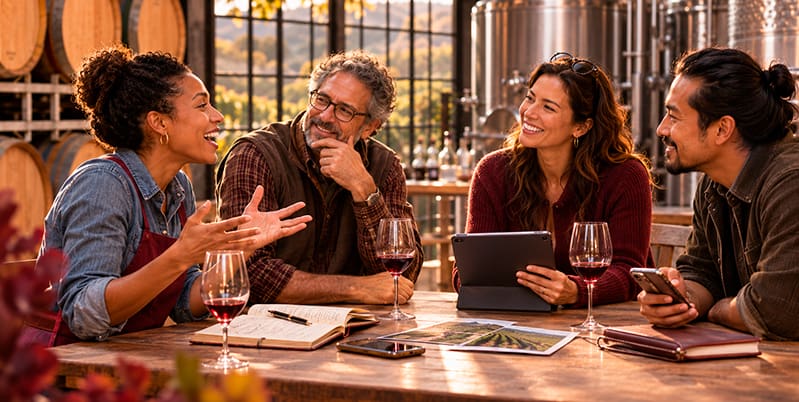
Wineries invest heavily in making their brands look polished, but Martin believes consumers are increasingly interested in what feels real. A winemaker talking candidly about a difficult vintage, an unusual family story, or a tasting room employee with a strong opinion about an overlooked wine may be more compelling than another carefully staged piece of brand content.
“If budgets are tight, I’d stop asking, ‘What should we create?’ and start asking, ‘What do we already have that people would actually care about?’”
The same principle applies to positioning. Familiar phrases such as “family owned,” “estate grown,” “handcrafted,” and “rooted in place” may all be accurate, but they are not necessarily distinctive when many wineries can make the same claims.
Martin recommends going one layer deeper. What actually happened in that family? What is unusual about the land? What does the winery believe that another winery might disagree with? What does the team deliberately do the hard way?
That is where she believes businesses begin to uncover something genuinely their own – and where taking action may require more curiosity than money.
Find the Expertise You Don’t Already Have
Of course, not every solution is sitting inside the business waiting to be uncovered.
Sometimes moving forward requires expertise a team does not have internally. Sometimes it means finding a technology platform, piece of equipment, service provider, or supplier that can address a specific operational challenge. And sometimes it begins with talking to someone who has already confronted the same problem.
For George Christie, President of Wine Industry Network, that connection between identifying a challenge and finding the people or resources that can help address it is central to the purpose of WIN Expo.
“What a business can learn from a particular conference session is important, but what’s more important is the ability to identify a problem early and connect with the people that have the tools and expertise to help you solve that problem.”
That is also what makes the combination of a conference and trade show particularly useful. A session may introduce a strategy or raise a question, while a conversation with an expert, fellow attendee, or exhibiting company can help turn that idea into something more concrete.
“The value of an industry event isn’t just hearing a good idea. It’s being able to walk out with a person to call, a solution to investigate, or a strategy you’re ready to test.”
The goal is not to pursue every new idea presented during the day. It is to recognize which ones matter to your business and have access to the people who can help determine what is worth doing next.
From the Conference Room to the Trade Show Floor
That is where WIN Expo becomes more than a place to hear about industry change.
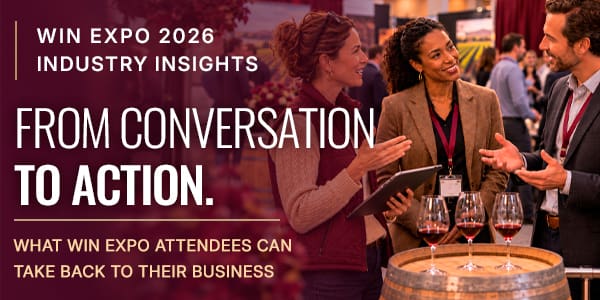
Across 12 conference sessions and more than 250 exhibiting companies, attendees can move from the issues affecting their business to the people working on possible answers. A conversation about AI, DTC, vineyard economics, production, consumer behavior, or emerging wine styles can continue on the trade show floor through discussions about the technology, equipment, services, and expertise available to address those challenges.
And the most useful takeaway does not have to be dramatic.
It might be a marketing experiment to run in January. A supplier to call the following week. A piece of equipment to investigate. A technology worth evaluating. A different way to use an existing employee, story, or business asset. Or simply a conversation that gives someone enough information to make a decision that has been sitting unresolved.
“The best outcome from WIN Expo is not simply leaving inspired. It’s leaving with something you can act on when you get back to work.”
The wine industry will continue to change, and no single conference session, technology, or strategy can provide every answer.
But businesses do not need every answer before they move.
Sometimes progress begins with one experiment, one resource viewed differently, one useful connection – or one idea worth putting into action.
Turn the industry’s biggest questions into your next move. Explore all 12 WIN Expo conference sessions and find the conversations most relevant to your business.