Winemakers spend countless hours on decisions in the vineyard and the cellar — varietal selection, canopy management, picking windows, fermentation choices, blending trials, and oak selection. By comparison, how much thought typically goes into the closure?
For many producers, the answer is: not nearly enough.
That gap is at the center of “Cork Stopper as an Oenological Tool – A Multidimensional Approach for Deciphering Red Wine Bottle Storage,” a Hosted Session at the 2026 WIN Expo presented by M.A. Silva.
Rethinking What a Closure Does
Cork and wine share a 250-year history built on trust, tradition, and a common purpose: preserving wine quality and supporting its evolution over time. Yet closures are still often treated primarily as a packaging decision — something chosen late in the process, after the real winemaking is complete.
The M.A. Silva team argues this framing misses what a closure actually does. Beyond sealing the bottle, a cork stopper plays an active role in how wine develops after bottling. It contributes to a wine’s identity, authenticity, and ageing journey — and ultimately, to the sensory experience when the bottle is opened.
What Research Shows
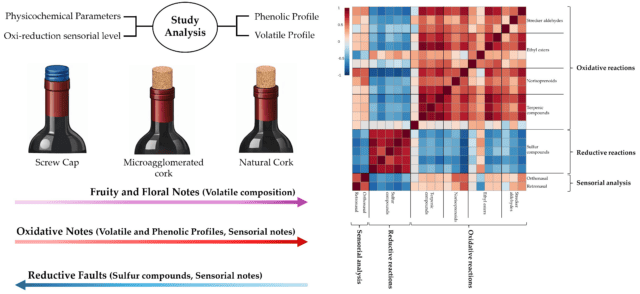
M.A. Silva’s collaboration with the University of Aveiro examined how different closures influence red wine during bottle ageing. The study found that different closure types modulate wine characteristics in distinct ways and that those differences become more pronounced over longer storage periods.
Among the key findings:
- Natural cork stoppers contributed to red wines with greater aromatic complexity, preserving most of the molecules associated with fruity and floral notes.
- Screw caps were associated with sulfur-related reductive defects over time.
- Micro agglomerated cork produced characteristics between those of natural cork and screw caps.
The research also examined how wine aroma is perceived differently through orthonasal and retronasal pathways — and how those perceptions correlate with changes in volatile compounds driven by closure type, storage time, and oxidation status.
Choosing a Closure with Intention
For winemakers, the practical implication is that closure selection should be driven by the same intentionality applied to other winemaking decisions. The initial wine matrix matters, but so do the intended ageing timeline, the desired oxidation balance, and the way aroma complexity should develop over time.
“Closure selection should be guided by how a winemaker wants the wine to evolve, not simply by how the bottle will be sealed,” says. Rita Leal, Ph.D., Project Manager R&D+I at M. A. Silva. “The wine’s initial characteristics, its intended aging period, and the desired aromatic profile all play a role in determining the most appropriate closure.”
That reframes the cork from a packaging component into an active winemaking tool — one that helps determine how a wine develops after it leaves the cellar, and whether the sensory profile a winemaker intended at bottling is still achieved when the bottle is finally opened.
What Attendees Will Take Away
Attendees will leave the session with a clearer understanding of:
- How different closures measurably shape the chemical composition and sensory evolution of red wines during medium-term storage
- How orthonasal and retronasal aroma perception relates to closure choice, storage time, and oxidation
- How to approach closure selection as an intentional winemaking decision rather than a late-stage packaging choice
“Cork Stopper as an Oenological Tool” will be presented as a Hosted Session at the 2026 WIN Expo, December 3 at the Sonoma County Fairgrounds.
Attendees can also visit M. A. Silva at Booth 221 on the trade show floor to meet the team, learn more about its cork closure solutions, and continue the conversation about the role of closures in wine quality and aging.
For more information about this session or to register: WIN Expo