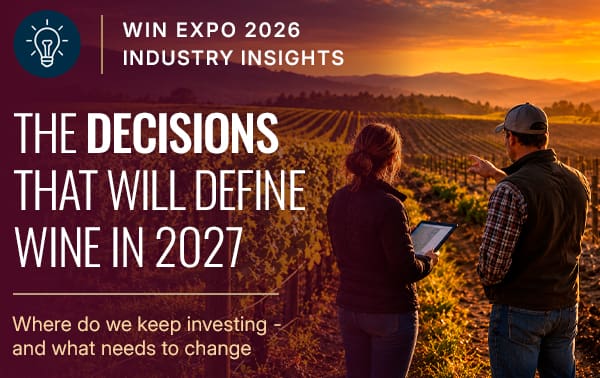
Vineyard acreage, ownership strategy, technology investment, and limited resources are forcing wine businesses to make choices that may shape far more than the year ahead.
The wine industry has spent considerable time asking what is happening. Demand has softened. Grape and bulk wine markets have shifted. Vineyard economics have become increasingly difficult. Ownership is changing. Consumers are behaving differently. And AI has arrived at precisely the moment many businesses have fewer people, less capital, and little appetite for another expensive experiment.
Heading into 2027, understanding the changes is no longer enough. The question is what to do about them — and the decisions being made now will have consequences that extend well beyond the next vintage.
When a Vineyard Stops Penciling Out

VP of Viticulture / Jackson Family Wines
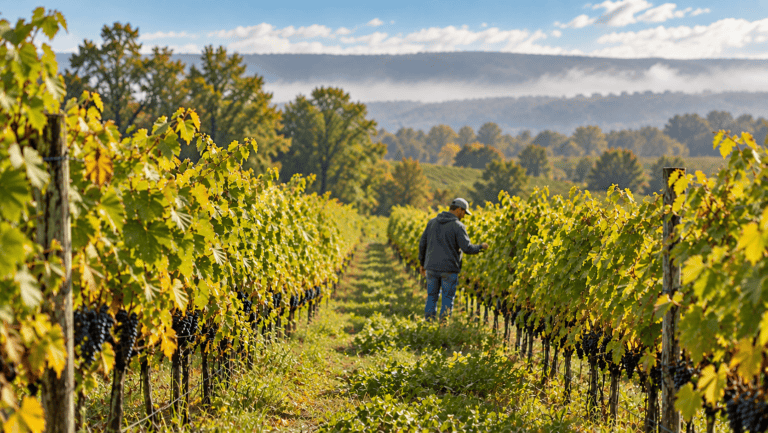
Few decisions illustrate that tension more clearly than what growers are facing in the vineyard.
John Azevedo of Jackson Family Wines says the starting point has to be brutally practical: vineyard health, farming costs, and realistic revenue potential. Older or diseased vineyards may no longer justify continued investment. But even healthy vineyards can become economically difficult when yields are low, and grape prices cannot support current farming costs.
Mothballing can provide another option, but Azevedo cautions against treating it as a pause button. Dormant acreage still costs money, and growers need to ask whether the vineyard is likely to generate enough future revenue to justify those carrying costs. The harder problem is that cutting expenses today — deferred maintenance, reduced fertilizer programs, postponed vine replacement — can narrow tomorrow’s choices.
“You need to survive today to fight tomorrow,” Azevedo says.
But he is equally wary of delaying a decision simply because conditions might improve.
“Your first loss is your best loss. Making bulk wine or mothballing vineyards without a real plan going forward is hoping to find a path forward. Hope is not a strategy.”
That may be one of the defining tensions heading into 2027: preserving optionality without using optimism as a substitute for a plan.
Consolidation Is Asking a Different Question
Similar decisions are taking place at the ownership level — but not in the way many assume.
For Pat DeLong of Azur Associates, current winery transaction activity is not primarily a story of expansion. It is a story of optimization.
“Rather than a growth narrative, transactions today are being driven with a focus on optimizing portfolios and platforms,” DeLong says.

Founder & Managing Partner / Azur Associates
That means looking closely at route-to-market capabilities, customer relationships, sourcing, production, and how different pieces of a business work together. The implications extend well beyond wineries actively considering a sale. Owners with no intention of entering the transaction market should still pay attention to what consolidation reveals about the business’s economics.
The assumptions that shaped yesterday’s wine consumer — and yesterday’s wine company — cannot automatically be projected forward.
DeLong says owners should ask whether their portfolio still aligns with today’s consumer, whether their route to market can reach that consumer effectively, and which parts of the business produce sustainable, repeatable free cash flow.
A business does not have to be for sale to benefit from looking at itself through a buyer’s eyes. What creates value? What absorbs resources? What is strategically important? And what exists primarily because it has always existed?
AI Has Its Own Resource-Allocation Problem
Technology presents a different version of the same challenge. The number of AI tools available is exploding at exactly the moment many winery teams have less time to evaluate them.
Andrea Savaiano of VintageIQ believes the best place to start isn’t with the technology — it’s with an asset most wineries already possess: their data.

Founder / VintageIQ
“Most wineries have the data they need to make better decisions, but may not be using it,” Savaiano says.
She sees some of the fastest potential returns in three areas: measuring program performance, improving customer segmentation, and reducing the time required for operational reporting. Analyses that once consumed hours or days can increasingly be completed in minutes.
“If the analysis can be done in minutes, there’s no longer an excuse not to do it and update it after each sales cycle,” she says.
But inexpensive AI also introduces a new temptation: solving problems simply because the technology makes it possible. It is now remarkably easy to prototype custom applications. Maintaining them is another matter. A winery may technically be capable of building its own reservation system, for example, but that also means assuming responsibility for product development, support, maintenance, and future upgrades.
The relevant question is no longer: Can we build this? It is: Should we own this?
The same principle applies more broadly to AI investment. Technology deserves resources when it helps the business make better decisions or gives employees more time to do the work humans do best.
“The core of the wine business is hospitality,” Savaiano says. “The wineries that get AI right will be the ones that use it to create more space for that connection.”
Choosing What Still Deserves Investment
A vineyard block, a winery portfolio, and an AI platform may seem like different kinds of business decisions. But they share something important heading into 2027: each requires wine businesses to decide what still deserves scarce resources.
None of those choices comes with perfect information. Waiting carries risk. Acting too quickly carries risk. But indecision is also a decision.
The businesses best positioned for 2027 may not be the ones trying hardest to preserve everything they had before the market changed. They may be the ones willing to determine what is still working, what needs to change, and where their next investment of money, time, and attention has the greatest chance of creating value.
Those are the decisions that will shape what comes next.
Take the Decision-Making Further at WIN Expo
The decisions shaping 2027 won’t be made in isolation. At the 2026 WIN Expo, growers, winery owners and industry leaders can take these conversations further through sessions focused on the choices businesses are confronting right now.
Rip It Out or Ride It Out? The Economics of Vineyard Transition will examine the realities behind removing, mothballing or preserving vineyard acreage. Winery & Vineyard Transactions: What Buyers & Sellers Need to Know will explore the forces reshaping ownership, valuation and investment. And AI in Action: Practical Tools, Real Winery Use Cases & Smarter Workflows will move beyond AI speculation to show where technology can create meaningful business value.
Together, these conversations are designed to help wine businesses move from understanding what’s changing to deciding what to do next.