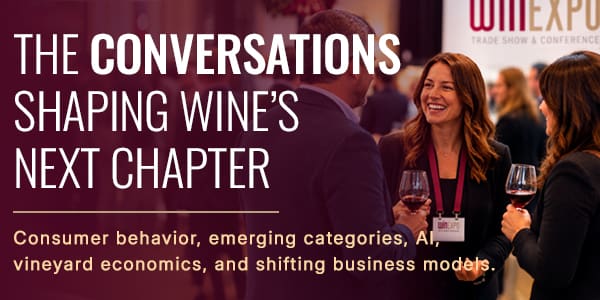
Consumer behavior, emerging categories, AI, vineyard economics, and shifting business models are all changing at the same time. For wine industry leaders, the challenge now is understanding what those changes mean together, and where they lead next.
The wine industry is no stranger to change, but it has often resisted it at every turn. What makes the current moment different is not any single disruption, but the number of fundamental shifts the industry is being asked to navigate simultaneously.
Longtime wine consumers are changing their behavior just as the industry works to engage a new generation. Moderation is creating new products and drinking occasions. AI is challenging traditional ways of working. Growers are making long-term vineyard decisions amid unusually uncertain market conditions. And wineries are reassessing sales strategies, investments, and what sustainable growth looks like in a market that may not simply return to the one they knew before.
For George Christie, President & CEO of Wine Industry Network, those changes point to a larger conversation the industry needs to be having.
“The industry isn’t dealing with one problem that we solve and then move on from. We’re seeing changes in the consumer, the marketplace, technology and the economics of growing and selling wine all happening at once. The companies that navigate this well will be the ones willing to have difficult conversations now about what needs to change,” says Christie.
A Consumer Market Changing at Both Ends
Much of the conversation about wine consumption has focused on younger consumers and why they are drinking less wine than previous generations did at the same age. Christian Miller, Research Director for Wine Market Council, believes that focus may be obscuring another important shift happening among the consumers who helped fuel wine’s growth for decades.
“There’s considerable evidence that drinking, including wine, declines considerably past 60 both in volume and frequency”

Research Director / Wine Market Council
“There’s considerable evidence that drinking, including wine, declines considerably past 60 both in volume and frequency,” says Miller. “On top of that, the Wine Market Council’s benchmark tracking survey has shown declines in consumption by boomers beyond what you might call the ‘natural’ rate.”
Miller says the trend began appearing around 2019 or 2020 in other alcohol categories and began affecting wine after 2021. For small and higher-end wineries, the implications extend beyond consumption. He also points to declining intent among Boomers to visit wine country, with circumstantial evidence that more core Boomer wine drinkers are “living off their cellars or club deliveries” when it comes to high-end wines.
The result is a more complicated consumer challenge than a generational handoff. But changing drinking behavior is also creating new opportunities. Sarah Qualters, VP of Marketing & Innovation at Rack & Riddle, sees the growth of alcohol-removed and low-alcohol wine as evidence that the boundaries of the wine category itself are expanding.

VP of Marketing & Innovation / Rack & Riddle
“We see alcohol-removed and low alcohol wines as an expansion of the category, not a replacement,” says Qualters. “Expanding occasions means two things. It’s the times and places where alcohol isn’t normally served: the office celebration, the weekday lunch, the venue without a license. And it’s the individual who’s limiting alcohol for any number of reasons, whether that’s health, training, pregnancy, medication, or simply pacing a long evening. In both cases, wine now has something to offer where it used to have nothing.”
That shift, she says, also challenges the idea that consumers belong neatly in one drinking category. “The wine consumer is no longer defined by a single drinking style. The same person moves between full-strength, low, and no-alcohol across a single week. Moderation is a behavior, not an identity, and the growth of these categories tells us wine can travel with that consumer instead of losing them.”
Making Long-Term Bets in a Short-Term Market
Shifts in demand eventually work their way back through the entire business — including what growers decide belongs in the ground. And nowhere is the tension between a changing market and long-term decision-making more apparent than in the vineyard.

Partner / Sangiacomo Family Vineyards
Steve Sangiacomo, Partner at Sangiacomo Family Vineyards, says his family’s approach has long been to resist chasing short-term market trends when deciding what to plant.
“We have always believed in planting the varietal that best suits the site due to the microclimate it sits in,” says Sangiacomo. “During down markets we definitely take advantage of the opportunity to remove vineyards that are underperforming due to wine quality and vine health.”
Down markets have traditionally carried their own opportunity. Plant during the downturn, the thinking goes, and the market may have recovered by the time the vineyard reaches production. But even that assumption is being tested.
“It has been said the best time to plant is during a downturn, as when the vineyard comes into production the market will have turned,” says Sangiacomo. “However, this cycle is testing that theory.”
“It has been said the best time to plant is during a downturn, as when the vineyard comes into production the market will have turned… However, this cycle is testing that theory.”
The underlying question facing growers is the same one confronting the industry more broadly: which assumptions still hold, and which ones need to change?
When the Way We Work Changes, Too
Adaptation isn’t only about responding to what is changing in the market. It also means reconsidering how work gets done — and whether established processes still make sense when new capabilities become available.

Founder & CEO / New Vintage Labs
Artificial intelligence is accelerating that conversation. Tasks that once required significant manual work, specialized knowledge, or outside resources are becoming more accessible to smaller winery teams.
Stephen Mok, Founder & CEO of New Vintage Labs, is already seeing that shift among winery marketers and DTC teams.
“Marketers that I’m seeing that are really leaning into it are discovering new ways of working just because now they have the accessibility to some of these functionalities,” says Mok. “In the past, that would have required a lot of either manual work for no-code tools or straight-up software engineering.”
The significance isn’t simply that AI can make existing tasks faster. Mok believes winery leaders should view it as a new capability that can change how people, data, and workflows work together, rather than as another technology purchase.
The Decisions That Shape What Comes Next
These pressures don’t exist independently. They influence one another — shaping what wineries invest in, what growers plant, and how leaders assess opportunity and risk. That interconnectedness may ultimately define this period for wine. There is no single trend that explains where the industry is headed, and no single strategy that will determine who succeeds. The next chapter will be shaped by a series of decisions being made across the business at the same time.
“There’s still tremendous opportunity in this industry, but opportunity doesn’t necessarily mean returning to exactly what worked before. We have to be willing to look at what’s changing, understand what it’s telling us, and decide where we need to adapt”
For Christie, that makes the willingness to examine old assumptions as important as identifying new ones.
“There’s still tremendous opportunity in this industry, but opportunity doesn’t necessarily mean returning to exactly what worked before. We have to be willing to look at what’s changing, understand what it’s telling us, and decide where we need to adapt,” says Christie.
All of these conversations and more will shape the 2026 WIN Expo conference program. Across 12 sessions, more than 35 industry experts will examine consumer behavior, emerging wine categories, DTC strategy, AI, vineyard transition, market conditions, winery and vineyard transactions, and other decisions already reshaping how wine is grown, produced, marketed, and sold.
No one conversation can define wine’s next chapter. But taken together, they can help the industry better understand the changes already underway and make smarter decisions about what comes next.
Continue the Conversation at WIN Expo
December 3, 2026 | Sonoma County Fairgrounds | Santa Rosa, CA
VIEW THE 2026 CONFERENCE PROGRAM HERE!