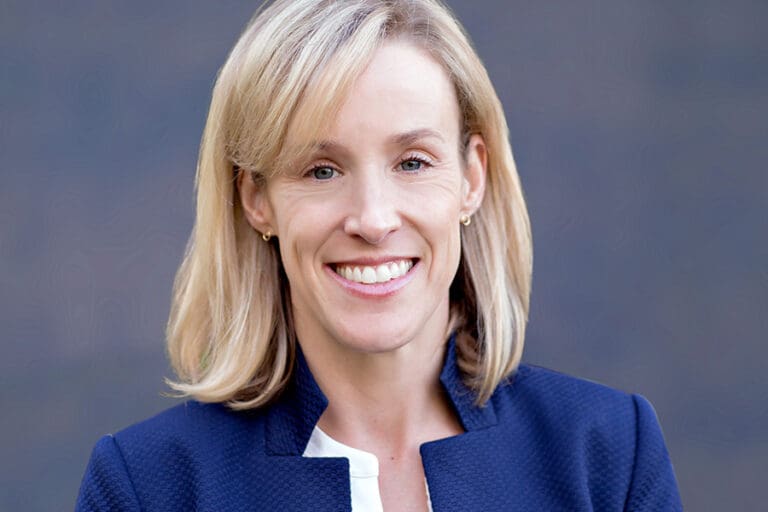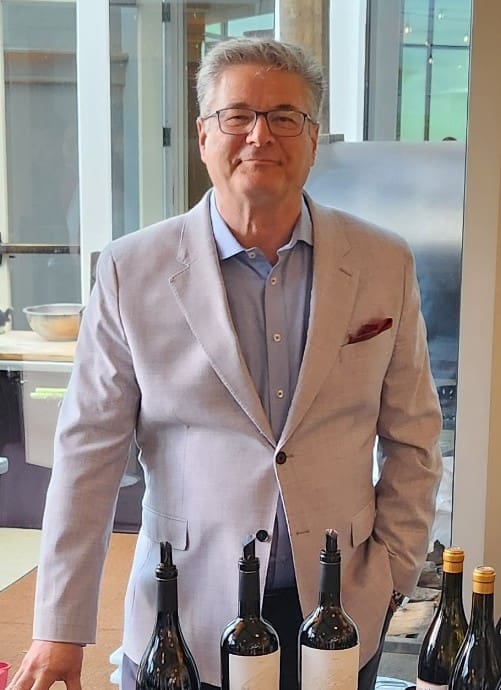
Jim began his wine career along the I-95 corridor between New York and Washington, DC. A graduate of Walnut Hill College with a degree in Hotel and Restaurant Management, he entered the trade as a retail wine buyer, highlighted by the 1990 Bordeaux and Burgundy futures, before working as a sommelier for Striped Bass and the Four Seasons hotel group.
He later moved into sales and general management roles with Henry Wine Group, Grupo Codorníu, and the Hess Group in New York, and went on to manage several prominent Long Island wineries. During this period, Jim founded Empire State Cellars (ESCX), exporting New York wines to China, served as a New York State trade liaison to Shanghai, and founded and sold a hard cider company.
Relocating to California in 2013, Jim became General Manager of Bonny Doon Vineyard, working with Randall Grahm, and later with the Martinelli family in Sonoma County. He moved to Napa in 2017, serving as GM of Anderson’s Conn Valley Vineyards and, for six years, as Managing Director for Bulgheroni Family Vineyards, overseeing Lithology (Napa) and Renwood (Plymouth), while also founding New Frontier Wine Company.
Most recently, Jim served as Chief Sales Officer of WineDirect Fulfillment. He is the author of The Post-Pandemic Wine Market: A Practical Guide (Board and Bench, 2025) and lives in Napa with his wife and three children.
Follow Jim on Substack: https://substack.com/@jimsilver and pickup his book: Post-Pandemic Wine Market: A Practical Guide
How did you come to wine, and to wine writing?
Part of my early college learning included a “stage” (said with a French accent) at La Varennes in Dijon to study pastries, among other things. A field trip with the class took us to the Clos de Vougeot in the Côte d’Or, which to my teenage mind was beyond description, beyond beautiful. In there, I tasted real wines, and really good wines, for the first time. Without exaggeration, wine became a part of me forever after.
What prompted you to write The Post-Pandemic Wine Market?
In truth, I was between positions for a short period, and my mind was restless. I think deeply about our business and enjoy learning as much as I can. But I wanted to say to someone, anyone, what I had learned so far – but make it a useful conversation – not just a dry recitation of wine business principles. I’m asked if AI helped me write it – no, plainly – but it helped me develop an outline of chapters, and that was very helpful indeed.
You’ve done it all in the wine business. What role was your favorite and why?
I’ve enjoyed all my roles, literally. I would not give back any of the time I spent. But one is remarkable above the others for a couple of reasons, and that is as the GM of Bonny Doon Vineyard from 2013 to 2016. I loved it because it was impossible to maintain what Randall had built, like spinning ten plates on sticks. But it was inspiring, thoughtful, challenging, and endlessly stimulating, especially because of Randall’s “madness” and genius. It was my deepest dive into winery financials and banking trials, and ultimately, we succeeded at least for that time period.
What would you tell individuals aspiring to work in our industry or write about wine?
To work in our industry requires a love of the product. Even if I didn’t like the wine I was selling at the time (which happened a lot) I loved that I was making and selling it, and I was the consummate “true believer” in that sense. If you have that kind of passion for our business, working isn’t working anymore – at least for me. That doesn’t mean it can’t be frustrating or challenging sometimes, but usually it isn’t wine’s fault – it’s other people – and so if you thrive in the development of personal and professional relationships, few industries rely as much on those as does ours. To write about wine is personal, because your potential audience is extremely small, and has probably developed their own opinions already. The exceptions are the McNeils, Robinsons, and Chukan-Browns of the world, along with the Dunnucks and Czerwinskis. And there are so few truly great wordsmiths in this space, but Andrew Jefford is my favorite.
Is it possible to make a living as a wine writer or author today? What are the primary challenges and hurdles you faced?
I would say ‘no’, flatly, knowing that there are rare exceptions. You can count on two hands the ones who truly do (now), and two more hands the ones that truly did. I personally faced no challenges or hurdles because I wrote knowing it was as much for me as for the potential audience. Selling a thousand copies of anything would be a remarkable achievement – and so I set my sights quite low, purposefully. On the other hand, the future is asking for this sort of content – but we have yet to figure out how to package and deliver it. That’s what a future wine writer might look like, as something not yet thought of. For today, if you are enjoying someone’s (wine) writing, you ought to probably pay them for it.
What would people be surprised to know about you, other than competitive foil fencing?
Ha, yes. My teenage daughter started fencing a number of years ago and I got used to dropping her off at the meets and practices regularly, so I decided one day to give it a try. It is incredibly fun and something that anyone can do at almost any age. Mentally, physically, it is beyond anything I’ve ever done before, and I highly recommend it. I just wish I could be as good as she is, but that’s not going to happen. The only other thing that is surprising, I think, was writing a book that got published and sold. The thing that surprised me most was how rich my life has been looking back on it (so far).
What haven’t you done that you’d like to do?
Travel for extended periods of time. I’m talking about a villa in Provence for a month or a tour of Japan that takes weeks. I never made the time to relax and live like that. It’s a mighty big regret, but there’s still plenty of time.
What is one thing you’d like your wineries to take away from your book?
Know thyself. Know that the wine business does not conform to what we think of as business in the sense of the global economy, or the economic apparatus that moves markets. No, the capital-intensive wine business is full of infinite vagaries and challenges, across long, long arcs of time. In the sense of business, the wine business makes no sense – unless you are at the highest scales imaginable. Know thyself means to temper your expectations, know what things cost, look far into the future, avoid growth for growth’s sake, and build on quality, then quality at scale. Think Caymus, Silver Oak, Duckhorn, and similar. Start small(er) and build on real value. Be social. Repeat. Do everything you can.
What’s the best story you have written? Please provide a link.
Perhaps this recent one? Hard to say. I’m not convinced I’m very good.
Can you describe your approach to wine and book writing?
More difficult to say. I’m working on the framework for my second book. I wrote the whole thing already, but I’m not in love with it, so I keep going back to it again and again. Now I don’t recognize it. Same thing with my first book. I gave it to wine-tech-guru Paul Mabray to peer-review, and he was kind enough to send back massive notes – the best being, “this book is not good.” This caused me to reorganize and rewrite a huge portion of it, and it was infinitely better as a result. I’m grateful for that in a thousand ways.
How do you develop and collaborate with sources for story ideas?
I do. Usually, a Substack article erupts from a conversation – the ideas coming to me in real time and developed in real time with someone else’s thoughts in contrast to them.
Do you post your articles on social media? Why is that important?
Substack, yes, and it is important because you will find that your readers’ concepts of what you are saying are oftentimes not at all what you meant. That’s very important: to learn not only to make sense, but also to be clear and be heard. I’ve not gotten there yet. Writing makes you very vulnerable.
Do you consider yourself an Influencer? What’s the difference today between a writer and an influencer, in your opinion?
I aspire to that, truly. It would be nice to be paid for your thoughts, but business is still business, and wine needs to be produced, marketed, and sold, and so I do that as well. To me, there is a thin line between a writer and an influencer, with the dividing line being criticism. A writer can educate, influence, and promote, but also criticize. But an influencer pushes ideas, products, and concepts for commercial purposes, almost exclusively, and that’s a different business.
What are your recommendations to wineries when interacting with journalists?
You need to realize that you are not nearly as interesting as you think you are. They’ve heard all of this stuff before. Being yourself, being a real person, and speaking openly and honestly about what’s really going on inside these four walls will make the article a lot better.
What advantages are there in working directly with winery publicists?
I’m critical of PR generally, especially for using clicks and potential views like currency. The ROI is never really known, how could it be? The advantages come when you and your publicists are working very closely, collaborating on a fine-tuned, almost surgical strategy. The publicist has the tactics you need to reach whomever you want, and if you’re both working towards a common, specific goal, you’ll get there with the message. In the PR area, I don’t think broadly (maybe that’s not good); rather, I prefer precision strikes.
Which wine reviewers/critics would you most like to be on a competition panel with?
Jeb Dunnuck is a very cool guy. Even after 30 years in the wine trade, I follow his recommendations on Southern Rhônes (especially). He’s uncannily accurate.
Which wine personalities would you most like to meet and taste with (living or dead)?
Jeb would be cool to hang out with, but my hero is Hugh Johnson. I’ve met him only a couple of times. That his first wine book ever, simply called Wine, was published when he was just 27, amazes me. The Story of Wine remains my favorite wine book of all time.
If you take days off, how do you spend them?
I don’t, which is why I cherish the couple of hours each week fencing. It switches me off work and onto something completely different.
What is your most memorable wine or wine tasting experience?
I was a wine-buyer in Delaware in the 90s. We used to have special events for our customers all the time, but one day I decided to go a little over the top. In this case, we reenacted the dinner from the movie “Babette’s Feast” right down to the modern versions of the wine and the exact menu. The Hotel duPont handled the cooking, and I went out of my way to procure the right wines. Best of all, we made the event black-tie. It sold out so fast, we added a second night. The local newspaper and a television news crew actually covered the event, as it was so grand. Not bad for a kid in his early 20s.
What’s your cure for a wine hangover?
Good golly. Two blue Advil, a lot of watered-down lemonade, and a Jimmy Dean sausage sandwich. It works.
What’s your favorite wine region in the world?
I have three – The Cotes de Py in Morgon, Beaujolais; Marsannay in the Cotes d’Or; Vacqueyras in the Cotes-du-Rhone. I love Napa too, but that’s more personal. I write a lot about the smaller Napa producers, mostly because I worry about their future. The business is getting harder and harder.
Do you have a favorite wine and food pairing? Favorite recipe/pairing?
My kids enjoy “Duck Five Ways,” which is a duck, parted out, adding a couple of extra legs. They are cooked confit-style. The breast is removed and cooked separately in a sauté pan. The carcass is roasted and, with some vegetables, becomes a duck consommé soup to start. The skin is rendered crisp, chopped, and added to salad greens, while the fat is used for roasted potatoes. A few times a year, we’ll do this (because it is just too healthy!) and I’ll open a good Bordeaux. I save my Bordeaux for this meal and I’m making it tonight.

Carl Giavanti is a Winery Publicist in his 16th year of consulting. Carl has been in business marketing and public relations for over 30 years; his background in tech, marketing and project management informs his role as a publicist and wine writer. Clients are or have been in Willamette Valley, Napa Valley, and Columbia Valley https://carlgiavanticonsulting.com/ He also writes for several wine and travel publications https://linktr.ee/carlgiavanti