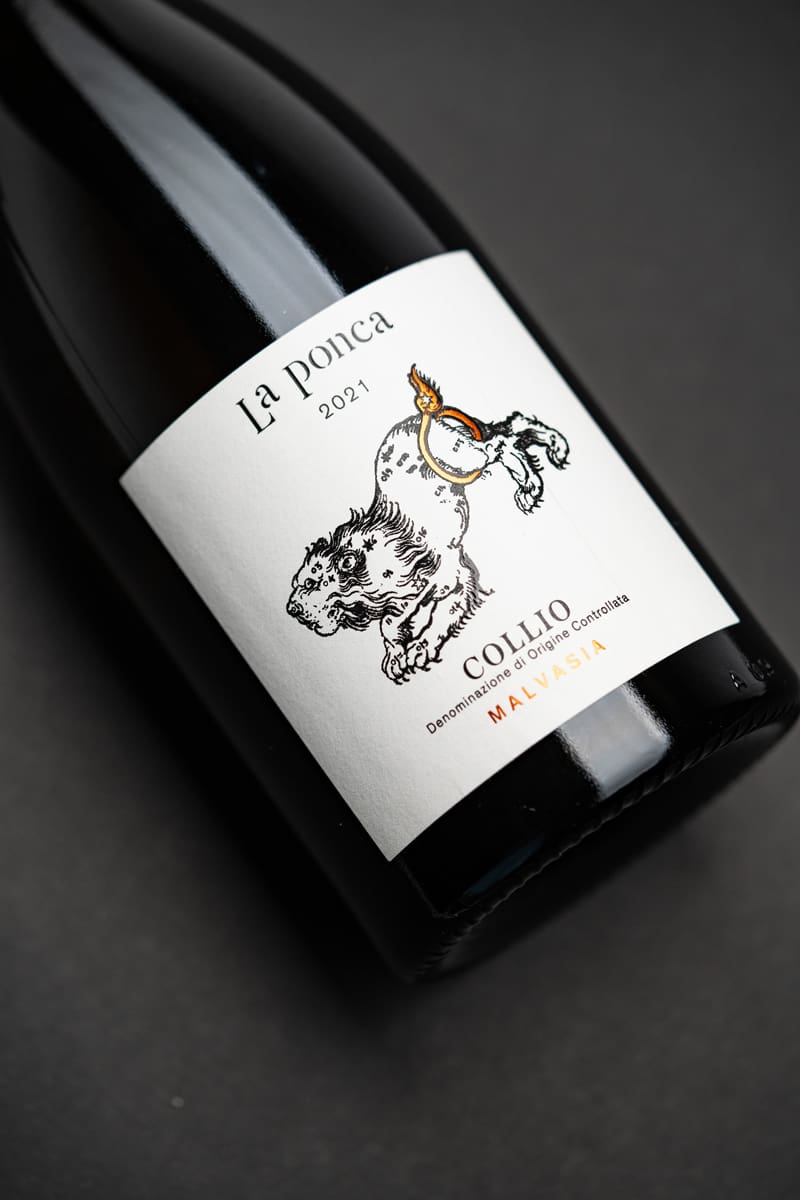
La Ponca’s interpretation of Malvasia immediately conveys the character of the Scriò Hills. The result is a rich and profound wine that highlights the historic bond between the grape variety and the land to which it belongs.
October 1, 2025 (Scriò – Dolegna del Collio, Italy) — Malvasia, an indigenous grape of the region, finds its distinctive expression in the marl and sandstone soils of this area, confirming its deep-rooted connection to its homeland. The climatic and geological characteristics of this part of Collio allow the variety to develop wines with complex aromas, structure, and persistence on the palate. It is one of the most representative grape varieties of La Ponca, a wine estate located in the highest part of Collio at the foothills of Mount Korada. Here, the soils derive from the alteration of a rocky system formed around 65 million years ago, giving rise to a unique geology. The 12 hectares of vineyards are surrounded by 40 hectares of woodland and benefit from the contrast between the cool mountain currents and the Bora wind blowing from the east.
THE PETRIS AND PACIAL CRUS ON MARL AND SANDSTONE, LA PONCA, OF EOCENE ORIGIN
La Ponca’s interpretation of Malvasia Collio DOC comes from vineyards located in the Petris and Pacial crus, grown on hillside soils composed of marl and sandstone of Eocene origin, locally called ponca, which gives the estate its name. The vines are between 14 and 18 years old, planted at a density of 5,000 per hectare and trained with unilateral Guyot at an altitude ranging between 200 and 260 meters above sea level. Winemaking begins with a cold maceration on the skins of about 24 hours, followed by gentle pressing and cold static decantation for must clarification. Alcoholic fermentation and subsequent maturation take place at controlled temperature, partly in stainless steel and partly in oak barrels, with 15 months on fine lees.
The result is a bright straw-yellow wine with golden reflections, iodine notes, balsamic hints, and nuances of exotic fruit. On the palate, it is rich and creamy, with a pleasant acidity that balances the aromatic bouquet. Perfectly suited to pairings with mushroom-based dishes, aged cheeses, pumpkin pasta dishes, and fish courses.