Three global hotel chains are running three different marketing strategies to win the same guest. Wineries and Wine Tourism Managers should study why they can afford to diverge — and what a far smaller, far more fragmented industry can still borrow from each of them.
By Angelo A. Camillo, PhD
Former Korbel Brothers Professor of Wine Business, Sonoma State University’s Wine Business Institute; Editor-in-Chief, Wine Business Journal
Rohnert Park, California, USA, September 10, 2026
A Different Kind of Competition
Every hotel guest who books a room, and every wine tourist who reserves a tasting appointment, is the object of the same fight for attention — a fight that increasingly happens before either of them ever reaches a lobby or a barrel room, inside a search bar, a social feed, or a third-party booking platform. Research published this month by GlobalData’s Hotel Management Network makes a point worth pausing on: Hilton, Marriott and Accor, three companies competing for the same global traveler in many of the same cities, are not converging on a shared advertising formula. They run three distinct strategies; each built on a different theory of how a guest chooses where to stay.
That divergence is the interesting part. It is tempting, especially for an industry as fragmented and resource constrained as wine, to look at what the market leaders do and try to copy it. I want to make the opposite argument here: the reason Hilton, Marriott, and Accor can each run a completely different playbook is precisely what most wineries don’t have — and understanding why is more useful to wine tourism than trying to imitate any one of their tactics directly.
Three Chains, Three Theories of the Guest
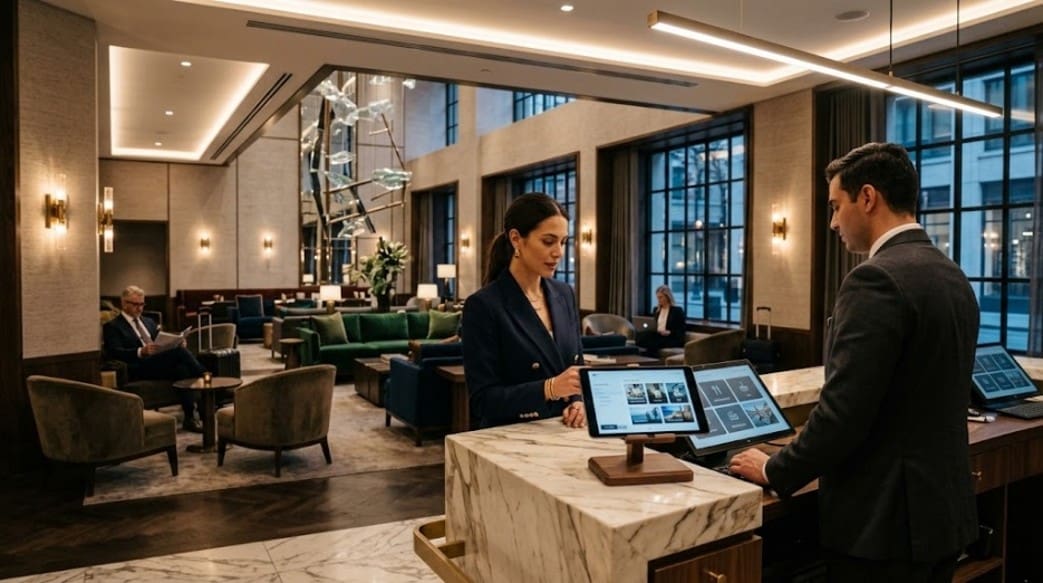
(Source: AI-generated Image. Segmentation, emotional storytelling and loyalty infrastructure — Hilton, Marriott and Accor are each betting on a different theory of what makes a traveler book.)
Hilton’s advertising, per GlobalData’s analysis of its February–July 2025 campaigns, centers on portfolio segmentation. Rather than one message for one brand, Hilton runs a different pitch for each property tier and each audience: Waldorf Astoria and the V Hotel Dubai carry the luxury and opulence message; Embassy Suites and Hampton Inn sell space and complimentary breakfast to families; a partnership with actress Deepika Padukone and motorsport tie-ins with McLaren Racing reach business travelers and enthusiasts who respond to prestige and performance. In effect, dozens of micro-campaigns run under one corporate roof, each precisely aimed at a guest segment Hilton already knows how to describe.
Marriott, by contrast, is betting on something closer to mass emotional brand-building. Its “Travel Shapes Us” campaign, unveiled in April 2025 and described by the travel-industry outlet Skift as a multi-million-dollar overhaul, deliberately moves away from showing pools, lobbies and beds. It pairs Bonvoy with entertainment culture — Skift’s coverage of the launch cited Taylor Swift and Beyoncé among its cultural touchpoints — to sell travel as identity formation for a younger generation, prioritizing brand consideration over an immediate booking. Where Hilton segments, Marriott unifies: one emotional story, told at scale, meant to make Bonvoy feel like a value system rather than a rewards program.
Accor’s approach is different again, and arguably the most structurally interesting of the three. Rather than leading an ad campaign, Accor has built its competitive position around a loyalty and data ecosystem. ALL Accor+, its paid loyalty program, reached 100 million members in under five years and now extends beyond hotels into airlines, banks and retail partners, onboarding new partners in under three weeks, according to Skift’s May 2025 reporting. Accor executives describe a deliberately tiered approach to AI and personalization — automating heavily at economy brands where margins are tight, keeping human-led service at luxury properties — and a pragmatic relationship with online travel agencies: rather than treating Expedia or Booking.com purely as a threat, Accor uses them to acquire less brand-loyal travelers, then works to shift repeat guests onto its own app, where restaurant reservations, spa bookings and point redemption all live in one place.
Segmentation. Emotion. Ecosystem. Three legitimate strategies, three different bets on what drives a booking — and all three companies can afford to run their bet at full scale, indefinitely, while they watch which one wins.
Why the Wine Industry Can’t Just Copy the Playbook
Here is the uncomfortable comparison for wine. A tasting-room visit and a hotel stay are both experience purchases. This shared dynamic requires a physical encounter but is increasingly shaped by the same digital channels, often mediated by the same category of third-party platforms. An OTA (Online Travel Agency/ Agent) for a hotel room is functionally not so different from a wine-tourism marketplace or a regional events aggregator competing for a visitor’s tasting reservation. The direct-booking-versus-OTA tension that Accor manages so deliberately is a tension every winery with a tasting room already lives with, usually without any of Accor’s tools for managing it.
But the asymmetry is the whole story. Hilton, Marriott and Accor are each, in different ways, spending scale to buy certainty: enough properties and enough guest data to know precisely which segment responds to which message (Hilton); enough marketing budget to fund a “multi-million-dollar” campaign and celebrity partnerships that most consumer brands, let alone wineries, could never justify (Marriott); enough technical infrastructure and negotiating leverage to build a hundred-million-member loyalty ecosystem and set terms with OTAs rather than submit to them (Accor). None of that is available to the individual winery. The overwhelming majority of the world’s wineries are small, often family-run operations producing a few thousand to a few tens of thousands of cases a year — closer in scale to a single independent inn than to a global hotel brand. A winery cannot fund a McLaren Racing partnership, cannot build its own hundred-million-member loyalty app, and rarely has the customer-data infrastructure to run Hilton-style segmented campaigns with any statistical confidence.
This is where I think the analogy is frequently misapplied. Consultants and conference speakers point to what Hilton or Marriott or Accor does and tell wineries to “do the same, but smaller.” That instruction is close to meaningless, because what makes each of these three marketing strategies work is not the creative concept — it is the scale underneath it. A winery that tries to run a scaled-down version of Marriott’s emotional brand campaign, alone, is not doing a smaller version of the same strategy. It is doing something structurally different, and usually far less effective, because it lacks the reach to make an emotional brand promise mean anything beyond its own tasting room.
The Inferential Leap: Borrow the Principle, Not the Scale
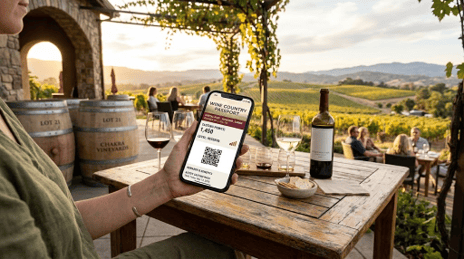
(Source: AI-generated Image. A Wine Country Passport: A single regional loyalty app, usable at tasting rooms across dozens of wineries — the booking-and-rewards ecosystem no wine region has yet fully built.)
The more useful question is not “which hotel chain should a winery copy,” but “at what level does a winery actually have Hilton’s, Marriott’s, or Accor’s scale?” The answer, in almost every wine region I have studied for my forthcoming book, Winery Hospitality Management: Strategies for the Global Wine Experience Economy, is not the individual winery—the appellation, the wine trail, or the regional wine tourism body.
Consider how each marketing strategy can be elevated from tactical execution to strategic advantage.
Portfolio segmentation, at the level of a wine region rather than a single property, is not a stretch; it is close to whathappens informally, and what a region does formally when it profiles its visitors. In my strategic marketing management work developing visitor-typology frameworks for my forthcoming book — distinguishing, for instance, Wine-Lovers, Wine-Interested, and Wine-Curious segments by motivation, income, education, and media habits — the goal is exactly the kind of guest description Hilton already has for each of its brands. A regional wine trail or appellation marketing body that segments its member wineries the way Hilton segments its hotel brands — this estate for the connoisseur, that estate for the family outing, a third for the curious first-time visitor — can direct advertising dollars with Hilton-level precision, at a scale no individual winery could otherwise afford.
Emotional, identity-driven storytelling, Marriott’s bet, is arguably wine’s oldest asset and its most underused digital one. Terroir, heritage and place are already identity claims; what wine regions have rarely done is fund a “Travel Shapes Us”-scale campaign around them collectively, the way a Napa Valley Vintners, a Bordeaux wine council or a Wine Australia can when member wineries pool marketing resources rather than each running an under-funded solo campaign.
A shared loyalty and booking ecosystem, Accor’s bet, is the piece wine regions have never fully assembled, and the one I would argue is most urgent. The pieces already exist; they just aren’t together. Sonoma County’s Wine Road runs an Insider membership across 20-plus independently owned wineries in Alexander Valley, Dry Creek Valley and Russian River Valley, ticketed through CellarPass — the same booking platform that also distributes wine-country reservations to TripAdvisor, Booking.com and Expedia — but the membership itself is a flat annual discount card, not an accruing loyalty currency. A 2019 fintech venture, Grand Reserve Rewards, tried the reverse: a card-linked points program good “regardless of brand” at wineries, wine clubs and wine shops, but built around retail purchases rather than tasting-room visits, and it does not appear to have survived past its beta launch. No region has yet combined Wine Road’s booking-integrated membership model with an actual points currency, earned and redeemed at the point of a tasting-room reservation.
A regional or national wine-tourism passport that did combine them — one login, one loyalty currency, redeemable at tasting rooms across dozens of participating wineries, integrated with the same booking systems used by third-party wine-tourism marketplaces — would do for a wine region exactly what ALL Accor+ does for Accor’s guests: give the visitor a reason to book through the region’s own channel rather than a third-party aggregator, while still letting that aggregator do the work of first-time acquisition.
Applying It at Home and Abroad
Domestically, the infrastructure for this already exists in part. Regional associations — a Sonoma County Vintners, a Napa Valley Vintners, a Paso Robles Wine Country Alliance — already play something like the role of a hotel parent company for their member wineries: shared marketing budget, a shared regional brand, and, increasingly, shared digital booking tools. What is usually missing is a deliberate marketing strategy layer: treating the region’s member wineries as a segmented portfolio, the way Hilton treats its brands and treating the region’s booking platform as a loyalty ecosystem the way Accor treats ALL Accor+, rather than a passive events calendar.
Globally, the opportunity is larger and less developed. Formal appellation systems—Europe’s AOC and DOC designations, and comparable geographic-indication frameworks emerging across New World (if I can still use this definition) wine regions—already provide the geographic and quality-based segmentation infrastructure that Hilton spends heavily to build through brand management. What most of these systems have not yet built is the connective tissue: a cross-border loyalty or membership layer that lets a wine tourist who joins a loyalty program in Priorat carry recognized status, or earn redeemable benefits, at a partner estate in the Douro or the Barossa. That is a genuinely global proposal — and one considerably more achievable for a coordinated network of appellations than it would ever be for Accor’s competitors to replicate Accor’s own hundred-million-member ecosystem from scratch.
Conclusion
None of this makes Hilton’s, Marriott’s, or Accor’s individual tactics directly transferable to a winery’s marketing budget, and no consultant should tell a 5,000-case producer to run a celebrity partnership. But the underlying logic — segment deliberately, tell an emotional story at a scale big enough to matter, and build a loyalty ecosystem that gives visitors a reason to book direct — is entirely transferable, provided the wine industry is honest about which organizational level actually has the scale to run it.
Sources
GlobalData / Hotel Management Network, “How Hilton, Marriott and Accor compete for hotel guests,” September 10, 2026. https://www.hotelmanagement-network.com/features/how-hilton-marriott-and-accor-compete-for-hotel-guests/
GlobalData analysis via Hotel News Resource, “Hilton’s Advertising Campaigns Elevate Luxury and Unique Experiences in the Travel Industry.” https://www.hotelnewsresource.com/article137945.html
Skift, “Marriott Unveils New Ad Campaign: ‘Travel Shapes Us,’” April 10, 2025. https://skift.com/2025/04/10/marriott-unveils-new-ad-campaign-travel-shapes-us/
Skift, “Inside Accor’s Tech Strategy: Loyalty, AI, and Agility at Scale,” May 27, 2025. https://skift.com/2025/05/27/accor-digital-strategy-ai-loyalty-hospitality/
Wine Road, “Wine Road Insider” membership (ticketed via CellarPass). https://www.wineroad.com/explore/insider/
PR Newswire, “First-Of-Its-Kind Loyalty Program Rewards Wine Lovers for All Purchases at Wineries, Wine Clubs and Wine Shops Regardless of Brand,” November 19, 2019. https://www.prnewswire.com/news-releases/first-of-its-kind-loyalty-program-rewards-wine-lovers-for-all-purchases-at-wineries-wine-clubs-and-wine-shops-regardless-of-brand-300960821.html
Ethics Press, Winery Hospitality Management: Strategies for the Global Wine Experience Economy. https://ethicspress.com/products/winery-hospitality-management

About the Author
Angelo A. Camillo, PhD, is the former Korbel Brothers Professor of Wine Business at Sonoma State University’s Wine Business Institute and Editor-in-Chief of the Wine Business Journal. His forthcoming book, Winery Hospitality Management: Strategies for the Global Wine Experience Economy, is available for pre-order from Ethics Press.