Designed to accompany wine through every stage of its evolution, the Nals Margreid winery creates a continuous dialogue between work, landscape and hospitality. From the moment visitors enter, their gaze moves through operational spaces and production areas, making them part of the process itself and revealing the winery’s daily relationship with wine, its production precision and the identity of South Tyrol.
June 11, 2026 (Nalles, Italy) — In South Tyrol, where the relationship between landscape, viticulture and architecture is built on balance and continuity, Nals Margreid winery stands as a tangible example of integration between production, territory and architectural vision. Designed by architect Markus Scherer and developed in phases between 2011 and 2020, the winery originated from a project launched in 2007 with the aim of bringing all company operations together in a single location. The result is a coherent relationship between production functionality, landscape integration and hospitality. The project interprets the winery not merely as an operational facility, but as an integrated system where architecture, work and territory are in constant dialogue. From the organisation of production flows to the choice of materials, from the restoration of historic buildings to the integration within the natural environment, every element contributes to defining a clear and recognisable identity.
ARCHITECTURE AND WINEMAKING: A WINERY BUILT AROUND WINE
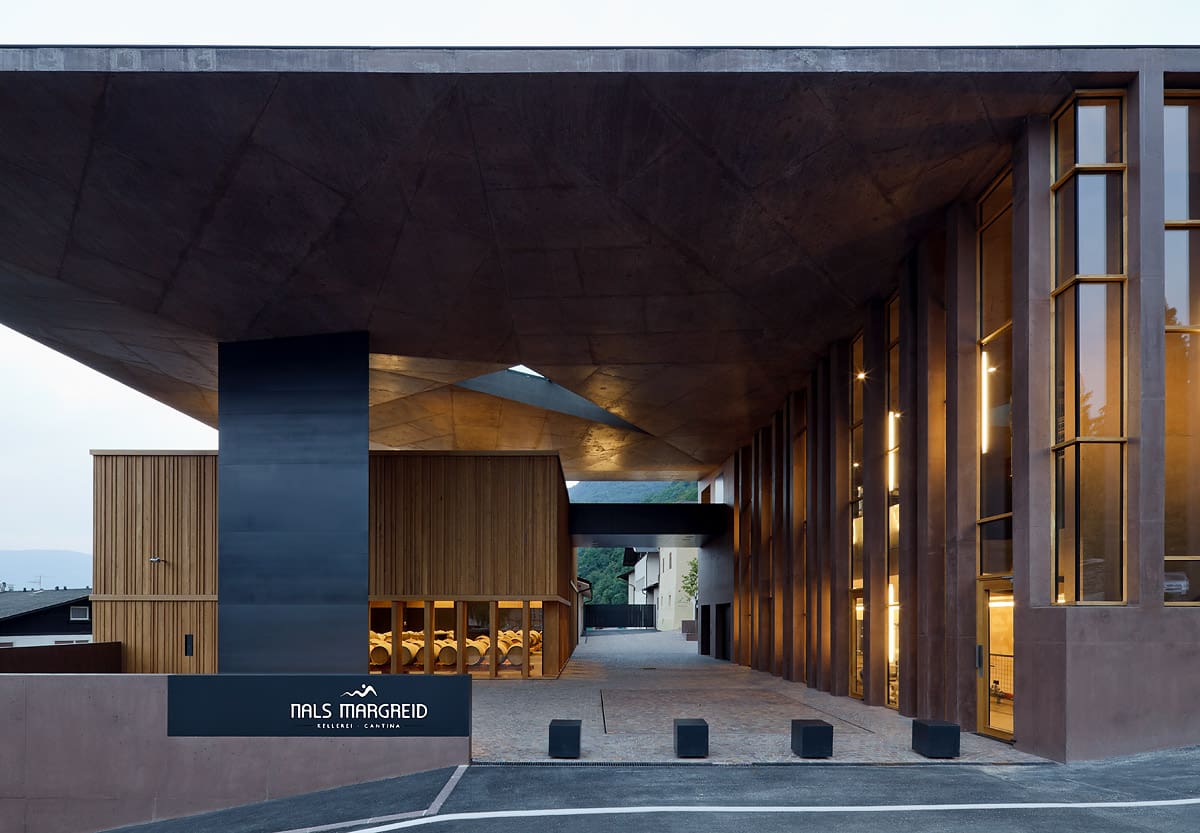
At the heart of the project lies the relationship between architecture and the winemaking process. From the earliest design stages, the development focused on a gravity-flow vinification system, designed to harness gravity during the transformation of grapes into wine while reducing mechanical handling. The structure was therefore conceived as a true production machine, built around the needs of both the wine and the people working in the cellar. The organisation of spaces naturally follows the production process, from grape reception through to ageing. The vinification tower represents the technical core of the building, while the Weinhof, the “wine courtyard”, serves as the winery’s operational and relational centre: a space dedicated to manual activities, hospitality, and the connection between people and production. The barrel cellar, built above ground and clad in oak wood, was also conceived through both functional and sensory considerations, introducing a solution that remains uncommon within traditional wine production. Transparency is another key element of the project: glazed surfaces, internal views and visual connections allow visitors to engage directly with the production process, transforming the winery into an open and shared environment. From the entrance onwards, visitors can look through the production areas, from the barrels to the ageing spaces, creating a visual continuity that accompanies them through the winery as participants in the process itself. This approach reflects the desire to create an “open winery”, capable of transparently showcasing daily work, production precision and the winery’s ongoing relationship with wine.
MATERIALS, LANDSCAPE AND HERITAGE RESTORATION
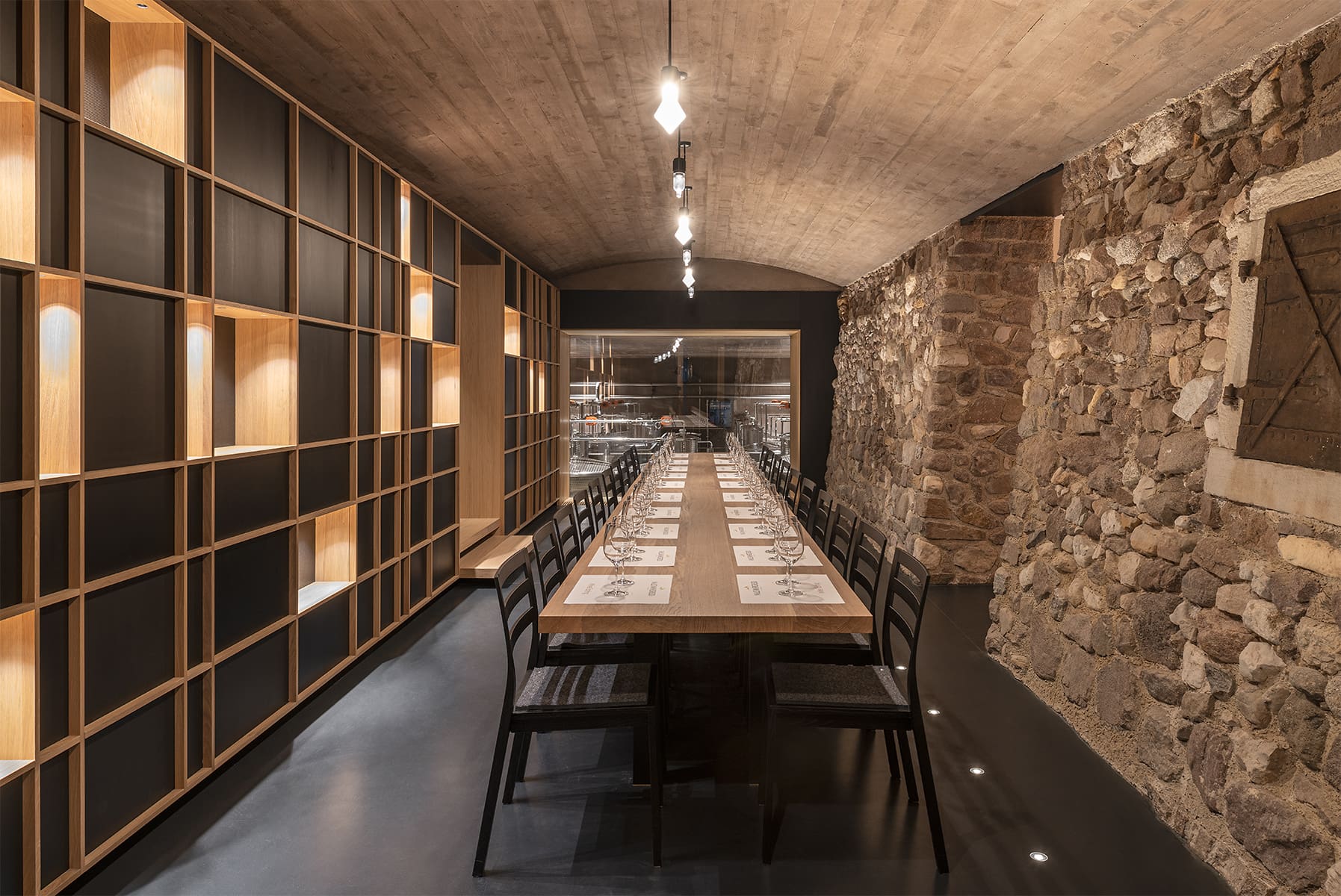
Alongside production functionality, the project carefully addresses its relationship with the landscape and the site’s historical memory. The building volumes follow the natural contours of the land and integrate into the environment through materials that directly reference the surrounding territory. Concrete pigmented with locally sourced porphyry aggregate reflects the characteristic colours of the area between Bolzano and Merano, while wood and glass contribute to an architectural language that is both essential and restrained. A key aspect of the project was the restoration of the historic Ansitz von Campi, an ancient farmhouse that forms part of the site’s architectural heritage. The building was integrated into the contemporary complex without altering its original character. This approach made it possible to maintain continuity between memory and innovation, enhancing the site’s historical elements while preserving its connection to the original rural setting. The project has established a continuous dialogue between historic architecture and the new spaces dedicated to hospitality, wine tasting and wine sales, preserving the site’s layered history and respecting the historical identity of the settlement. Over the years, the winery’s architectural project has received several awards for its ability to combine contemporary architecture, production functionality and landscape integration. In 2012, the winery was featured at the Venice Biennale as part of the international competition The Wine Cathedrals, receiving recognition in the Interior Design category. Today, the project stands as a tangible example of how architecture can help communicate the productive and cultural identity of a territory through balance, coherence and a meaningful relationship with the landscape.