From Silicon Valley to the VineyardFrom Silicon Valley to the Vineyard
By Angelo A. Camillo, PhD, June 1st, 2026 — Technology & Industry Analysis
A generation ago, investors poured billions into internet companies with no clear path to profit. AOL, Yahoo, Earthlink, and Hotmail dominated headlines. Then Google arrived and, within a decade, redrew the entire map. Today, the same pattern is emerging in artificial intelligence. The structural forces, the concentration of capital, the breathless valuations, and the unresolved business models all rhyme with 1998. But the ending will not be identical — and understanding the differences matters enormously for anyone deciding how much to invest, which platforms to trust, and where the real competitive advantages will land. What does this all mean for the global wine industry?
The Dot-Com Parallel: What Is Similar, What Is Different
The comparisons between the current AI surge and the late-1990s internet boom are not journalistic overreach. They are documented and structurally grounded. The NASDAQ soared 572% between 1995 and its March 2000 peak, then collapsed 78% by October 2002. Today, NVIDIA alone reached a $4.3 trillion market cap in early 2026, a number that dwarfs anything from the dot-com era. The five largest AI-adjacent companies now hold 30% of the S&P 500 — the highest market concentration in half a century. In late 2025, 54% of global fund managers surveyed said AI-related stocks were in bubble territory, and JPMorgan CEO Jamie Dimon publicly warned that some AI investments would be wasted.
The parallel, however, breaks down in one crucial place: today’s leading AI companies have real revenue, real products, and real enterprise customers. OpenAI counts 800 million weekly active users. Anthropic is forecasting $70 billion in annual recurring revenue by 2028. Microsoft, Google, and Amazon — the infrastructure layer beneath all of it — are highly profitable businesses whose AI investments are funded by operating cash flow rather than speculative capital. In 1999, Pets.com had none of those things.
The more accurate analogy is not a crash — it is consolidation. Academic research from MIT Sloan and the National Bureau of Economic Research finds that the economics of AI strongly favor concentration: computing, data, and engineering talent all exhibit massive economies of scale, creating a natural gravitational pull toward a small number of dominant platforms. Venture analysts at Asymmetric Capital Partners put it plainly: enterprise AI budgets will increase for a narrow set of products that clearly deliver results and decline sharply for everything else. The timeline most cited by analysts — explosive growth through approximately 2027, followed by a shakeout between 2027 and 2030 — suggests the industry is in the middle of the boom phase, not at its peak. Indeed, the AI industry rollout may not be too distant.
Winners, Losers, and Google Question
The companies best positioned for the consolidation phase share three characteristics: infrastructure control, ecosystem depth, and a profitable core business that can subsidize AI development through the transition. Google, Microsoft, and Amazon control the compute infrastructure that every AI model runs on, have the capital to sustain losses, and — critically — already have the enterprise relationships that make switching costs prohibitive. Google’s additional structural advantage is distribution: it controls the browser, the search engine, the email platform, and the mobile operating system that billions of people use every day. Several prominent analysts have predicted that by the end of 2026, Google will have overtaken OpenAI as the leading source of consumer AI engagement, not by building a better model but by embedding AI into surfaces people already occupy. That prediction, however, may be affected by currently unknown strategies of competitive players.
The companies at greatest risk are what researchers call undifferentiated model wrappers — products that are essentially thin interfaces built atop someone else’s foundation model. Research from Columbia Business School found that AI adoption alone is not a competitive moat. In markets with many similar adopters, widespread use of generative AI may erode differentiation rather than create it. If a product’s core value proposition is access to AI capabilities, and those capabilities get cheaper every quarter as open-source models improve, the business case deteriorates with them. This is the dot-com lesson that AOL and Yahoo learned: distribution advantage matters more than product novelty, and a better-integrated competitor will eventually outperform a faster-to-market one.
The risk is not total collapse. It is overcapacity followed by rapid, ruthless consolidation — and the survivors will be those with the deepest ecosystem integration, not the flashiest models.
The Advertising Question: Will AI Become Free?
The historical comparison to AOL, Yahoo, and Earthlink rests on a specific assumption: that AI platforms will eventually go free and ad-supported, just as early internet services did, and that the winner will be whoever masters advertising most effectively. The analogy is partially right but structurally limited by one critical economic difference. Every AI query has a real computational cost — GPU time, electricity, and memory bandwidth. Unlike a search result or a display advertisement, AI inference does not scale to zero marginal cost. This changes the sustainability calculus fundamentally.
The market is already splitting in response. OpenAI introduced advertising in ChatGPT for free and entry-tier users in early 2026. Anthropic, by contrast, ran Super Bowl advertising that appeared to mock the concept of AI-powered ads and confirmed there are no plans to follow suit. The emerging industry structure is a three-tier model: a free or ad-supported consumer layer used for distribution and data collection rather than profitability; a subscription tier for power users where consumer revenue is generated; and an enterprise API and contract licensing layer where the real money lives. McKinsey research notes that AI is turning software from a tool into a platform that performs work, and pricing is evolving accordingly — away from paying for access and toward paying for measurable outcomes.
The Wine Industry: A Convergence Opportunity
Within the broader AI landscape, agriculture occupies an unusual position. McKinsey estimates AI could create roughly $100 billion of value at the farm level and an additional $150 billion at the enterprise level across food production value chains. The wine industry sits at a particularly compelling intersection of that opportunity: it combines the physical complexity of large-scale agriculture with the brand, marketing, and distribution complexity of a global consumer goods business. AI can address both dimensions simultaneously, and the combination creates compounding advantages that most single-sector businesses lack.
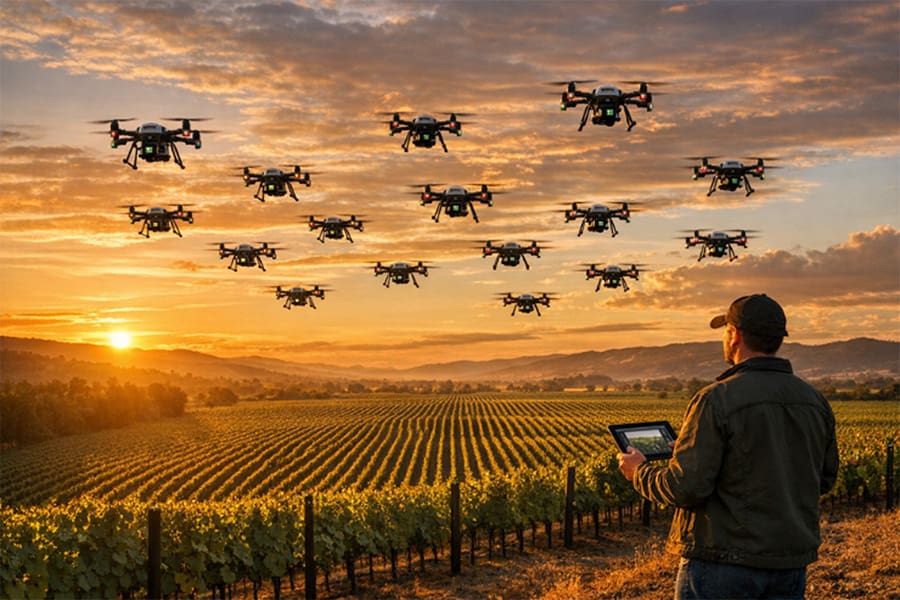
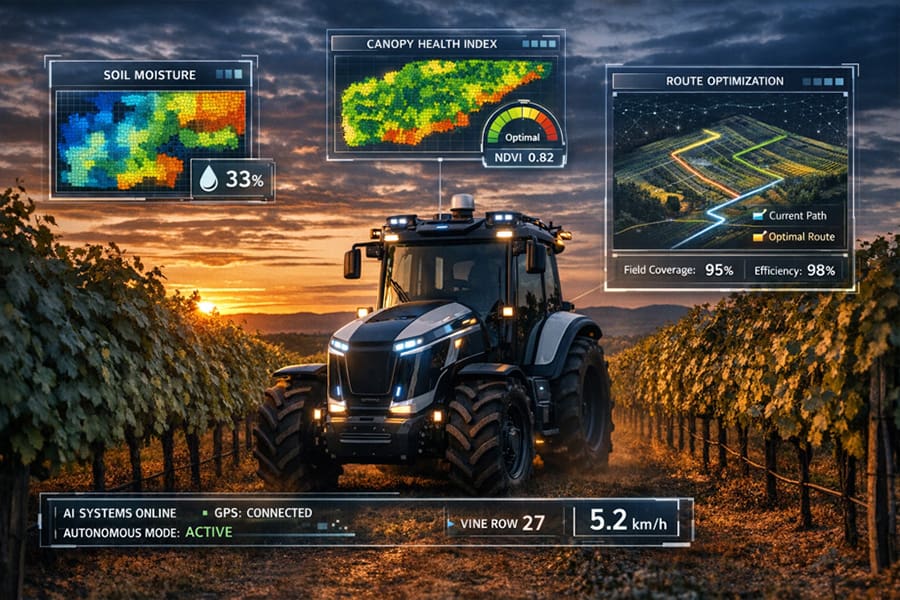
In the vineyard, drone and sensor technology backed by machine learning is already in documented use for canopy mapping, water stress detection, early disease identification, yield estimation, and variable-rate input application. The research literature on precision viticulture confirms that AI-driven models processing multispectral drone and IoT – M2M sensor data can monitor soil health, water stress, and canopy dynamics in near-real time, enabling targeted interventions that conventional scouting simply cannot match in speed or spatial resolution.
The staffing question around drone operations requires precision. Under FAA Part 107 rules governing commercial drone operations in the United States, a pilot or visual observer cannot participate in more than one drone operation simultaneously. A single certified operator cannot legally fly multiple drones simultaneously under standard rules without a waiver. The realistic picture for a 1,000-acre operation is not one person replacing twenty scouts — it is a small, AI-supported team of two to four operators accomplishing what previously required ten to fifteen full-time seasonal workers, while doing it faster, with greater spatial coverage, and generating data that accumulates in value over time.
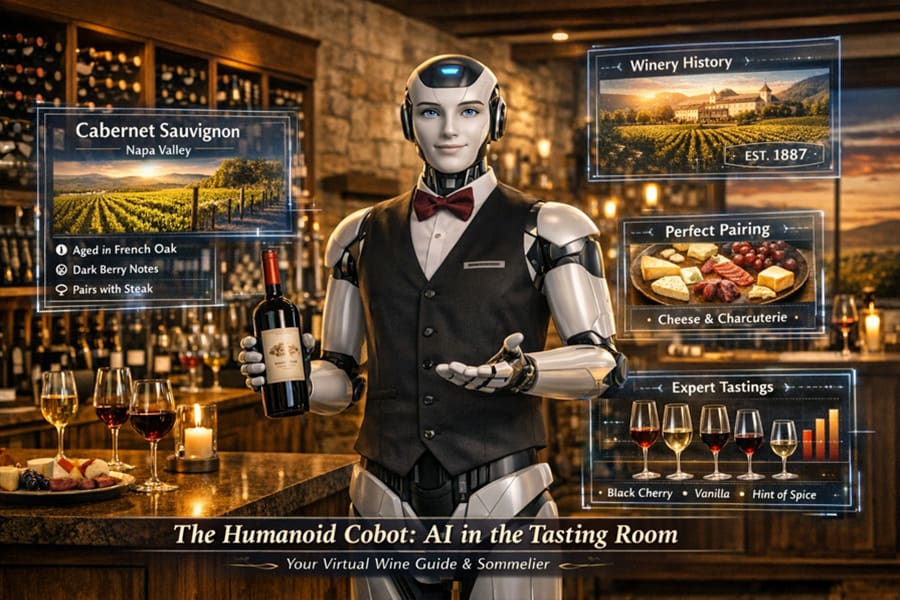
The Humanoid Cobot: AI in the Tasting Room
Beyond the vineyard, AI is beginning to reshape the visitor and customer experience in ways that will matter to producers with direct-to-consumer operations. Humanoid cobots — collaborative robots designed to work alongside humans rather than replace them — are entering hospitality environments as guides, educators, and brand ambassadors. A winery cobot stationed in a tasting room can deliver personalized wine history, varietal education, food-pairing recommendations, and winery heritage storytelling, drawn from a knowledge base that no human employee can match in depth or consistency. For wineries with high visitor volumes, this creates a scalable educational layer that enhances rather than replaces the human experience. In a way, we could infer that the wine industry is at a crossroads and a point of no return. Like when the MITS Altair 8800 was introduced in January 1975, the question soon became not whether a business needed a PC, but how many PCs it needed to run the operation.
The Strategic Conclusion: Data Is the Real Moat
Four conclusions emerge from synthesizing broad AI market research with evidence from the agricultural and wine industries. First, consolidation is coming and will be faster than most operators expect — two to five dominant platforms will capture most of the value in each AI category within five years. Second, free-and-ad-supported is not the dominant model; the marginal cost of AI inference makes the pure advertising play structurally difficult, and hybrid subscription and usage-based pricing will define the survivor landscape. Third, the dot-com crash comparison, while useful as a cautionary frame, misses the key difference: today’s AI leaders have real revenue, real infrastructure, and real enterprise dependency — the correction, when it comes, will look more like cloud computing’s consolidation than the NASDAQ’s 2002 collapse. Fourth, and most importantly for wine producers, proprietary data accumulated now is the competitive moat that will matter most when the platforms consolidate.
Google did not win by building the first search engine. It won by building the best one and then embedding it so deeply into how people find information that switching became unthinkable. The wine industry equivalent is not about purchasing the most advanced drone available today. It is about building the systematic data infrastructure — vineyard health records, microclimate sensor histories, customer purchase patterns, production performance data — that makes AI dramatically more effective for a specific operation over time. The window for first-mover data advantage is open now. History suggests it will not stay open indefinitely.
Sources
This AI-assisted analysis is compiled from the author’s own desk and field research and draws on research from McKinsey Global Institute, the National Bureau of Economic Research, MIT Sloan Management Review, Carlton School of Computer Science, Columbia Business School, EMARKETER, Sapphire Ventures, PwC, IoT Analytics, FAA Part 107 regulatory documentation, peer-reviewed viticulture literature (MDPI), and market reporting from Bloomberg and Goldman Sachs. All data reflects information available through May 2026. The validity and reliability of the secondary data rest with the sources from which it was obtained.
Angelo A. Camillo, PhD, is Associate Professor of Management and Wine Business at the Wine Business Institute and the Department of Management in the School of Business at Sonoma State University in Rohnert Park, California, in the heart of the Wine Country.
Dr. Camillo’s interdisciplinary research encompasses critical issues in international business, corporate social responsibility, competitive advantage, innovation, strategy, business policy, marketing, and technology across industries, with a focus on hospitality and the wine business in Europe, Australasia, and North America.
He can be reached at: camillo@sonoma.edu, https://business.sonoma.edu/about/faculty/angelo-camillo-phd