From the Supply Chain Pact to emissions reduction targets: Italy’s leading private wine group reports tangible progress across its value chain
May 18, 2026 (Milan, Italy) — Argea presents its new 2025 Sustainability Report – Habitat, the document that reports on the progress of the Group’s ESG journey across four pillars – Direction, Supply Chain, Land and Talent – and reaffirms the integration of sustainability into its business strategy.
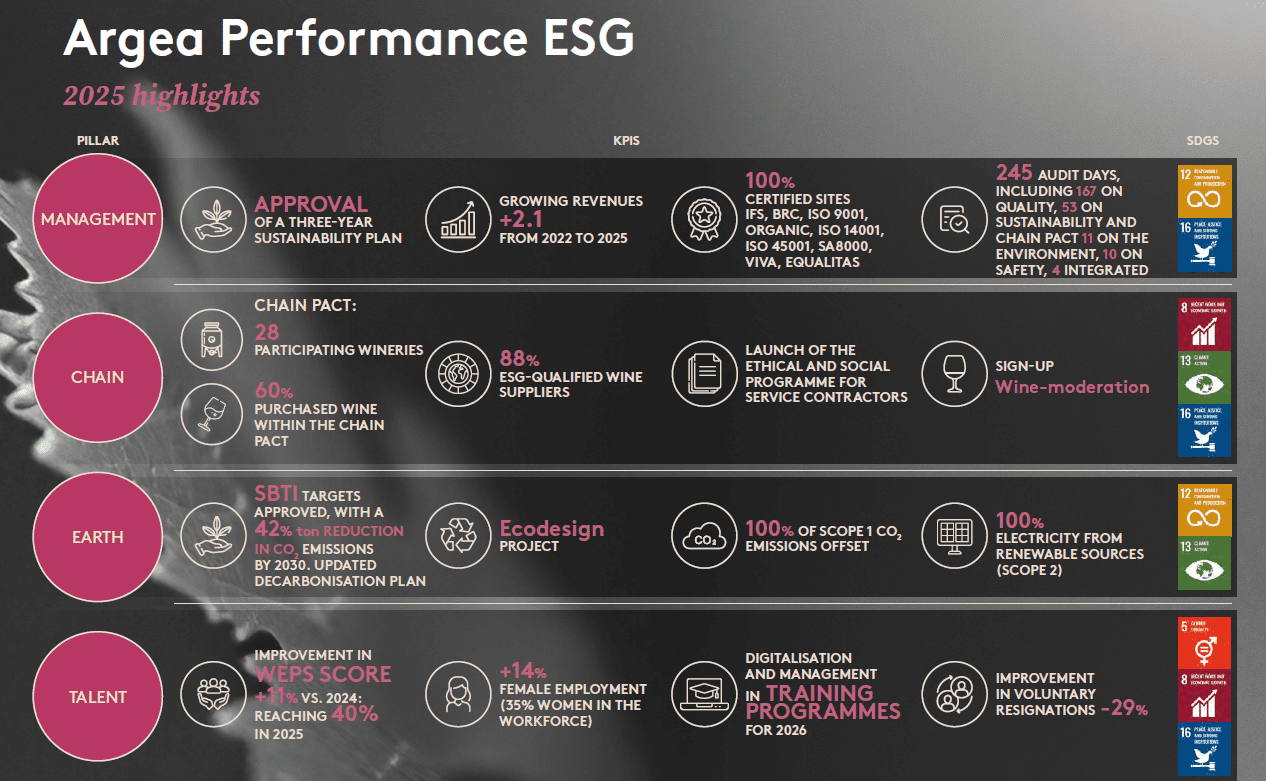
- In 2025, the Group strengthened its work across the supply chain: the Argea Wine Supply Chain Sustainability Pact now covers 60.5% of wine sourced from external suppliers, involving 28 wineries and 424 hours of audits. In addition, 88% of wine suppliers successfully completed the ESG qualification process, which assesses environmental, social and governance criteria.
- The Report also highlights progress in resource management: 100% of electricity from renewable sources, a reduction of more than 20% in waste generation, 89.3% of waste sent for recycling, and net water consumption reduced by approximately 24%.
- On the climate front, total emissions decreased by around 2.6% compared to 2024. Argea also obtained approval of its targets from the Science Based Targets initiative, committing to reduce emissions generated by business operations, purchased energy and the supply chain by 42% by 2030, and a Net-Zero target for 2050.
- Among the Group’s product-related initiatives, one of the most representative is Gualdo Romagna DOC Sangiovese Predappio Biosimbiotico by Poderi dal Nespoli – a practical example of biosymbiotic agriculture combined with ecodesign principles.
- 100% of Argea sites are now certified according to international standards for quality, occupational health and safety, environment, food safety and sustainability.
- From a social perspective, voluntary turnover fell to 5.2%, women now represent 34.7% of the workforce, and the WEPs score on gender equality increased from 36% to 40%.

“In a particularly complex context for the wine industry, marked by declining consumption, rising cost pressure, evolving consumption styles and growing attention to environmental impacts, Argea is consolidating its development model with data that relate not only to production sites, but to the entire value chain: vineyards, supplying wineries, suppliers, packaging, logistics, people and communities,” says Massimo Romani, CEO of Argea. “For Argea, sustainability means taking responsibility for the impact we generate and turning it into long-term positive value. With this objective, we have continued to reinforce our approach, keeping sustainability as a central axis of the Group’s industrial and strategic decisions. This Report is not a finishing point, but another step in an ongoing journey.”
A sustainability model for Italian wine
With Habitat 2025, Argea strengthens its positioning as an Italian wine group capable of combining industrial scale, strong territorial roots and increasingly rigorous impact measurement.
The Report outlines a model in which sustainability is not treated as a separate area from the business, but rather as an operational criterion running across the supply chain, production, packaging, markets, people and governance. An approach that views wine not simply as a product, but as a system of relationships between agriculture, enterprise, communities and shared responsibility.
“Talking about sustainability means making the traces of the way we do business legible: turning commitment into evidence, choices into results, principles into verifiable practices,” comments Michael Isnardi, Group QHSE & Sustainability Director at Argea. “In 2025, we worked to strengthen ESG governance, improve data quality, advance supplier qualification, pursue decarbonisation, and develop pilot projects capable of generating knowledge for the entire Group.”

DETAILS OF THE MAIN ESG INITIATIVES
Supply chain: a pact covering 60.5% of wine from external suppliers
Among the most significant achievements of 2025, the Argea Wine Supply Chain Sustainability Pact now covers 60.5% of purchased wine, involving 28 supplying wineries and 424 hours of audits.
Launched in 2023 with 24 wineries and expanded to 26 in 2024, the Pact is now one of the Group’s main tools for overseeing quality, traceability, safety, human rights, environmental standards and continuous improvement across the wine supply chain.
In 2025, 88% of wine suppliers successfully completed the ESG qualification process. This figure reflects the continued strengthening of a collaborative model based on dialogue, transparency and shared objectives, with particular attention given to the harvest period – the most critical and complex stage of the supply chain.
Climate: approved SBTi targets and emissions reduction
On the climate front, 2025 marked an important step: Argea received official approval of its emissions reduction targets from the Science Based Targets initiative – the international body that assesses the consistency of companies’ climate commitments with scientific evidence on climate change – with Near-Term targets for 2030 and a Net-Zero target for 2050.
The Group has committed to reducing absolute Scope 1, Scope 2 and Scope 3 emissions by 42% by 2030, compared with the 2023 baseline. These refer, respectively, to emissions generated directly by company operations, those linked to purchased energy, and those produced along the value chain, from suppliers to logistics. Argea has also committed to reducing Scope 1 and 3 FLAG emissions by 30.3%, namely those connected to agriculture, land use and the primary supply chain – areas of particular relevance for the wine sector. The plan also includes maintaining the procurement of electricity from renewable sources. By 2050, the objective is to achieve climate neutrality across the entire value chain.
In 2025, total emissions decreased by approximately 2.6% compared with 2024. Scope 3 emissions continue to account for more than 98% of Argea’s carbon footprint, confirming the central role of the supply chain in generating climate impact and the need to progressively involve supplying wineries, dry goods suppliers and logistics partners.
Environment: more recycling, less waste, lower water consumption
Environmental commitment also translates into more efficient resource management. In 2025, Argea reduced the total amount of waste generated by more than 20% compared with the previous year, while further consolidating its recovery and circularity model.
The share sent for recycling reached 89.3%, up from 77% in 2024 and now close to the medium-term target of 90%. The Report also highlights a significant improvement in water management: net consumption decreased by approximately 24% compared to 2024, reflecting tighter control over the use of resources throughout production processes.
The Group also confirms the purchase of 100% of its electricity from renewable sources, a choice adopted in 2022 and maintained in 2025 as part of its low-carbon transition pathway.
Materials and packaging: towards greater circularity
In 2025, the total volume of materials used by Argea amounted to 251,804 tonnes, with an overall recycling rate of 22.6%.
The Report highlights, in particular, the use of 62% recycled glass, the introduction of cork and aluminium closures containing 55% recycled components, and a recycling rate of 69.9%, driven primarily by the integration of recycled cardboard.
For Argea, the choice of materials is a strategic area of intervention, given its direct impact on indirect emissions, logistics efficiency and the sustainability of the finished product.
Ecodesign: Gualdo as a winegrowing laboratory
One of the most representative projects featured in the new Report is Gualdo Romagna DOC Sangiovese Predappio Biosimbiotico by Poderi dal Nespoli, a project that brings together biosymbiotic agriculture, wine production and ecodesign.
The wine comes from Italy’s first certified biosymbiotic district and from a 13.74-hectare vineyard planted mainly with Sangiovese in the Predappio subzone. The packaging has been redesigned according to circularity criteria, including the transition from a 540-gram bottle to a 300-gram bottle, reducing glass usage by 240 grams per bottle.
The redesign also involves the other packaging components: a label made with cellulose derived from grape-processing residues, recycled paper and FSC-certified paper; a natural beeswax-based capsule; and a microgranulated technical closure with a binder obtained from residues of the cereal supply chain.
The project was also assessed as part of a PRIN – Research Project of National Interest, conducted by a group of Italian universities led by the University of Chieti-Pescara, as a case study for the wine sector.
Responsible consumption: Wine in Moderation and No-Low Alcohol
The Report also highlights the evolution of the portfolio towards new consumption occasions. Argea supports the international Wine in Moderation programme – since 2022 through MGM and since 2024 as a Group – and integrates this commitment with research work on the No and Low Alcohol segments.
Following the presentation in 2024 of the Group’s first anthology of eight Italian no-alcohol wines, 2025 saw the addition of Tralcetto Sparkling no-alcohol by Zaccagnini and Brilla! no-alcohol. The path continues in 2026 with the new brand Angelow and entry into the Ready-to-Drink segment through a new range of products, including Brilla! Mimosa.
For Argea, this topic forms part of a broader vision of responsible consumption, aimed at offering different choices that align with evolving lifestyles and drinking habits.
People: stability, inclusion and safety
Argea recorded an improvement in employment stability. Voluntary turnover stood at 5.2%, down by almost 30% compared with 7.3% in 2024.
Women now represent 34.7% of the workforce, compared with 32.4% in 2024, while the Group’s WEPs Gender Gap Analysis Tool score – the international benchmark measuring the integration of gender equality policies within companies – increased from 36% to 40%.
In 2025, 3,853 hours of training were delivered, focusing on health and safety, internal training, and technical and operational skills.
Occupational health and safety remains a priority area. In 2025, Argea maintained both targets relating to injury indicators: a frequency rate of 6.85, below the target of 8, and a severity rate of 0.24, below the target of 0.25. No fatalities due to occupational injuries or diseases were recorded.
Certifications and audits
The Report confirms the Group’s certification pathway: 100% of sites are certified according to standards including IFS, BRC, ISO 9001, organic, ISO 14001, ISO 45001, SA8000, VIVA and Equalitas.
In 2025, 245 audit days were carried out: 167 in the quality area, 53 dedicated to sustainability and the Supply Chain Pact, 11 environmental audits, 10 in the safety area and 4 integrated audits. The quality system also recorded zero recalls for food safety, confirming the Group’s oversight of production processes and its commitment to consumer protection.
ABOUT ARGEA
Argea was established in 2022 following the acquisition of Botter by the private equity group Clessidra and the subsequent integration of Mondodelvino, creating the largest private wine group in Italy.
In March 2023 the Group further expanded with the addition of the wine assets of Cantina Zaccagnini. Argea brings together diverse companies within a shared project based on quality, development and sustainability, aiming to involve leading players in the Italian wine sector while preserving their identities as expressions of Italy’s finest winemaking traditions.
Argea was created with the ambition of becoming an accelerator for the Italian wine ecosystem worldwide. In line with this goal, in 2025 the company acquired WinesU, a historic US wine importer.
Today the Group exports a diversified portfolio of Italian wines to more than 85 countries, supported by a wide sales network in markets such as the United States, the United Kingdom, Germany and the Scandinavian countries, as well as regions with growing interest in Italian wine including China, South Korea and Canada.