A new partnership brings winemaking back to Pompeii for the first time in 2000 years
April 8, 2025 – For the first time in nearly two millennia, winemaking is returning to Pompeii. Tenute Capaldo Group and the Pompeii Archaeological Park have announced a new partnership to plant vineyards and build a fully operational winery within the ancient city. This initiative not only revives Pompeii’s viticultural heritage but also supports the preservation of the site’s legacy.
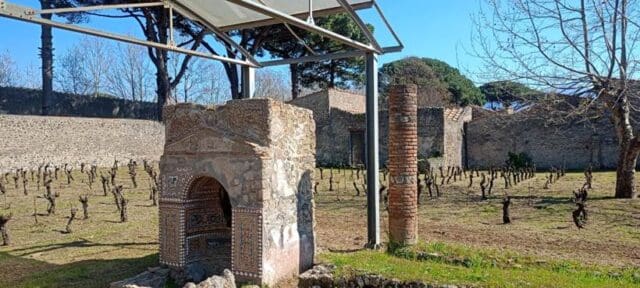
The project will establish a true “archaeological” vineyard, drawing on the agricultural expertise of Feudi di San Gregorio and the organic winemaking experience of Basilisco, both wineries under Tenute Capaldo Group. The new winery will be 100% organic and will rely on the guidance of Feudi di San Gregorio’s production manager and winemaker Pierpaolo Sirch, an internationally renowned agronomist. The initiative will also incorporate research into ancient vine-training systems and grape processing techniques in collaboration with Prof. Attilio Scienza of the University of Milan.
The new winery will feature vineyards spanning more than 15 acres, with winemaking and aging facilities to be built on-site and first harvest projected in 2025. Subsequent harvests will potentially yield one white and two red wines.
The land, untouched since the eruption of Mount Vesuvius in 79 AD, offers a unique opportunity to revive traditional viticultural practices. Currently, 3.7 acres were planted in the 1990s as part of an earlier project. The existing vines, averaging 35 years old, are primarily trained in the traditional goblet or bush vine training style. The focus will be on planting indigenous grape varieties and using a mix of historical vine training techniques best suited to the grapes and terroir.
Park Director Gabriel Zuchtriegel stated, “Since the 1990s, botanical studies have been conducted by the in-house Applied Research Laboratory of the Archaeological Park to analyze the vineyards of ancient Pompeii, in order to examine their historical and scientific characteristics, wine-growing techniques used in ancient times, and the population’s eating habits. Subsequently, the vineyards were enhanced with the aim of recounting the story of the ancient city and making it known from different aspects.”
Zuchtriegel continued, “Today, the Park is investing in a wider scope of enhancement as well as the conservation of the natural heritage, landscape, and environment that are essential features of the archaeological area. The winery is part of a broader archaeo-farming scheme that is also involving other activities such as the optimized cultivation of olive trees, and social farming projects within the framework of the “social and cultural farm.” Indeed, we firmly believe that the best way to achieve important results for the whole area is to involve private enterprises with specific expertise as active partners in the project.”
The archaeo-farming area will be open to tourists, featuring vegetable gardens, fruit trees, and vineyards that will be recreated after ancient Roman agricultural practices. This new immersive experience will allow visitors to explore how gardens and orchards were cultivated during the Roman Empire.
For almost 40 years, Feudi di San Gregorio has been actively engaged in the study and promotion of indigenous Campania grape varieties, including the centuries-old Taurasi vines of their Dal Re vineyard. This project aligns with their commitment to promoting the territory and supporting community development, a core value included in the company statute when it became a Benefit Corporation in 2021 and acquired its B-Corp certification in 2022. Indeed, the new winery in Pompeii will be strongly embedded in its territory culturally, productively, and socially, as the project will employ local community members.
President of Feudi di San Gregorio Antonio Capaldo stated, “As the Pompeii Archaeological Park is one of the most important cultural sites in the world and a fundamental pillar of our region’s identity, we are enthusiastic about this initiative and have put our skills at the service of the Park to develop together an innovative agricultural and agronomic project. We want to revive Pompeii not only as a place of research and knowledge, but also as a center of production and exchange, by restoring its historical roots.
“Of course, this will take time and significant investments, but this will not deter us; on the contrary, having the courage to embark on new journeys and looking at this ambitious historic project with new eyes unites our vision with that of the Park.
Capaldo finished by saying, “The approach chosen is strongly cultural and not speculative, with a long-sighted vision that goes beyond any immediate return in economic terms and consideration for future generations to come. It ensures a sustainable future for this extraordinary place. Moreover, it gives us the opportunity to continue to share with the world the millenary culture of winemaking.”
About Feudi di San Gregorio
Founded in 1986, Feudi di San Gregorio is the largest family-owned winery in southern Italy. Owned and managed by the Capaldo family, the estate has 740+ acres of vineyards cultivated across various high altitudes, soils, and exposures throughout Campania. Feudi di San Gregorio embodies the renaissance of wine in Campania and focuses on indigenous varietals, bringing a modern winemaking approach to native grape varieties such as Aglianico, Falanghina, Greco di Tufo, and Fiano di Avellino. Certified B-Corp since 2022, Feudi di San Gregorio is committed to long-term corporate, environmental, and social sustainability, helping to ensure a future for Campania’s unique viticultural heritage. For more information, visit www.feudi.it/en.