With its Vino Nobile di Montepulciano Pieve Le Grazie, the historic winery owned by the Jacorossi family interprets the Pieve project. It offers a new reading of the territory, centered on Sangiovese, zoning, and the estate’s distinctive vineyard characteristics
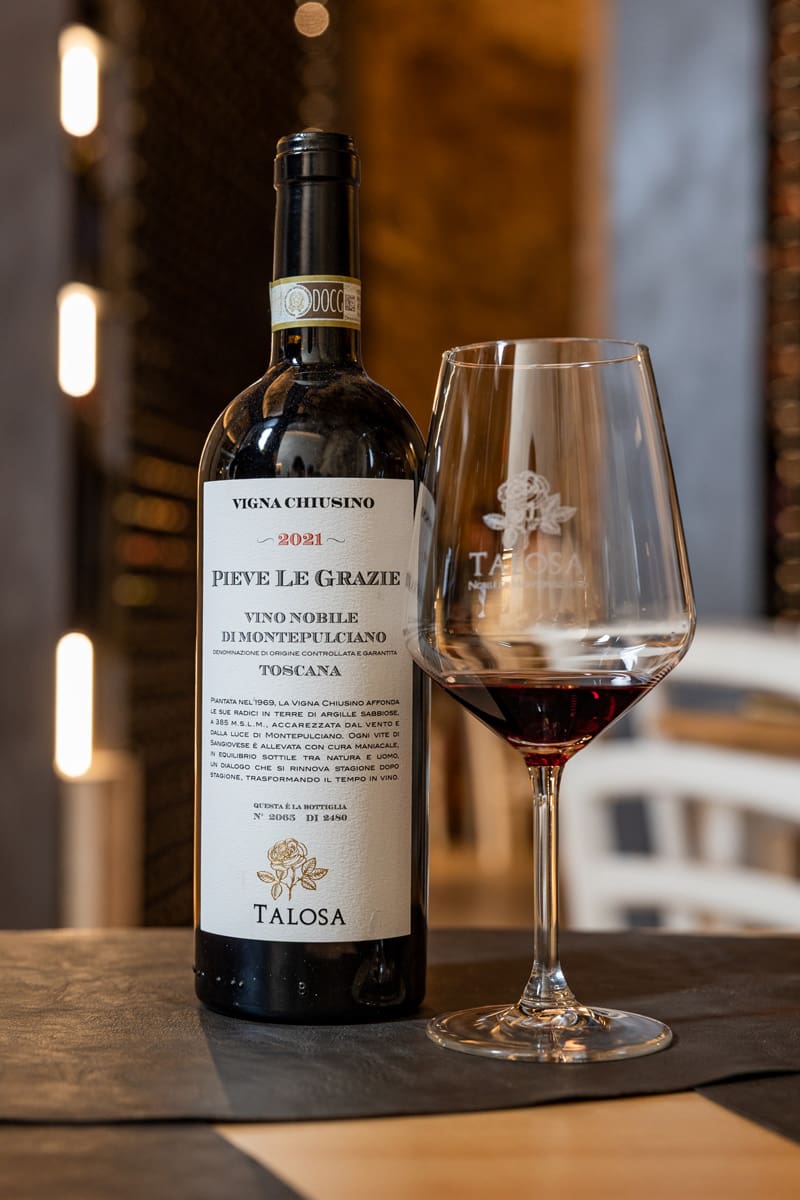
October 1, 2026 (Montepulciano, Italy) — The Pieve project marks the beginning of a new chapter for Vino Nobile di Montepulciano, offering a more precise interpretation of the different historic areas that make up the denomination. Within this framework, Talosa has focused on Pieve Le Grazie, the area to which the estate has long been connected and where the new Vino Nobile di Montepulciano Pieve Le Grazie finds one of its most representative expressions.
More than simply a geographical indication, the Pieve designation restores the provenance of the grapes—and the differences that define the Montepulciano territory—to a central role. Through the Pievi, Vino Nobile strengthens its connection to individual historic production areas, highlighting their soils, aspects, microclimates, and winegrowing traditions.
For Talosa, Pieve Le Grazie represents the culmination of a journey developed over time through studying its soils and vinifying individual vineyard parcels separately. The estate’s 33 hectares of vineyards are located in Pietrose, at elevations ranging from 330 to 400 meters above sea level, with predominantly south-westerly aspects. The vineyards grow on Pliocene soils, formed between five and 2.6 million years ago and shaped by the ancient sea, as shown by marine fossils still found among the vine rows.
The estate encompasses three main soil types: a predominantly clay-rich area, a transitional zone between clay and sand, and an entirely sandy area. This diversity allows Sangiovese to express different characteristics and has led Talosa to build its production model around an in-depth understanding of, and tailored management for, each vineyard.
“We strongly believe in the Pieve project because it allows us to convey the story of Vino Nobile di Montepulciano through the distinct identities that make up its territory,” says Edoardo Mottini Jacorossi, CEO of Talosa. “Pieve Le Grazie is the area where our vineyards are located and to which our estate is deeply connected. With this wine, we aim to express the character of Sangiovese with precision, as well as the relationship between our vineyards and the soils of this Pieve.”
Vino Nobile di Montepulciano Pieve Le Grazie is produced from grapes grown in Vigna Chiusino, the estate’s oldest vineyard, planted in 1969 on sandy-clay soils. This parcel embodies the vision behind the Pievi: letting a wine tell the story of a clearly defined place through the age of its vines, the composition of its soils, and how Sangiovese responds to the conditions of that specific area.
The grapes are hand-harvested and carefully selected. After vinification, the wine matures for two years in second-use tonneaux before being bottled for extended bottle aging. The restrained use of oak supports the evolution of the Sangiovese without overshadowing the vineyard’s character, encouraging integration of its tannic structure and the development of complexity.
In the glass, Pieve Le Grazie expresses the profile of Sangiovese from the Pieve Le Grazie area, with notes of sour cherry, violet and spice, a deep tannic texture and a freshness that supports its natural potential for longevity. Elegance, precision and the ability to evolve define a wine destined to stand at the pinnacle of Talosa’s quality pyramid.
The project forms part of the estate’s development over the past twenty years. In 2004, Talosa inaugurated its new winemaking facility opposite the vineyards, bringing together all activities related to vinification, maturation, bottling, bottle aging, and logistics. In the years that followed, renewal also extended to the vineyards through new plantings, the selection of clones and rootstocks, and increasingly precise vineyard management tailored to the characteristics of the soils and individual parcels.
Today, the estate’s internal zoning is a cornerstone of Talosa’s production philosophy. Grapes from different areas are handled separately to preserve their individual identities and determine the most appropriate maturation process for each wine’s characteristics. This approach keeps technique firmly in the service of the raw material and its origin.
Talosa’s history in Montepulciano began in 1972 with Angelo Jacorossi and continues today with the family’s third generation. Alongside the estate and its vineyards, the Historic Cellar, located in the center of Montepulciano, remains the symbolic heart of the winery. In the 16th-century underground cellars beneath Palazzo Tarugi and Palazzo Sinatti, just a short distance from Piazza Grande, Vino Nobile matures in large oak casks, preserving the connection between the denomination’s historic heritage and the contemporary work carried out in the vineyards.
About Talosa
The Jacorossi family has owned Talosa since 1972. It was among the first estates in Montepulciano to embark on a quality-driven path that helped elevate Vino Nobile di Montepulciano to the highest levels of Tuscan and Italian winemaking. Over the years, the winery has grown into an estate renowned for outstanding-quality wines. Talosa’s vineyards extend across 33 hectares in Pietrose, one of the most evocative areas of the Montepulciano cru, at elevations ranging from 330 to 400 meters above sea level and with a south-westerly aspect. Talosa’s oldest aging cellar is located in Montepulciano’s historic center, beneath Palazzo Tarugi and Palazzo Sinatti, built during the early decades of the 16th century opposite Montepulciano Cathedral. Entering Talosa’s Historic Cellar transports visitors back to the Italian Renaissance. Built entirely of brick, its tunnels unfold through a succession of vaulted chambers and niches housing the large casks used to age the wines.