June 24, 2025 (Japan) — The Kokushu Fair 2025, organized by the Japan Sake and Shochu Makers Association (JSS), was held in Osaka over two days on June 14 and 15. Kokushu refers collectively to sake, honkaku shochu, awamori, and other traditional Japanese alcoholic beverages that are born from the traditional knowledge and skills of sake-making with koji mold in Japan, which was registered in 2024 as a UNESCO Intangible Cultural Heritage. This year, the world’s largest sake event, the Sake Fair, held 16 times in the past, was integrated with the Honkaku Shochu & Awamori Fair, which has been running since 2022. This grand combined event featured 1,149 varieties of sake from 339 breweries across 45 prefectures, and 302 varieties of honkaku shochu and awamori from 65 companies across 12 prefectures—making it the world’s largest event of its kind.
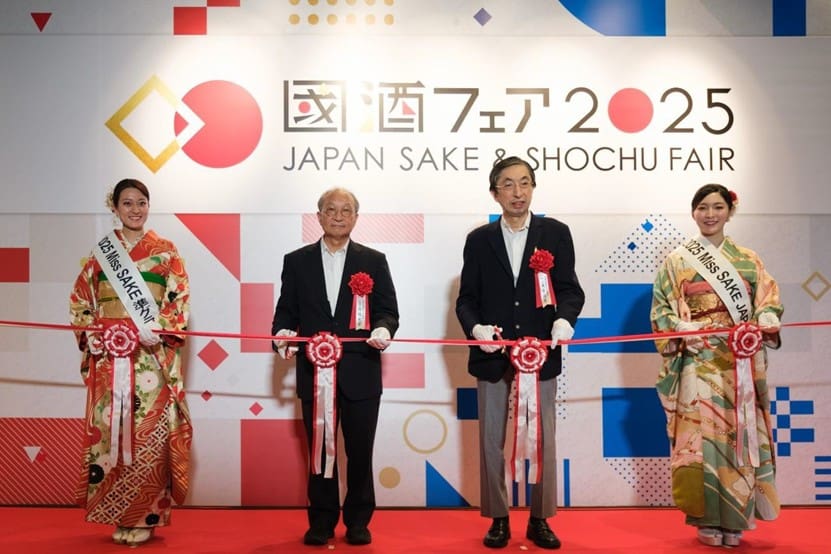
The JSS regards the Kokushu Fair as a crucial opportunity for producers to directly communicate with consumers about the current state of sake, honkaku shochu, and awamori. This year’s fair was held in Osaka in alignment with the ongoing 2025 World Expo. While the global alcohol market has stagnated in recent years, the sake industry has shown strong export performance. In 2024, sake exports amounted to ¥43.5 billion, totaling 3.45 million 9- liter cases across a record-high of 80 countries and regions, representing a 6% increase in value compared to the previous year. Moreover, from January to April 2025, export growth continued with a 15% year-on-year increase for the same period.
Mr. Naotaka Miyasaka, Overseas Sake Promotion Committee Chair at JSS, attributed this growth partly to the recent collaboration between JSS and the Association de la Sommellerie
Internationale (ASI) and the Union de la Sommellerie Française. These partnerships have successfully conveyed the appeal of sake through sommeliers worldwide. “There are tens of thousands of sommeliers globally, and their influence is enormous. Continuing to strengthen this initiative is essential to further expanding sake exports,” he emphasized.
Mr. Miyasaka also noted that the recent diversification of sake styles is a key factor enhancing the industry’s appeal. “Young brewers today are challenging traditional sake-making. While many once adhered to a uniform standard—for example, how much you polish Yamada Nishiki, the so-called king of sake rice—now we see breweries using local rice instead, or choosing to polish it less to highlight the flavor of the rice itself. Others are going in the opposite direction and polishing rice more than ever to express greater delicacy. We are also encountering new aromas resulting from unconventional choices of rice varieties and yeast strains. Sake is becoming more diverse. Its future looks very bright,” he said.
At the Kokushu Fair, booths representing breweries from 45 prefectures served 1,149 types of sake. Some booths even allowed visitors to purchase their favorite sake on the spot, a practice that was very well received.
Since honkaku shochu and awamori were integrated into the Sake Fair for the first time this year, their booths stood in contrast to the sake booths with a completely different design concept—resembling bars to convey the spirits’ emerging modern aesthetic. Historically, in hotter regions of Japan where rice could not be easily cultivated, people distilled other grains into honkaku shochu, which they often diluted with water and drank with meals as an alternative to sake. However, honkaku shochu is now gaining visibility as a modern spirit in the bar scene—not only served neat or on the rocks but also featured in cocktails crafted by bartenders and mixologists.
This year, the event featured winning cocktails from past Honkaku Shochu & Awamori Cocktail Competitions and six basic cocktails using different base ingredients. This lineup signaled a clear intent to evolve honkaku shochu from a local spirit into one beloved globally. Mr. Kohsuke Kami, Sub Committee on Shochu Promotion Committee Chair at JSS, remarked:
“Honkaku shochu can be made from a wide variety of ingredients such as sweet potatoes, barley, rice, or even buckwheat. Moreover, different koji strains (typically white or black koji, rather than the yellow koji used in sake), distillation methods, and aging vessels (tanks, earthenware jars, oak barrels) dramatically affect the flavor. This diversity is now drawing significant interest from overseas bartenders.”
On the other hand, both the sake and honkaku shochu industries are facing growing challenges in raw material supply. The sake industry is deeply concerned about rice cultivation. Since 2024, a supply-demand imbalance has caused the price of table rice to nearly double. Sake rice is harvested later, grows taller (making it more prone to lodging), and is more labor-intensive. It also often suffers from high grain shattering, leading to lower yields per area. These factors have traditionally justified higher prices for sake rice. However, the current surge in table rice prices has begun to surpass those of sake rice, prompting some sake rice farmers to switch to table rice cultivation.
Mr. Miyasaka warned:
“We are urging the government to implement emergency measures to stabilize prices and ensure long-term supply. The average age of rice farmers is now around 69, and many have no successors—largely due to lack of profitability. Unless we create a system where farming is profitable enough to attract successors, both rice cultivation and sake-making in Japan will collapse. This is an urgent issue.”
In the honkaku shochu industry, motogusare-byo, a root rot disease affecting sweet potatoes essential to imo shochu, was first reported in 2018 and has rapidly spread across Japan. Some major shochu producers were forced to scale back production.
Historically, sake and honkaku shochu have been made under a division of labor: farmers produce the ingredients, and breweries turn them into alcohol. These industries cannot survive without farmers. The JSS believes that boosting demand both in Japan and abroad— especially among consumers who value high-quality products—is essential not only for business, but also for sustaining and protecting the farmers who support the industry.
The Kokushu Fair provides a one-of-a-kind platform to experience quality sake, honkaku shochu, and awamori firsthand and to spread their appeal across the globe. Through such demand-generation activities, the JSS aims to bring the allure of Japan’s national drinks to the world.