In the Novare Valley, near Verona, the Bertani brothers produce a Riserva only in the finest vintages, born from a unique ecosystem combining a historic vineyard, woodland and waters of Roman origin
September 8, 2026 (Verona, Italy) — Tenuta Santa Maria, in the heart of Valpolicella Classica, is a historic estate deeply rooted in the territory and recognized as one of the most authoritative expressions of Amarone. Today led by the Bertani Brothers, it combines history, craftsmanship and agronomic research within a vision in which time and precision in the work define the identity of its wines.
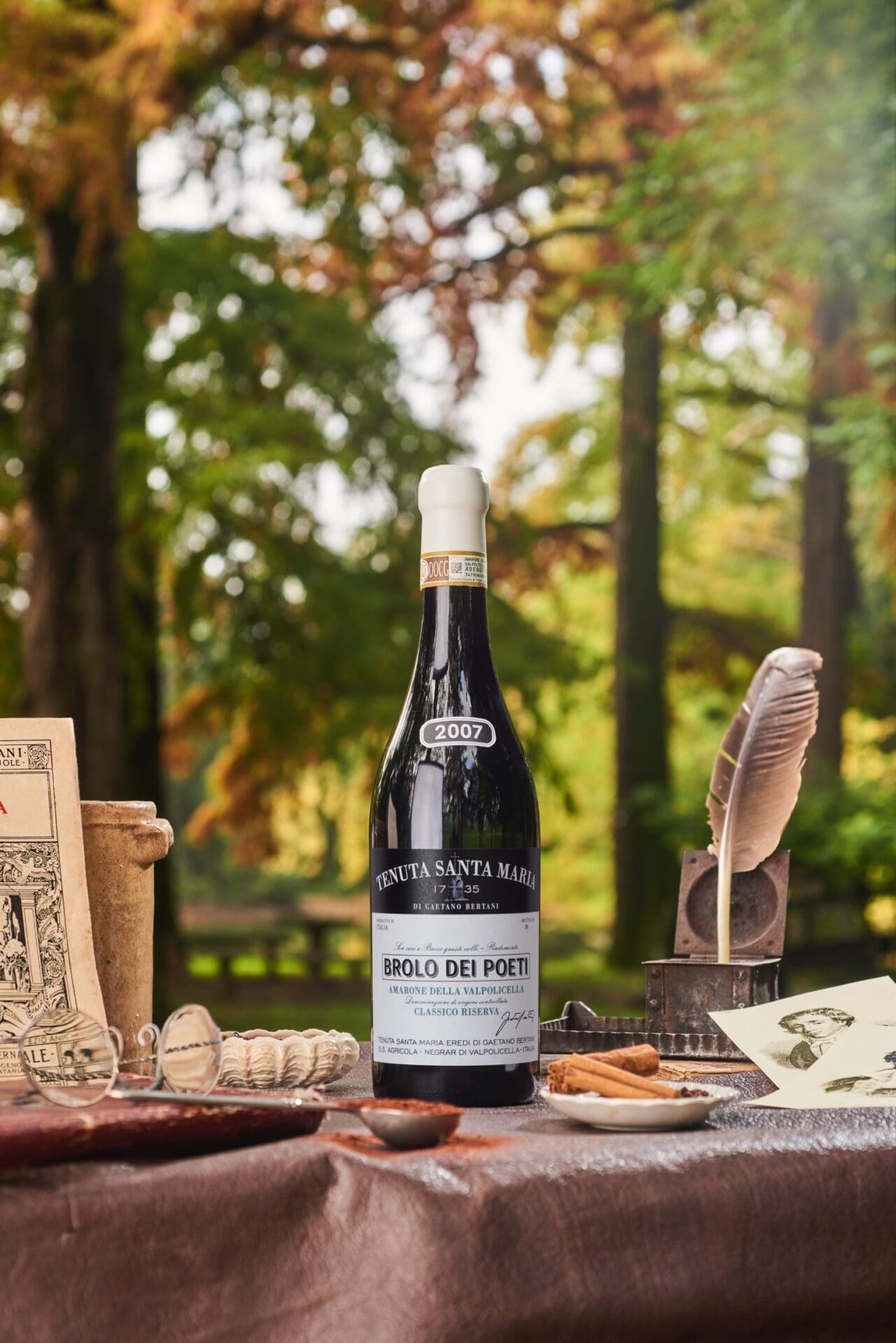
Brolo dei Poeti is Tenuta Santa Maria’s cru, originating from a place that is unique within the landscape of this territory. In Arbizzano di Negrar, Verona, a 3.5-kilometer wall has enclosed, since the 16th century, a self-sufficient agricultural system consisting of vineyard, woodland, a small lake and water from three springs of Roman origin, channeled through stone conduits that are still active today during the driest periods. Its name recalls the literary salon that Ippolito Pindemonte hosted in these places at the end of the 18th century, welcoming some of the most illustrious poets, artists and intellectuals of the time during the summer months. Within this enclosed space, a productive microcosm takes shape, in which soil, exposure and microclimate contribute to creating a precise identity. The vineyard, on calcareous marl soil with a south-eastern exposure and vines over 35 years old, is at the heart of a system that is not only agricultural but also part of the landscape, designed from the outset as a balance between function and form.
These plots give rise to Amarone Classico Riserva DOCG Brolo dei Poeti, produced only in the finest vintages and in extremely limited quantities, with fourteen years of aging in large Slavonian oak casks.
“Fourteen years in cask change a wine in a way that no other aging path can replicate. It is not a stylistic choice; it is what the Brolo requires, and we have followed this approach since the very first vintage,” says Giovanni Bertani. “It is a passage of time that can be perceived in the glass, in the wine’s aromatic depth and in the way it opens and evolves without ever losing its balance.”
Alongside this vision is that of Guglielmo Bertani: “Such prolonged aging allows a progressive integration of the wine’s components. Slow oxygenation in cask enables the tannins to relax naturally and the aromatic components to come together with precision. It is a process that requires constant control and great patience, but it results in a more measured Amarone, built on definition rather than concentration.”
The walled vineyard, developed between the 16th and 18th centuries, is one of the oldest examples in Italy of a vineyard landscape that has remained intact. The model recalls that of the clos of Burgundy: a perimeter that defines and protects an enclosed system in which soil, exposure, microclimate and an exclusive varietal heritage contribute to creating a precise identity of place that cannot be reproduced elsewhere. In Valpolicella, where Amarone is almost always produced from blends of grapes from different vineyards, a walled cru with its own clones and an independent production process remains an absolute rarity within the regional context. As early as the 19th century, the Brolo was the subject of an agronomic report by the Academy of Sciences and Agriculture of Verona, illustrated by photographer Moritz Lotze, documenting its early conversion to the high-density Guyot training system beginning in 1874, with a recorded density of approximately 5,900 vines per hectare.
At the heart of the vineyard is a proprietary clone of Corvina, selected from the oldest vines and preserved as an exclusive genetic heritage of the Estate. Unlike the more widespread clones in Valpolicella, which tend to express a marked cherry character, this clone is distinguished by a subtler and recognizable aromatic profile: notes of strawberry and raspberry that form a precise signature, found as a common thread in all the wines originating from the Brolo. Alongside Corvina, the vineyard also includes Rondinella, Oseleta and other indigenous varieties of the territory.
The Brolo also includes an area of woodland, helping to recreate a complete ecosystem in which vines, water and vegetation define a distinctive agronomic and environmental balance.
The harvest is carried out by hand and is among the earliest in Valpolicella: an intentional agronomic choice that preserves the natural acidity of the grapes and contributes to creating the fresh, mineral profile that distinguishes the wine. The grapes are dried in the historic fruttaio on cane racks, with natural ventilation, for approximately three months. The long aging in cask accompanies a slow and continuous evolution, based on a process of progressive oxygenation that allows the tannins and aromatic components to integrate deeply. In the glass, the wine shows a deep garnet-red color, velvety tannins and a complex profile of warm spices, cocoa, tobacco and ripe fruit, supported by a mineral freshness that extends its persistence.
An Amarone that builds its balance over time, rather than through concentration. The first vintage of the cru was 2007, followed by the 2010 vintage. Since then, Brolo dei Poeti has been produced only in exceptional vintages, from a selection of the finest and highest plots of the vineyard, in extremely limited quantities. Every bottle is numbered. Brolo dei Poeti is the estate’s Amarone that completes fourteen years of ageing in cask, ideally reconnecting with the historic signature of the original Amarone of the 1960s, vinified to preserve freshness, tension and precision. This is a choice that Tenuta Santa Maria has maintained consistently even during the years when the general trend in Valpolicella moved towards wines made from more concentrated and prolonged grape drying, often accompanied by more pronounced residual sugar. Only 3% of the Amarone produced in Valpolicella carries the Riserva designation: a figure that measures the selectivity of this category, produced only when the vintage truly allows it.
More than a wine, Brolo dei Poeti represents a complete idea of territory and time. In it, the vision of the Bertani Family takes shape in a precise and coherent form, in which landscape, agronomic knowledge and the measured value of waiting converge in an Amarone capable of expressing one of the most rigorous and recognizable interpretations of Valpolicella Classica.
About Tenuta Santa Maria
Tenuta Santa Maria is one of the oldest and most significant wine estates in the Valpolicella region. Located in Arbizzano di Negrar, in the heart of the Valpolicella Classica area, its monumental winery and 22-hectare walled vineyard form a unified and historic production estate whose origins date back to the 16th century. It was in this very winery that, in 1936, Amarone took shape as a dry wine, a pivotal moment that continues to inform the estate’s style and production philosophy today. The estate is currently managed by brothers Giovanni and Guglielmo Bertani, who carry forward the work begun by their father, Gaetano, continuing a tradition built on precision in the vineyard, grape drying in the historic drying lofts, and long ageing periods. Production is divided between the estate in Negrar and the property in Colognola ai Colli, in the heart of the Soave DOC area.