The summer programme that brought the Guardians of the Mediterranean Diet to the stage
comes to a close on Thursday, 27 August at the Paideia Campus, in the Castello dei Principi Capano.
The Paideia Campus of the Future Food Institute Foundation and the Municipality of Pollica, together with its “Angelo Vassallo” Mediterranean Diet Study Centre, join forces to enhance gastronomic heritage as cultural infrastructure and a strategic asset for the future of the territory.
August 21, 2026 (Pollica, Italy) — This Thursday, 27 August, the 2026 edition of Trame Mediterranee – Teatro Gastronomico comes to a close. The cultural format is promoted by the Paideia Campus of the Future Food Institute Foundation together with the Municipality of Pollica and curated by journalist Yuri Buono. A month of encounters and conviviality has transformed the Castello dei Principi Capano into a stage dedicated to the people, products, landscapes and knowledge that keep the Mediterranean Diet alive.
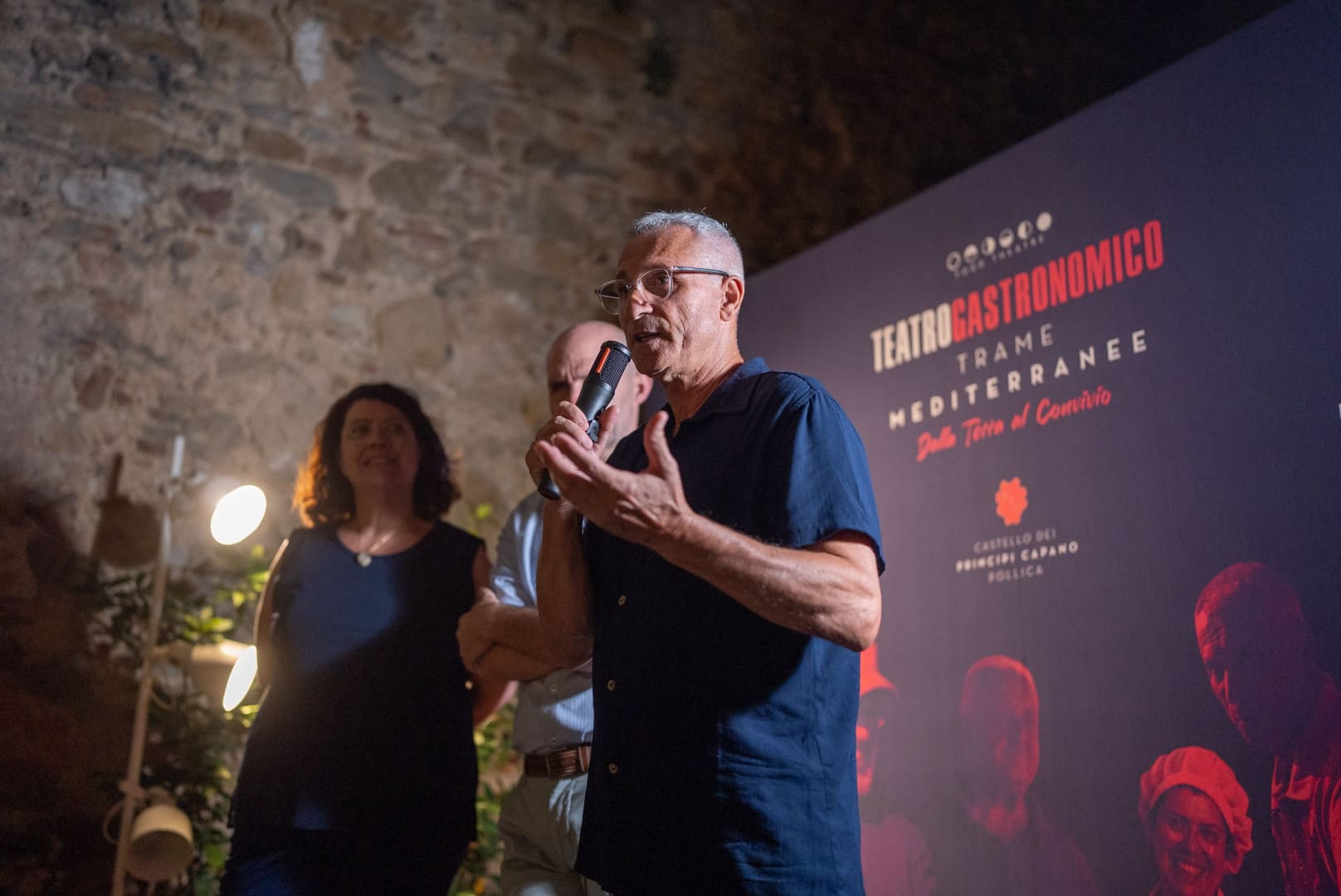
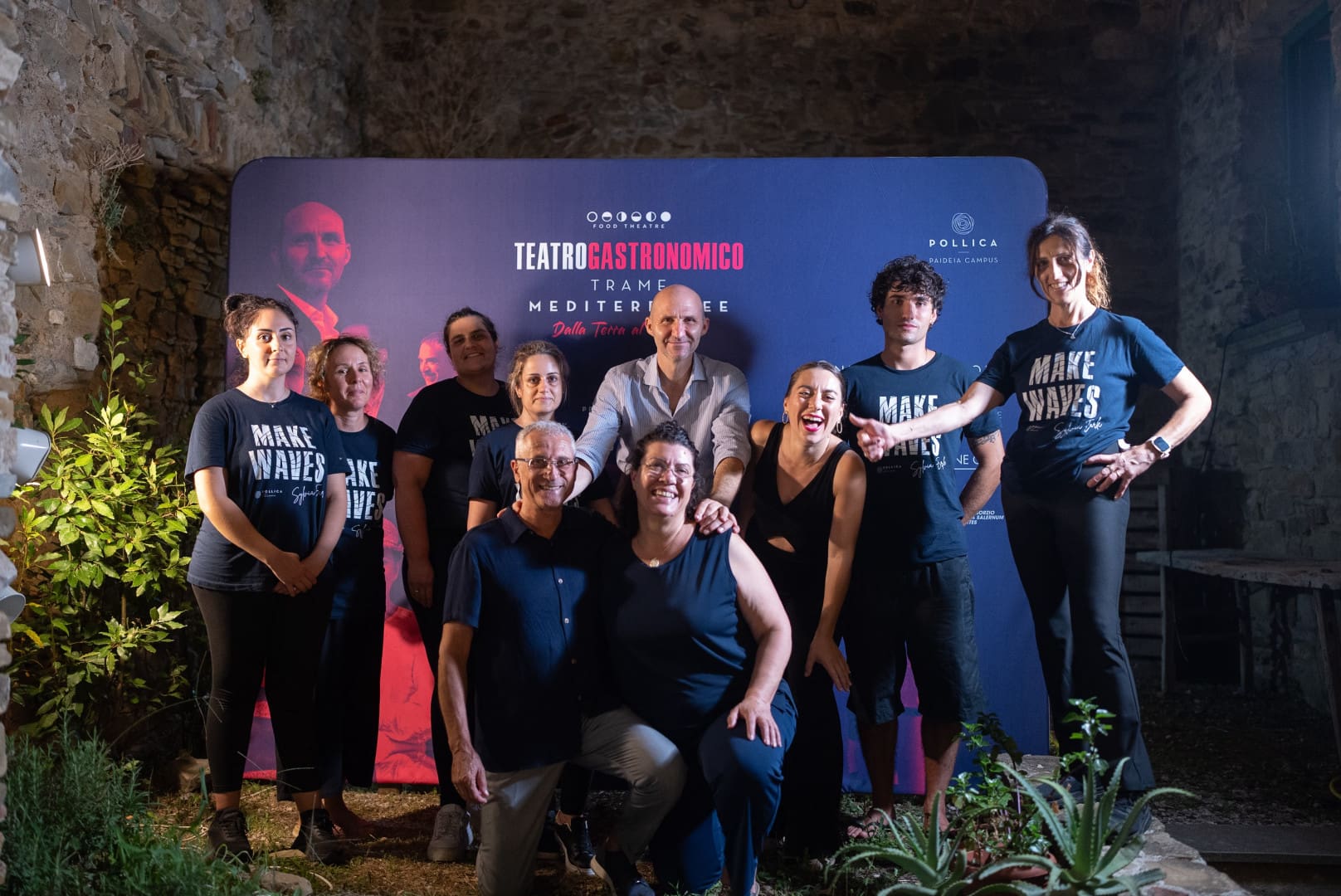
The project is part of the ongoing work of the Paideia Campus of the Future Food Institute Foundation and the Municipality of Pollica through its “Angelo Vassallo” Mediterranean Diet Study Centre, a socio-cultural hub active throughout the year at the Castello dei Principi Capano. Here, heritage, education, research, training and community engagement come together in a continuous programme. Trame Mediterranee is one of the most visible expressions of this shared work: not an isolated event, but a stage in a process that brings together culture, schools, the local area, relationships and opportunities.
At the heart of the UNESCO Emblematic Community of the Mediterranean Diet, Trame Mediterranee has created a collective narrative of Cilento through theatre, public engagement, music, memory and tasting. More than a food and wine festival, it has been a cultural experience in which food became a way to understand the territory, build relationships between generations and restore value to those who safeguard the Mediterranean biocultural heritage every day.
THE GUARDIANS OF THE TERRITORY TAKE CENTRE STAGE
The protagonists of the programme were farmers, livestock breeders, fishermen, winegrowers, producers and food artisans: true architects of the landscape and contemporary interpreters of centuries-old knowledge. Alongside them, chefs, artists, musicians, communicators and local communities brought a gastronomic theatre to life, where every ingredient became a story and every shared table a space for encounter.
The journey explored some of Cilento’s most representative heritage: goats and dairy traditions, the Cicerale chickpea and wild herbs, ancient grains and organic farming, mozzarella nella mortella, local botanicals, native grape varieties, the White Fig of Cilento and artisanal honey, Menaica anchovies and sustainable fishing, through to extra virgin olive oil. Giving a face and voice to this story were Annacarla Tredici, Giovanna Voria, Edmondo Soffritti, Silvia Chirico, Danilo Porro, Marco Serra, Beppe Cilento, Pasqualino Volpe, Donatella Marino, Vittorio Rambaldo and Piero Matarazzo, together with the grandmothers of Pollica and the Cilento producers who took part in the final convivial gathering.
THE CASTELLO DEI PRINCIPI CAPANO: A PERMANENT SOCIO-CULTURAL HUB
The venue itself is part of the project. The Castello dei Principi Capano, home to the Angelo Vassallo Mediterranean Diet Study Centre since 2011, has hosted the Paideia Campus since 2021, a permanent socio-cultural hub: a vibrant space lived by the community, where heritage, history, education, traditions, research, art, technology, generations and experimentation meet every day. The Campus works continuously with local schools, the Italian education system and international innovation networks, developing pathways and residential projects that connect young people, teachers, researchers, institutions and communities.
At the same time, it is a gateway to the world and a place of permanent connection: the joint work of the Paideia Campus of the Future Food Institute Foundation and the Municipality of Pollica connects the deeply local dimension of the Mediterranean Diet with national and international programmes, expertise and conversations, fostering learning, innovation, cultural production and new opportunities for the territory over time.
Trame Mediterranee embodies this public-private-territorial alliance in action: public heritage becomes a community space and cultural platform; local knowledge meets research and innovation; producers and citizens are not simply the recipients of a programme, but active participants in shaping it.
GASTRODIPLOMACY AS A STRATEGIC ASSET OF THE PAIDEIA CAMPUS
Within the cultural framework of the Paideia Campus, Gastrodiplomacy is a permanent area of work. For years, the Campus has developed programmes, training pathways and opportunities for dialogue together with institutions, universities, international networks and United Nations multilateral agencies, using food as a universal language to build relationships, dialogue and cooperation among territories, cultures and generations.
The table thus becomes an educational and civic space; conviviality becomes cultural infrastructure; the producer becomes a bearer of knowledge; and the landscape becomes a common good. Gastrodiplomacy makes it possible to connect the deeply local dimension of the Mediterranean Diet with some of the major contemporary challenges — peace, health, climate, biodiversity, migration, identity and international cooperation — transforming the gastronomic experience into a tool for mutual understanding, listening and bridge-building.
From this perspective, Trame Mediterranee is one of the public expressions of work that the Paideia Campus carries out throughout the year: not simply celebrating the Mediterranean Diet, but keeping it alive as a system of knowledge, relationships and practices capable of nurturing communities, generating culture and opening the territory to new connections and opportunities.
A PARTNERSHIP INVESTING IN THE FUTURE
The 2026 edition consolidates the shared path between the Paideia Campus of the Future Food Institute Foundation and the Municipality of Pollica’s “Angelo Vassallo” Mediterranean Diet Study Centre, continuing to nourish the territory with ideas, relationships and new connections. This work brings longevity, integral ecology, education and culture into dialogue to build bridges, strengthen the sense of community and generate new opportunities, especially for local young people. In this vision, culture is a space for encounter and continuous growth, capable of nurturing local energies and opening them to the world.
The programme also benefited from the collaboration of the Consorzio Tutela Vini Salerno, which supported the narrative around local wine production and native grape varieties, and from the contribution of experts from ONAV – National Organisation of Wine Tasters and ONAF – National Organisation of Cheese Tasters, strengthening the path of knowledge and informed appreciation of local products.
“Trame Mediterranee tells the story of what we have been building in Pollica for years together with the Municipality extremely well,” says Sara Roversi, President of the Future Food Institute Foundation. “It is a place where culture, education, heritage and community become concrete tools for regeneration. Here we develop international Gastrodiplomacy programmes because we believe food is one of the most powerful languages for building dialogue, trust and cooperation. But everything begins with the people who keep this heritage alive every day: farmers, fishermen, livestock breeders, producers, artisans and communities. For us, gastronomy is not simply an experience to consume: it is a cultural and educational tool capable of connecting biodiversity, health, landscape, identity and the local economy. This is exactly what Trame Mediterranee is about: starting from a table in Pollica to tell the story of a territory and build the future.”
The summer season of Trame Mediterranee comes to a close on 27 August, but the journey does not end there. From Pollica, a packed international agenda will begin, through which the Teatro Gastronomico will continue to bring the stories, knowledge, producers and heritage of the Mediterranean Diet to the world. This journey, developed jointly by the Paideia Campus of the Future Food Institute Foundation and the Municipality of Pollica’s “Angelo Vassallo” Mediterranean Diet Study Centre, will begin in New York at the end of September, during the week of the United Nations General Assembly and Climate Week, and continue with numerous international events through 16 November. On that very day, at the United Nations Headquarters in New York, the first International Day of the Mediterranean Diet will be celebrated: a symbolic and tangible milestone that will once again bring Pollica, its territory and its guardians into a global conversation. Trame Mediterranee therefore closes not with the end of a programme, but with the consolidation of an ongoing process that continues to recognise, connect and enhance the people who safeguard the Mediterranean, transforming local knowledge into bridges, relationships and opportunities for future generations.