On the Tuscan coast, Caiarossa brings together Bordeaux winemaking culture, Mediterranean vitality and a biodynamic philosophy to create wines of depth, brightness and contemporary elegance
August 10, 2026 (Tuscany, Italy) — On Tuscany’s western coast, between the rolling hills of Riparbella and the Tyrrhenian Sea, Caiarossa offers one of the most distinctive interpretations of contemporary winemaking. Its identity is rooted in a unique meeting of worlds: on one side, the Bordeaux tradition of blending, meticulous parcel selection and attention to detail; on the other, the vibrant energy of a Mediterranean landscape shaped by the sea, rich biodiversity, native scrubland and an extraordinary diversity of soils.
Caiarossa is not an attempt to recreate Bordeaux in Tuscany. Instead, it is an estate that transforms French precision into a distinctly Mediterranean expression. It is precisely this balance between discipline and vitality, structure and freshness, method and landscape that defines the winery’s unique style.
Founded in 1998 at Podere Serra all’Olio, just a few kilometres from the coast and surrounded by Mediterranean woodland, Caiarossa embraced biodynamics from the very beginning—not simply as an agricultural practice, but as a holistic philosophy governing the relationship between people, vineyards and nature.
A defining moment in the estate’s history came in 2004, when it was acquired by Eric Albada Jelgersma, owner of Château Giscours, the renowned Grand Cru Classé estate in Margaux. From that point onward, Caiarossa entered into dialogue with a winemaking culture deeply rooted in Bordeaux—one based on observation, precision, an intimate understanding of each vineyard parcel, and the art of crafting blends capable of expressing depth, balance and identity.
Today, Caiarossa is part of AJ Domaines, the Albada Jelgersma family’s wine group, which also includes Château Giscours. While the two estates remain firmly rooted in their respective terroirs, they share the same philosophy: wine should never be the result of a formula, but rather the authentic expression of a place interpreted with rigour, sensitivity and continuity.
In Riparbella, however, this technical heritage encounters a landscape profoundly different from Bordeaux. Here, the climate is brighter and more breezy, the influence of the sea is ever present, Mediterranean vegetation surrounds the vineyards, and biodiversity becomes an essential part of the estate’s identity. Precision therefore never translates into rigidity; instead, it is shaped by light, wind, soils and the vibrant energy of the Tuscan coast.
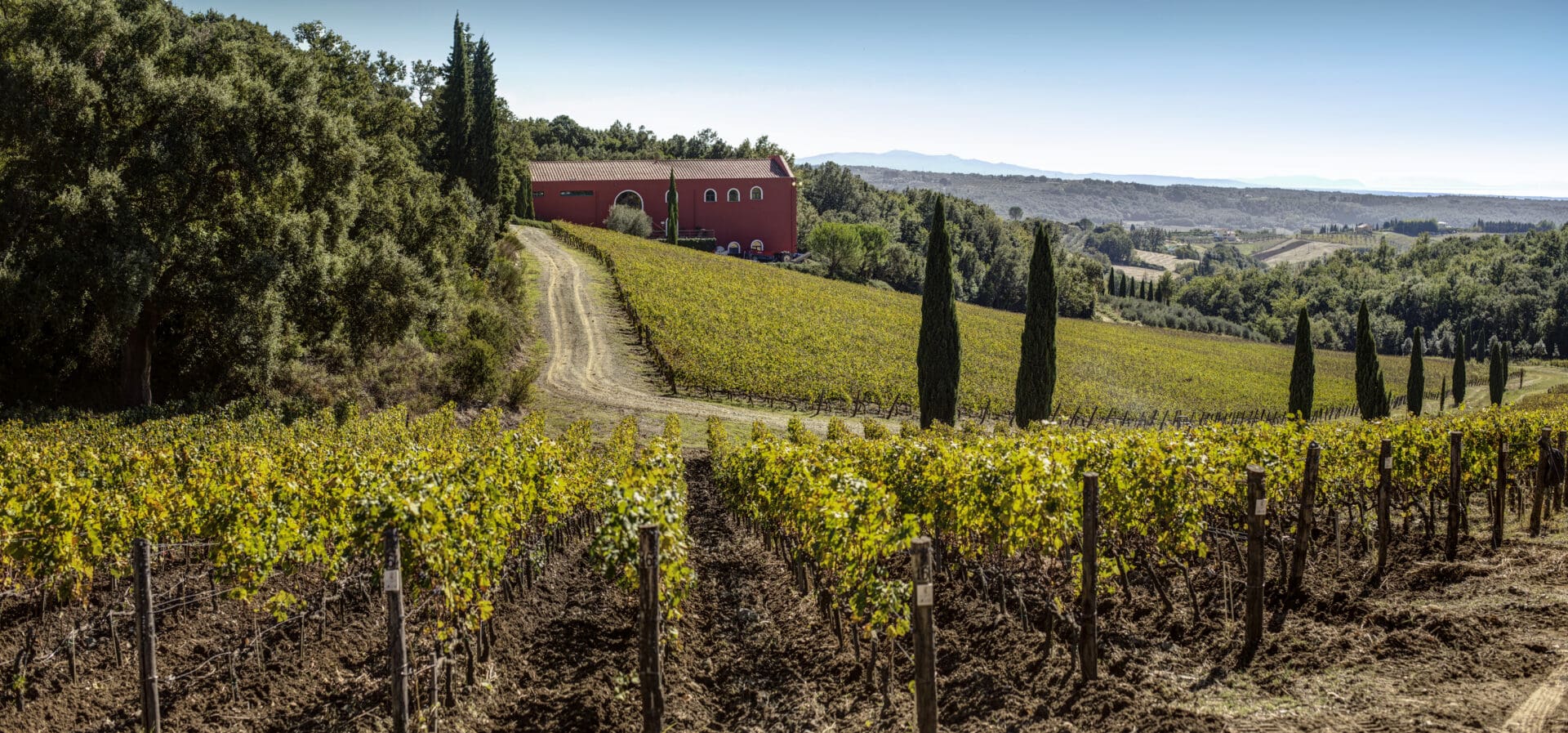
The estate extends over approximately 110 hectares, including 40 hectares of vineyards, 33 hectares of woodland, 31 hectares of flowering meadows and 6 hectares of olive groves. Its production area is a mosaic of 59 individual vineyard parcels, ranging from 120 to 350 metres above sea level and spread across three main sites: Podere Serra all’Olio, Le Lame/Val di Cecina and Nocolino. The diversity of soils, exposures and microclimates allows each parcel to be interpreted individually, contributing to the remarkable complexity of the wines.
It is precisely this diversity that makes Caiarossa unique within the Tuscan Coast appellation. The estate cultivates ten grape varieties—Cabernet Franc, Syrah, Cabernet Sauvignon, Merlot, Sangiovese, Petit Verdot, Chardonnay, Viognier, Vermentino and Petit Manseng—not according to a predetermined formula, but through a careful reading of each individual parcel. Every variety is planted where it can best express its own character, contributing to blends that are layered, harmonious and deeply rooted in their place of origin.
This ability to interpret diversity clearly reflects Caiarossa’s Bordeaux heritage: in the precision of vineyard establishment, the parcel-by-parcel approach to vineyard management, the meticulous attention to detail and the pursuit of structural clarity. Yet it is not methodology alone that defines these wines. Coastal Tuscany adds a more open and dynamic dimension: the sea, the intense light, the marked day-to-night temperature variations, the rich biodiversity and the surrounding Mediterranean landscape all contribute freshness, energy and remarkable aromatic depth.
Biodynamics is one of the cornerstones of Caiarossa’s identity. Since its foundation, the estate has embraced a holistic approach that respects the entire ecosystem, avoiding chemical fertilisers and pesticides, producing its own compost, applying biodynamic preparations, and working in harmony with nature’s rhythms.
A diverse mix of cover crops—including fava beans, clover, mustard, oats and barley—is sown between the vineyard rows to improve soil structure and encourage biodiversity. The estate’s beehives complete this natural balance, supporting pollination and contributing to the overall vitality of the environment.
As Technical Director Francesco Villa explains: “Our work is first and foremost about listening: to the vineyard, to the vintage and to every single parcel. The structural approach may reflect a Bordeaux philosophy, but here it is shaped by the sea, the light and the Mediterranean climate. What we seek is balance: precision without rigidity, expression without excess.”
This balance also stems from the continuous dialogue between Italian and French expertise. Caiarossa’s technical team works alongside consultants from Bordeaux, whose contribution enriches the estate’s knowledge and experience. The objective is not to transfer a model from one region to another, but rather to create a conversation between two wine cultures: on one side, the analytical rigour and blending discipline of Bordeaux; on the other, the vitality of the Mediterranean and the expressive energy of the Tuscan landscape.
As Jérôme Poissons, who embodies this French perspective, observes: “What makes Caiarossa so compelling is not its ambition to reproduce Bordeaux, but to reinterpret its discipline within an entirely different landscape. The Mediterranean brings movement, openness and a more instinctive dimension. It is a dialogue between two cultures.”
It is in this convergence—rather than in contrast—that Caiarossa has forged its own distinctive identity: where rigour meets naturalness, depth meets light, and French precision encounters Mediterranean energy.
ABOUT CAIAROSSA
The energy of nature gathers strength and shelter near the medieval village of Riparbella, on the Tuscan Coast. Lush vegetation, fruit trees, olive groves, vegetables and aromatic plants together paint the colours, aromas and wonder of a unique landscape: the very place where Caiarossa was born. By day, a magical light created by the sun’s reflection on the distant sea; by night, a vast star‑studded sky. The sense of enchantment is profound, embracing the winery itself, red like the earth’s core, set on the south‑west slope of the hill. It was in 2004 that Eric Albada Jelgersma decided to acquire an estate in this special corner of Italy, bringing with him the experience he had developed over the years in Bordeaux with Château Giscours, the renowned winery in the Margaux appellation. Eric Albada fell in love with this small yet beautiful estate, nestled in the Mediterranean scrub on the western side of a hill overlooking the sea. Today, his children Dennis, Derk and Valérie continue in their father’s footsteps, pursuing ever greater precision in the production of the wines, in a deep connection with the rhythms of nature, which is why the estate has followed the principles of biodynamic agriculture since its inception, with the aim of enhancing the vitality and resilience of the soil. The wines of Caiarossa are unique: refined blends that emerge from a balance between experimentation and harmony. A sense of equilibrium that offers a virtuous interpretation of the territory, through a French lens.