Deploying field pilots worldwide, now subsidized by NASA and U.S. National Science Foundation
April 23, 2026 (Rochester, NY) — Advanced Growing Resources (AGR®) has developed a solution that diagnoses and prescribes treatments for all common crop afflictions over a week earlier than current methods, enabling the transition from sample-and-wait with labs to scan-and-act in the field. AGR’s intelligence layer provides agronomists with defensible, efficient prescriptions to protect against the rising cost of treatments and fuel.
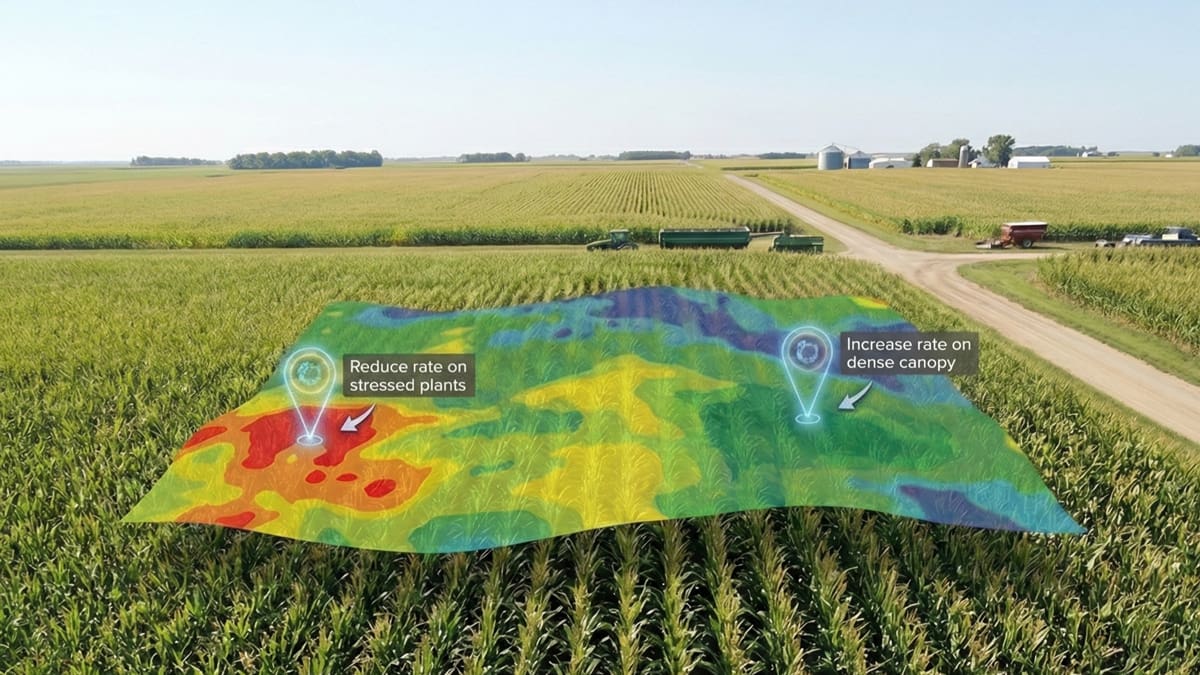
Although the entire team has a background in agriculture, AGR interviewed over 100 crop experts to understand the difference between operations that survive and those that thrive. They discovered that size does not matter – but efficiency does. That insight inspired AGR to guide field scouting using AI-assisted satellite imagery that spots crop afflictions before they are visible to the naked eye or standard vegetative indices. After pinpointing problems, AGR brings the lab to the field with their Spectre® handheld scanners that leverage thousands of trusted agronomy publications into a single database. Combined with proprietary chemical signature data, AGR has achieved 99% accuracy in controlled field trials. By calculating return on investment (ROI) to determine the exact amount of chemical before it is loaded, AGR ensures that nothing is wasted when treating crops.
Francis Pellegrino, the company’s founder and CEO, insists that agronomists and farmers remain the experts in their fields. “Everyone we have worked with already knows where their blind spots are.” Pellegrino said when asked about AGR’s mission. “What they don’t have is a way to spot trouble early enough to weigh costly decisions, and prescriptions that consistently produce a positive return. We built AGR to close that gap.”
From farmers to high-quality retail, prominent leaders across the food supply chain have already cemented AGR’s reputation as the crop ℞ company. In fact, AGR was recently ranked in the top 1% of American deep technology innovations after securing $2M in contracts and grants led by NASA and the U.S. National Science Foundation. Pellegrino, however, insists that overnight successes are just as big of a myth in technology as they are in farming. “I have been working on this problem for more than half of my life, so we feel blessed to have brought together the best farming engineers from across the globe including some of our own family and friends”.
AGR is in it for the long haul and has its sights set on a sustainable future. According to the UN Food and Agriculture Organization, crop production must increase by 70% over the next 30 years to feed a global population of over 10 billion people. As the workforce ages and farmland dwindles, efficiency is the only feasible path. By putting power back into the hands of those who need it most, AGR proves that the most impactful solutions do more than save money – they preserve the land’s ability to produce with more efficient chemical application.
After developing their solution alongside Cornell CALS, Virginia Tech’s extension, and the University of Rochester’s Institute of Optics, AGR is now offering field pilots covering more than 1,000 afflictions across corn, soybeans, wheat, cotton, grapes, and oranges with 12 more crops in their pipeline. Pilots are currently available in the United States and Australia with subsidies pre-applied for the first 25 operations in each country.
Learn how to See the Invisible® by scheduling a demo on your own fields with AGR’s founders at www.agrsensors.com