Bourgogne, 9 November 2026 – The year 2026 will go down in the history of Bourgogne. 2026 is the earliest vintage ever recorded in Bourgogne. Harvesting began as early as 8 August in the Mâconnais for Crémant de Bourgogne, following unprecedented weather conditions (see page 3).
Although heat and drought have reduced yields, quality looks promising. Initial tastings reveal wines of remarkable aromatic purity, bursting with flavour and already displaying a fine balance.
White wines
The white wines stand out for their roundness and suppleness. Their aromas are clear-cut and complex, with yellow-fruit notes of pear and peach. In some areas, exotic hints of mango or pineapple emerge.
On the palate, fresh-fruit flavours and fine balance preserve a welcome freshness.
Already expressive, these wines should be enjoyable in their youth.
Red wines
Winegrowers across the region agree: the reds are magnificent. They combine intensity and aromatic richness with harmonious structure and beautifully maintained balance.
The excellent ripeness of the grape skins contributed to the wines’ deep, intense colour right from the start.
The aromatic profiles, sometimes spicy, evoke dark fruits (blackcurrant, blackberry, blueberry, black cherry and fresh fig), without veering into cookedfruit notes, as the summer heat might have led us to fear.
On the palate, lively acidity and fully ripe tannins underpin harmonious structure and excellent balance.
Crémant de Bourgogne
The 2026 vintage offers generous, expressive and well-structured potential. Despite high levels of ripeness, acidity has preserved a welcome freshness in the base wines. Their profile combines length on the palate with ample structure.
Nevertheless, the distinctive character of this vintage calls for particular expertise to achieve the right balance and turn this natural richness into sparkling wines of precision and elegance. Reserve wines from 2024 and 2025 could prove valuable in adding complexity and freshness, while reinforcing the consistency and identity of future blends.
Weather conditions during the 2026 vintage
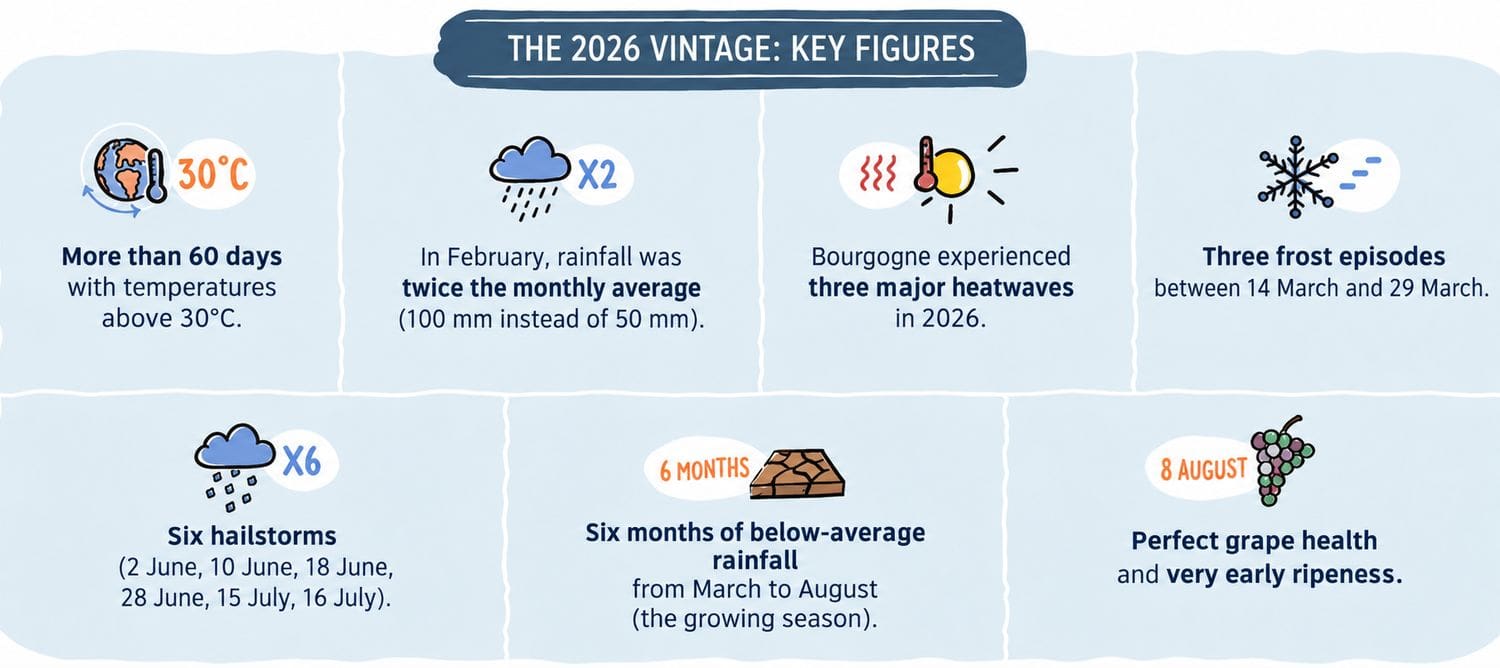
Could 2026 be the coolest vintage of the next 100 years? No one can say. For now, it is certainly the hottest ever recorded in Bourgogne. The vines endured several heatwaves, with around 60 days exceeding 30°C.
Fortunately, water reserves built up over winter generally enabled the vines to withstand these conditions until harvest. Another advantage was that the weather severely limited disease development, leaving the harvested grapes in impeccable health.
Nevertheless, these conditions affected the growing cycle and yields: ripeness came well before the 90 to 100 days after flowering typically observed in the past, while juice yields were disappointing. We look back at a year unlike any other, in which adaptability was the watchword for Bourgogne winegrowers.
A very mild winter replenishes soil water reserves
Overall, winter was very mild, with temperatures close to or slightly above normal. Between October and February, rainfall was considerably higher than average. This replenished soil water reserves, proving beneficial to the vines later on, particularly during the summer drought.
Early budburst under threat from frost
High temperatures and heavy rainfall in February prompted an early resumption of growth from midMarch. The average date for the half-budburst stage was 28 March, close to that observed in 2020.
As budburst progressed across the different vineyard areas, several frosts caused occasionally severe but highly localised damage. Côte d’Or was affected overnight on 22–23 March, followed by the rest of Bourgogne between 26 and 29 March. Temperatures fell to -5°C in the north of the region. Chablisien, Grand Auxerrois and Châtillonnais were hardest hit, with damage approaching 80% in some plots.
Rapid growth in heat and sunshine
In April, the vines developed rapidly. With almost summer-like temperatures and below-average rainfall, vines produced one or two new leaves per bud each week. The wind helped keep conditions generally dry, already restricting the development of fungal diseases.
By late April, the vines had reached an average of six unfolded leaves, with clusters clearly visible. The vintage was estimated to be nearly 20 days ahead of the average for the past two decades, already making it one of the earliest on record.
In early May, cooler weather slowed growth somewhat. On 6 May, some hail damage was observed in southern Mâconnais and along the Côte and Hautes-Côtes de Beaune. Leaves bore the brunt of the damage (perforations), while damage to the flower clusters remained generally limited thanks to the small hailstones.
The cooler spell was short-lived: temperatures began to rise again from 19 May. A dome of hot air over Western Europe brought temperatures above the seasonal norm.
Flowering at remarkable speed
Under these almost summer-like conditions, the first flowers appeared on 22 May. The half-flowering stage was reached in just a few days, with flowering dates converging across the different vineyard areas. The average half-flowering date was 27 May, similar to 2020 and 2022.
Temperatures soared across France, and the vineyards experienced unprecedented heat for this time of year. According to Météo-France, 25 May was the hottest May day recorded since 1947, with a national mean above 24°C and local peaks close to 35°C. Combined with still-cool soils, this heat brought exceptionally rapid flowering throughout Bourgogne.
By early June, berries were clearly visible in the earliest plots, already measuring 2–3 mm, while flowering was only just ending in the latest ones. Winegrowers welcomed the abundant fruit set, which at that stage suggested promising harvest potential.
On 2 June, a violent storm struck Côte d’Or and northern Côte Chalonnaise, causing highly variable damage, with up to 80% of clusters affected in some places. The Côte de Beaune was hardest hit. More storms followed in June and July, over six in total, with varying consequences and more than 90% of clusters affected in some areas.
At the same time, winegrowers observed significant coulure, particularly in white grape varieties. The resulting yield losses could be considerable. Combined with the dry weather, this gradually raised concerns about the rest of the growing season.
Heatwaves quicken the pace still further
In June, berry development continued at a fairly rapid pace, while vine growth remained particularly vigorous.
From 17 June, the first heatwave settled over France. Temperatures rose across Bourgogne, with weekly averages around 8°C higher and maximum temperatures almost 10°C higher than the previous week. Highs frequently exceeded 35°C, locally reaching nearly 39°C in the shadeWork in the vineyards was physically demanding. Nights remained relatively mild, however, with lows often between 17 and 22°C.
With virtually no rain and exceptional sunshine of nearly 13 hours and 30 minutes a day, the effects of this heatwave intensified. Vegetative growth accelerated, while evaporation from soils and leaves increased.
Soils dried out after four consecutive months of below-average rainfall (-50% in April, -17% in March, -15% in May and -39% in June). Sunburn and then water-stress symptoms appeared in some plots, particularly those with shallow soils, grass cover, young vines or the greatest exposure.
The first berries began to change colour in late June, confirming just how exceptionally early the vintage was.
July was likewise dry and hot. Lack of rain and very high temperatures slowed véraison (the onset of ripening). Water shortages restricted berry development, sometimes bringing it to a halt: although rapid colour change had been expected, by mid-July some plots still showed no signs of véraison.
The weather then became unstable, with several thunderstorms. Although rainfall varied greatly from place to place, these storms helped berry development resume across much of the vineyard. However, sunburn and water-stress symptoms remained clearly visible in the most vulnerable plots.
As ripening began, the vineyards were exceptionally healthy and free from disease. Encouraged by the promising quality, winegrowers were simply waiting for rain to fill out the berries with juice and prevent ripening from stalling.
Harvesting begins as early as 8 August!
The long-awaited rain never arrived, and successive heatwaves continued. Ripening suddenly accelerated in early August, with sugar levels rising rapidly.
This triggered the harvest: the first grapes for Crémant de Bourgogne were picked on 8 August in Mâconnais, followed by Côte Chalonnaise on 11 August, Côte de Beaune on 12, and Chablisien on 13. The harvest for still wines got properly under way after 15 August. Picking dates were difficult to set for individual plots because conditions varied so widely. Ripeness checks, berry tasting and measurements of sugar levels in the juice were crucial. Each grower had their own strategy, with the last estates still harvesting well into mid-September.
Conditions were extremely challenging for pickers, with temperatures peaking above 35°C. Winegrowers favoured night harvesting for machine-picked grapes and very early starts for hand picking.
The harvested berries were in perfect condition but small. The crop was healthy and, surprisingly, contained few shrivelled berries, which were sorted out before the grapes entered the winery. Juice yields, however, were very disappointing in view of the number of clusters, explaining a harvest well below average.
Fermentation began quickly thanks to the continuing warm weather and unusually high sugar levels. The grapes’ full ripeness and excellent health allowed for whole-cluster fermentation, which also brought freshness to the wines. Winemakers carefully monitored fermentations, which could sometimes be lengthy.
On the eve of the Hospices de Beaune Wine Auction, malolactic fermentations are still underway, but the first tasting impressions are highly encouraging.