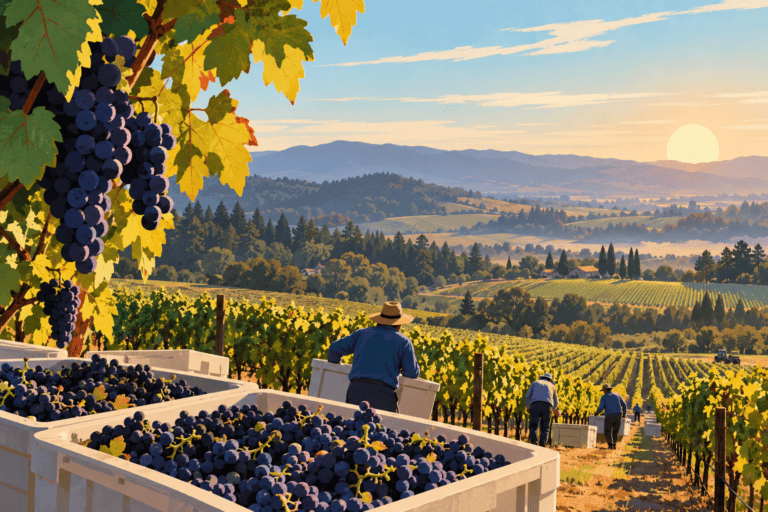
October 19, 2026 (St. Helena, CA) — At Titus Vineyards, the 2026 harvest was less a marathon than a sprint. After beginning with Sauvignon Blanc on August 5, the winery picked all its red grapes between September 1 and October 2—a compressed four-week stretch that kept winemaker Charles McKahn racing to clear fermentation tanks for the next incoming pick. The last grapes to come in on October 2 were Cabernet Sauvignon from the Titus Ranch. “Every vintage has its own story to tell,” mused Eric Titus, proprietor and vineyard manager, as he dropped off that last load of Cabernet Sauvignon. “2026 will be remembered for an early Spring, early veraison, even-tempered growing season resulting in this early harvest. Historically, early harvests with light crops bode well for the quality of the vintage.”
“If I had to choose one word to describe harvest this year, it would be ‘sprint,’” McKahn says. “Usually, harvest is much more spread out. It was a sprint to get the tanks cleared so we could bring in more grapes.”
For a winemaker, deciding when to pick is a balance of science and sensory judgment. McKahn and his team evaluate sugar levels (Brix), acidity, pH, seed color and, importantly, flavor. The grapes must be ready physiologically, but they also need to taste right.
This year, however, the challenge wasn’t simply determining ripeness. It was monitoring the pace at which the grapes reached it—and then making sure each lot received the attention it needed in the winery.
Titus farms a range of varieties, including Sauvignon Blanc, Zinfandel, Petite Sirah, Cabernet Sauvignon, Cabernet Franc, Malbec, and Petit Verdot. Most of the grapes come from two estate vineyards: one surrounding the winery and another located approximately 1 mile away on Ehlers Lane in St. Helena.
Yields were approximately 24% lower than in 2025, reflecting a season in which the vines produced fewer and smaller clusters. “There were all kinds of reasons for that smaller yield,” McKahn says. “Shatter was a primary factor at some vineyards, while our estate vineyards didn’t experience much shatter but cluster counts and weights were below average; it seems our older vineyards weighed in noticeably lighter,” he adds.
Titus harvests at night and in the very early morning, which means the fruit stays cool on the short ride from vineyard to winery. Bringing in cold grapes reduces the need to chill them after arrival and allows the team to begin processing with fruit at a favorable temperature to preserve aromas and flavors.
Once the grapes arrived, the sprint continued.
“This harvest was a challenge, in the best sense,” McKahn says. Along with the compressed picking schedule, the winery encountered slower extraction during fermentation. Extraction is the process by which color, tannins and other compounds are drawn from grape skins into the fermenting wine. When it takes longer than expected, the winemaking team must balance the time each lot needs with the practical demands of getting tanks ready for the incoming grapes.
“Coming off of 2025, which was so big and plentiful and easily extracted, this year was smaller and we had to work just as hard to make our same quality of wine,” McKahn says.
The contrast between vintages is a reminder that experience does not make harvest entirely predictable. Each season presents its own set of conditions and decisions, and the work continues long after the grapes have been picked. “I was surprised by how early the season was, harvesting whites on August 5 and reds on September 1—that was just very early,” he added.
For wine drinkers, harvest can seem to end when the last grapes arrive at the winery. For the winemaking team, that is when another critical phase begins.
“At that point we have the most important work still to do,” McKahn says. “Fermentations keep us hopping for several weeks, providing that magic that all of us love.”
The first wine Titus expects to release from the 2026 harvest is its estate-grown Sauvignon Blanc, anticipated in summer 2027.
About Titus Vineyards
Titus Vineyards is a family-owned, 50-acre vineyard and winery at the base of Howell Mountain along the Silverado Trail in Napa Valley’s St. Helena AVA. The property dates back to 1841 and includes important local figures such as General Mariano Vallejo, Dr. Edward Bale, Charles Krug and Eli York. The Titus family’s first harvest was in 1969, following Dr. Lee Titus’s purchase of the property in 1968. Today, the winery sustainably farms two estate vineyards and also sources grapes from selected vineyards across Napa Valley.
One of the distinctive aspects of Titus’ estate vineyards surrounding the winery is that the Napa River forms the western border. Eric Titus has long worked to maintain the native riparian ecosystem of the riverbank. He has vowed to keep a light footprint in the vineyard for the sake of vine health and the health of wildlife in the area.
Another landmark on the Titus property is the 30’ fall frost protecting fan, which was installed in 1952 and is the oldest vineyard fan in the Napa Valley. Called a “Tropic Breeze,” the fan is in working condition but was not activated in the 2026 growing season because there were no “killer frosts” this year.
The winery’s tasting room features floor-to-ceiling glass and outdoor seating overlooking the estate and the surrounding Napa Valley. Tastings are offered seven days a week by appointment.
For more information, visit www.titusvineyards.com.