James Douglas Meador, former owner of Ventana Vineyards, passed peacefully in Fallon, NV, in August. He was 85.
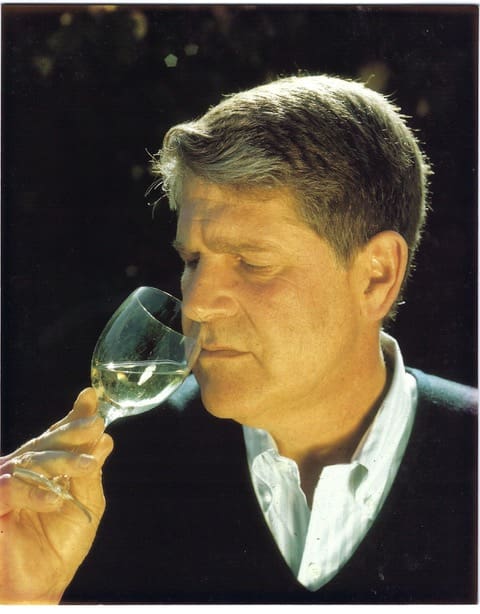
September 16, 2026 — Born in Wenatchee, Washington in 1940, the son of apple farmers, Doug Meador attended the University of Washington before going into military service on January 29,1966, as a Naval Aviator. He flew 360 plus missions in Vietnam off aircraft carriers, and received 23 air medals while serving this country.
After his service, he came to Monterey County’s wine region in the late 1970s to grow grapes. At the time, investors were planting vines as a tax write off. Asked if he knew anything about growing grapes, Meador said, “I know you plant them green side up.” Approximately 5,000 acres of grapes were in the ground before the tax laws were changed, causing the investors to go bankrupt on the entire holding.
Despite this, or because of it, Meador sold his apple orchards in Washington, and began focusing on reimagining the Monterey wine industry. He took 300 acres of the 5,000-acre holdings, and created Ventana Vineyards. Along with J Lohr, Wente, Mirassou, Scheid and Paraiso Springs, he set about bringing the Monterey County’s Wine Region to the national stage.
Self-educated in the industry, Meador read everything he could get his hands on, studying articles published by UC Davis and traveling to Europe to study how others were growing grapes. “By age 13, Doug had read all the volumes of Encyclopedia Brittanica,” says his former wife, Luann Meador Hutchinson.
Meador became a world renowned viticulturalist, researching the varietals that would perform best in Monterey Wine County. He was the first to bring Syrah and Tempranillo grapes to the region. Doug made wine to prove what you do in the vineyards changed the quality of wines. At the time, it was common practice to plant vine rows 12 or 7 feet apart, as suggested by UC Davis. He felt that 8-foot spacing was more appropriate for cool climates like foggy and windy Monterey, eventually settling on 6-foot row spacing, and even 4-foot spacing, depending on the variety.
Inspired by his visits to France, he became an advocate of tighter inter-vine spacing, allowing for greater vine density, to control vigor and maximize land use. He also practiced basal leaf removal around the grape clusters to improve light penetration and reduce disease pressure.
Meador also started planting vine rows perpendicular to the wind, instead of parallel, as was the norm. He found this enabled the vines to keep their stomata open during the prevailing afternoon wind, except at the very top of the canopy. He also championed VSP trellising, which helped open the canopy to sunlight to avoid veggie flavors. These are just some of the ways he helped change the way in which America’s vineyards grew grapes.
Meador, along with his then wife Luann, a Wells Fargo Bank Vice President at the time, turned Ventana Vineyards into one of the “Most Award-Winning Vineyards” in Monterey County, growing it to 50,000 cases, with 400 acres of grapes, and marketing to 26 states. They sold 1/3 of their production to other high-quality wineries in Santa Cruz, Napa and Sonoma counties, as well as other states.
They never forgot the home winemakers, though, as they were always welcomed at harvest with their bags, boxes and trailers.
Ventana Vineyards enjoyed 27 years of consecutive golds for its Rieslings grapes, and 26 consecutive golds for “The Gold Stripe Chardonnay.” Meador also grew Gewurztraminer, but it wasn’t selling in the marketplace.
“We took out a full-page ad in Wine Spectator to teach people how to pronounce it,” says Hutchinson. “Doug ended up selling all of the Gewurztraminer fruit to Thomas Fogarty, and they won lots of awards for it! I was pretty miffed I didn’t have any to sell.”
Meador may be best remembered for being the first to plant the Musqué clone of Sauvignon Blanc in Arroyo Seco, which was prized for its tropical aromatics and flavors, instead of the abundant pyrazines present in the commonly planted Sauvignon Blanc clones.
Winegrower Mark Chesebro, former winemaker at Bernardus, bought 95% of his Sauvignon Blanc and Chardonay fruit from Meador during his tenure there. He remembers the clone for its perfumey, orange blossom, honeysuckle and tropical aromatics.
“Doug brought the Musqué clone of Sauv Blanc from Arroyo Seco Vineyards,” says Chesebro. “The vines were tested at UC Davis and were found to have a virus that they didn’t want to clean up. But Doug actually did save the clone, and in our area, we use that clone pretty much everywhere, although our version has never been cleaned up.” Chesebro says that UC Davis has since cleaned up the Musqué clone due to high demand.
“Picking at 21 to 22 Brix for Musqué clone SB is good,” says Chesebro. “Nobody plants regular SB in Arroyo Seco anymore.”
Winegrower Dan Lee of Morgan Wines remembers Meador for his great stories and his willingness to share. “Doug was very knowledgeable and taught me about barrel fermentation of Chardonnay and introduce me to the best French TONNELLERIE there is, Francois Freres. We have used their barrels for 45 years for Pinot Noir, Chardonnay and Syrah.” Lee added that Meador will be best known for planting the Sauvignon Musqué clone of Sauvignon Blanc and experimenting with grape varieties. “He planted Albariño way before anyone knew what it was,” says Lee.
Those that knew him remember him with his cup of coffee in one hand, cigarette in the other and driving his old Yukon touring the vineyards. He was funny, with a quick wit, loved talking about Monterey County wines and showed his love of the wine industry by speaking and educating around the US and the World.
In 2006, Doug and LuAnn retired and sold Ventana Vineyards, including the production facility and 300 acres, to a group of local investors. It was sold again in 2021, to current owner/winemaker, Russell Joyce of Joyce Wine Company. Joyce has since lovingly restored the historic Ventana Vineyard barn, making it the centerpiece of Arroyo Seco wine culture.
Even after retiring, Meador and his lifelong love, wife, and co-partner, LuAnn Meador Hutchinson, remained committed to building Monterey County Wines around the US and internationally. Hutchinson served two terms with the Monterey County Vintners and Growers Association as President of the Board of Directors.
The couple parted ways in 2014, after realizing they were better business partners.
Among those they served with on the Board was Rhonda Motil, former Executive Director of the Monterey County Vintners and Growers Association from 2002-2012, and now Vice President of Marketing at J. Lohr Vineyards and Wine.
“The passing of someone with such a rich history in the California wine industry, but particularly the Monterey County viticulture community, is certainly something to reflect upon,” says Motil. “Doug was remarkable in how he shared his passion of winemaking and the land with others.”
One of the ways in which he did that was through his groundbreaking book called “The New Viticulture,” still available used on Amazon. An accomplished writer, Meador also wrote “Face the Tiger,” an account of his military life, and later published a book of fiction, called “Devils Ransom.”
Meador leaves behind three sisters, Sharon Artley Woodworth, from Tennessee, Karie Artley Omdahl and Judy Artley from Washington, and their husbands and families. Also surviving Meador is his son, Jason Douglas Meador, 34, of Ironton, Missouri, who has two children, as well as a stepdaughter; Roni Jagla Farrell, 59, her husband Dan and their two sons, Zack and Kelly, as well as their wives, all from Bend, Oregon; and a stepson Brent Sullivan, 48, his wife Sarah, two daughters and two stepdaughters, who are also living in Bend, Oregon. In lieu of flowers or donations, Luann asks that you buy a bottle of your favorite Monterey County Wine and toast to Doug Meador and his legacy. Cheers to Monterey and the legacy Meador leaves for all to enjoy.