Healdsburg event brings together three of Sonoma’s leading voices on the future of California wine
May 4, 2026 (Healdsburg, CA) — As climate pressures intensify and consumers show growing interest in off-the-beaten-path wines, California winemakers are increasingly turning to alternative grape varieties.
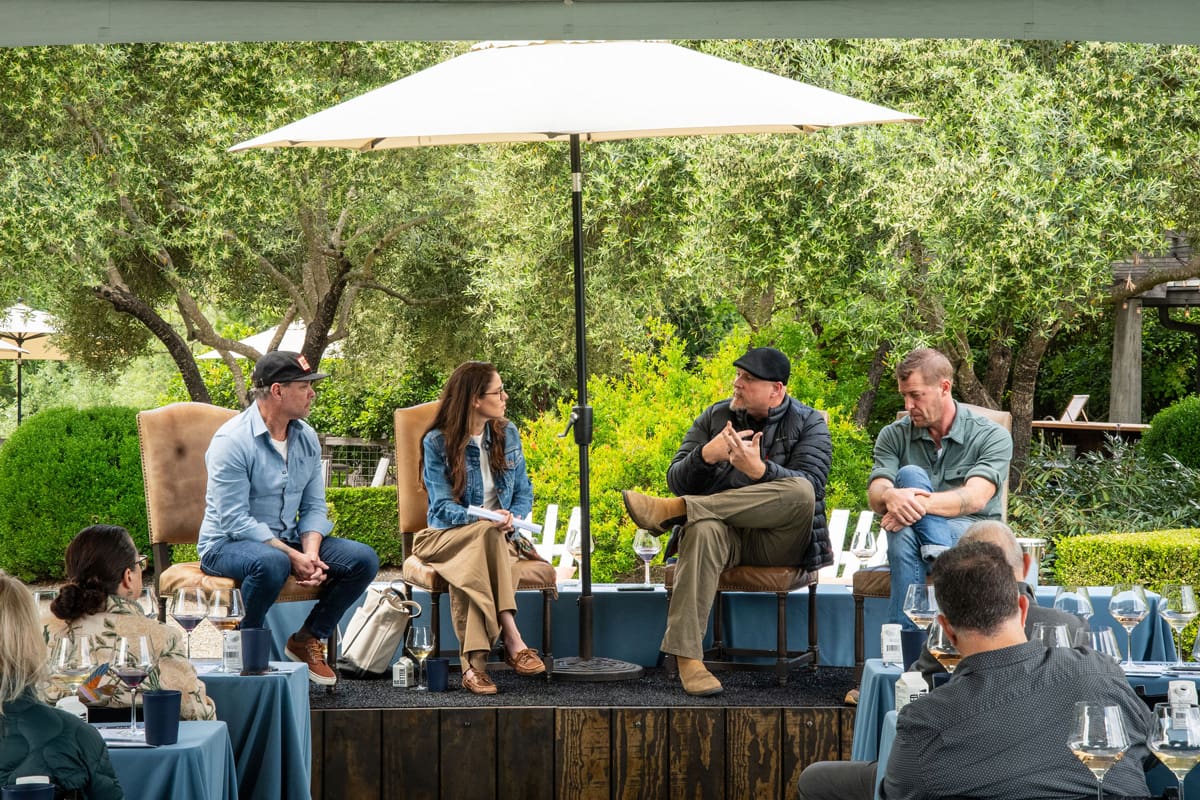
This shift was the focus of an industry panel hosted by Mascarin Family Wines (formerly 32 Winds) on April 9 at its creekside tasting room just outside downtown Healdsburg. Approximately 30 members of the trade and media attended the event, moderated by Ana Carolina Quintela, Sonoma County Correspondent at Decanter, and featuring Scott Schultz (Jolie-Laide Wines), Sam Bilbro (Idlewild Wines), and Matt Taylor (Mascarin Family Wines, Ink Grade & Matt Taylor Wines).
The panel explored varieties such as Chenin Blanc, Trousseau Gris, Timorasso, Gamay, Nebbiolo, Melon de Bourgogne, and other non-traditional grapes, pointing to the state’s diverse terrain and range of microclimates as a natural setting for broader experimentation.
“California is still a young winegrowing region compared to Europe, where traditions around grape varieties and place have developed over hundreds of years,” said Sam Bilbro, Owner & Winemaker, Idlewild Wines. “The opportunity here is to continue exploring what grows best across different sites, both in terms of quality and balance with the natural environment, rather than settling too quickly on a fixed set of grapes.”
Bilbro pointed to parallels with European regions, noting that sites within a few miles of the coast in California often align with grapes from Burgundy, Beaujolais, and the Loire Valley, while warmer inland regions may be better suited to varieties from Southern France and central and southern Italy.
Consumer behavior was another key theme, as interest in unconventional grapes is shaping what producers bring to market.
“We’re seeing growing curiosity and demand for under-the-radar varieties. These wines often come with fewer preconceived expectations and can feel more approachable to younger consumers, particularly as they look for wines that offer value. More established wine drinkers are also recognizing there’s still more to discover within the category,” said Matt Taylor, who has served as winemaker at Mascarin Family Wines for the past 10 years.
The panel also addressed how California wine is perceived globally, noting that while regions like Napa Valley are widely recognized, others, including Sonoma, remain less clearly understood, presenting both a challenge and an opportunity to expand the narrative.
“Sonoma has historically sat in the shadow of Napa, but it offers some of the most compelling terroirs and microclimates in California,” said Scott Schultz, Owner & Winemaker, Jolie-Laide Wines. “While the region has gained recognition through Chardonnay and Pinot Noir, there’s a movement to challenge that narrow lens by highlighting lesser-known vineyards and varieties that deserve attention on the world stage.”
Following the panel, attendees participated in a tasting and lunch showcasing wines made from the varieties discussed, offering a direct look at how these grapes are being interpreted across the state.
The event also marked a moment of transition for the host winery. Since 2025, Mascarin Family Wines has been replanting its Angelo vineyard, a project led by winemaker Matt Taylor, with a focus on Loire varieties – a direction Proprietor Mia Mascarin described as central to the winery’s future.
“Lesser-known varieties have long existed in California but are now experiencing a real resurgence,” said Mascarin. “Winemakers like Scott, Sam, and Matt are helping bring these nearly forgotten grapes back into focus, and what they’re doing reflects exactly what today’s consumers are hungry for.”
Media interested in exploring these themes further are invited to connect with the participating producers for interviews or to request samples of the wines discussed. For more information, please contact:
Joy Finn — joy@32windswine.com
Alex Sarovich — alex@ownrootedhospitality.com
Kaila Raymond — kaila@senseofplacepr.com
About Mascarin
Mascarin Family Wines has produced wine in Sonoma County for over 15 years. The portfolio encompasses both 32 Winds and Mascarin Wines labels, with the latter focused on single-vineyard expressions and sustainable and organic farming practices. Winemaker Matt Taylor brings 29 years of experience and a third-generation Sonoma County perspective to the cellar, shaped by time working in Spain, France, Argentina, and New Zealand. His approach centers on low-intervention winemaking, with a focus on clean, balanced, and terroir-driven wines that evolve over time. The winery’s tasting room sits among gardens alongside a creek flowing into the Russian River, just outside downtown Healdsburg.