Sierra foothills winery harvested 36 tons, 30% less than 2024
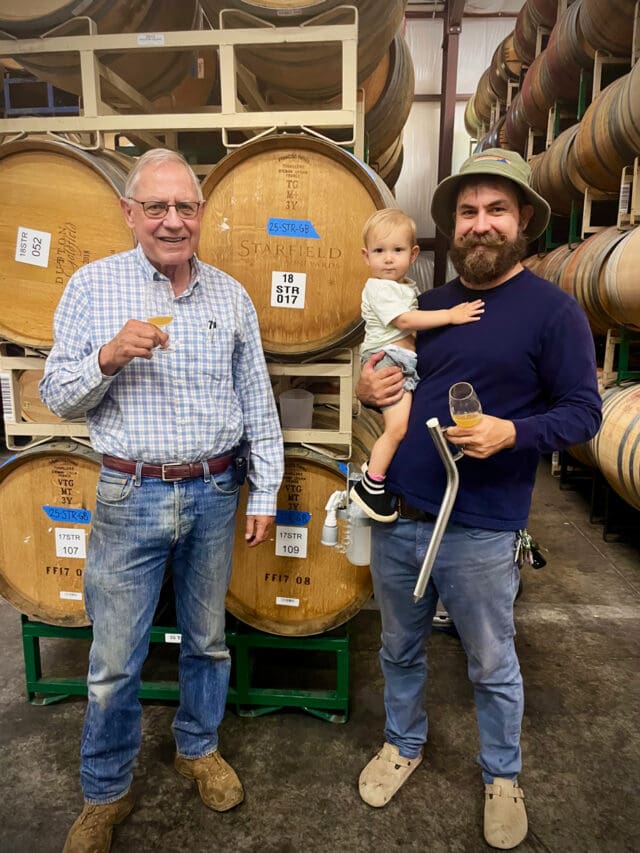
(Photo Courtesy of Starfield Vineyards)
November 20, 2025 (Placerville, CA) — Rob Sinton, the Winemaker at Starfield Vineyards, reports that the winery’s harvest started on August 11 with a small lot of recently grafted Grenache Blanc, along with Grenache Noir for sparkling Brut Rose. “We harvested most of the grapes for still wine between September 2 and September 29, and we concluded harvest just before the rains on October 13 with Mourvedre,” he explains.
Starfield harvested 36 tons of grapes from their estate vineyards, 30% less than last year. “Last year we began focusing more on field blends, and we continued that approach in 2025, combining Syrah with Viognier, and again fermenting Mourvedre with a second red grape, using Aglianico in 2024 and Petite Sirah in 2025,” Sinton adds. “Both results look very promising. Across all varieties, we also broadened our trials with Renaissance yeasts, with the goal of developing wines with brighter fruit aromas. So far the results look especially good, and we’re planning to continue the trials next year,” he said.
“Global warming did not impact our growing season in the Sierra Foothills during 2025. It was a deceptively cool year, with only one 100 degree day,” adds Tom Sinton, co-owner/founder of Starfield (and Rob’s father).
“We always harvest at night, usually starting at 3-4 AM, which keeps the grapes cool and firm, and allows us to deliver grapes to the winery early in the morning, assuring the fruit is destemmed or pressed and safely loaded in tank within 8-12 hours of harvest. Night picking and morning processing helps preserve the freshness of the delicate fruit flavors, which contributes to the bright fruit aromas in our Starfield wines. While it’s lovely in the early morning light, we really look forward to a Starbucks coffee before we declare the day’s harvest officially over,” Rob explains.
Rob continues, “in June of this year, we started moving to organic practices, and we applied our first fully organic treatment immediately after harvest, once we got one inch of rain, when we seeded an organic cover crop of bell beans, winter peas, barley and oats into our native cover crop, using our new Schmeiser No Till Seeder. And it worked! We now have a lovely crop of nitrogen-fixing plants mixed in with our native cover crop. Regenerative protocols mean we don’t till, but we’ll mow the cover crop a couple of times next spring to return the biomass to the soil, to build up the organic matter.”
“Most harvests have a distinct and unique aroma or taste in the grapes and the new wines,” Rob adds. “This year the wines are far more fruit forward than many past vintages. This aligns with our style—very fresh and aromatic, with the structure of ripe fruit.”
Rob said one grape that stood out this year was Tempranillo. “It normally has a very distinctive meaty, charcuterie-like character. This year it also developed intense blackberry and blueberry fruit aromas. That combination could make it our best vintage ever,” he said.
“As the grapes come in, we ferment the varietals separately (except for our co-ferments, such as Mourvedre and Petit Sirah or Syrah and Viognier). With the co-fermented wines we’re planning to stay away from new oak, so we can present a pure fruit expression,” Rob continued.
This is the first year the winery harvested Grenache Blanc, which is one of founder Tom Sinton’s favorite wines to drink. Starfield grafted 1.2 acres to Grenache Blanc in 2024. “We used a very old processing technique – which is new to us this year: natural oxidation,” Rob explained. “We did not add sulfur at the crusher, and we splashed the wine around a bit more, otherwise we fermented the wines as usual. Without sulfur in the juice, the phenolic compounds readily oxidize, and drop out of solution, resulting in a brilliant wine with delicate fruit character. The result we’re seeing is a more golden color in the Grenache Blanc, along with lovely peach and stone fruit characteristics and an almost tropical note. Depending how this trial works we will try this with other wines next year,” he added.
The first wine to be released from the 2025 harvest will be the 2025 Estate Grenache Blanc in the late spring of 2026.
Tom Sinton commented that “overall, the most surprising thing about this harvest was how cool the whole growing season was, in some ways reminiscent of 2023.”
What did Starfield do differently from its Sierra Foothills neighbors?
“We’re very focused on the clear expressions of fruit, so we keep a ‘tight leash’ on fermentation temperatures and yeast nutrition during primary fermentation. In addition, we co-inoculated all our red wines with bacteria for malo-lactic fermentation this year, which allowed us to complete processing well before cellar temperatures dropped and made this difficult. This yielded the purest wines we’ve ever seen, in our 14 years of winemaking. We think this is probably due to the cooler weather as well as changing our strain of ML bacteria,” Tom and Rob Sinton conclude.
The Winery
Perched in the El Dorado AVA in the Sierra Foothills, at an elevation of 2,400’, on hillsides with slopes up to 26%, the winery was founded in 2012 by Tom and Rob Sinton. The 31 acres of vineyard are planted to 17 varieties.
The Sintons have practiced sustainable, Fish-Friendly farming since 2012. This involves leaving swaths of native forest throughout the vineyard, which improves water percolation and provides habitat for natural predators. In addition, they planted buffer strips of native plants — including deer grass and wild roses — to reduce erosion, while routing runoff to three ponds in order to reduce sediment. To increase the native bluebird population, they installed 92 bluebird boxes: the large population of bluebirds helps control many insects. They began implementing regenerative agriculture in 2016, avoiding all tillage and allowing the vineyard to develop a natural cover crop, and they recently began transitioning the vineyard to fully organic farming. As part of that transition, they plan to reduce their carbon footprint by strategically using drones on the steep hillsides to apply organic treatments like sulfur, while also spreading beneficial insects to help control common vineyard pests.
The unique character of the vineyards develops from the high-elevation mountain terroir and is expressed as what they call Sierra Spice, a set of unique aroma and taste characteristics that come primarily from the western slope forests that surround their vineyards. “It’s a defining element of El Dorado terroir,” Tom and Rob Sinton explain. “Our forest conifers are full of aromatic terpenes, essential oils that the trees release to attract pollinators or defend against insects, and these form our unique forest character which we call Sierra Spice,” they say. After considerable research and collaboration with other El Dorado vintners, they recognize Ponderosa Pines, Incense Cedars and Douglas firs as the specific trees which define Sierra Spice. “The signature qualities are bright, earthy, and woodsy forest smells, as well as distinctive basil, floral and citrus aromatics,” Rob Sinton explains. “Grapes planted adjacent to the forest absorb the oils and they are integrated into the fruit character, giving the wines a citrusy, minty freshness and brightness,” he adds.
The winery is set on a high hill overlooking vineyards, gardens, forests and steep slopes of the Sierra Foothills and offers 360° mountain views. Visitors enjoy walking through The Gardens, which extend over ten acres of forest, woodland and ponds. They are inspired by the ferme ornée — decorated farm — style of eighteenth-century English landscape architecture. George Washington incorporated many of these style elements in his Mt. Vernon estate, as did Thomas Jefferson at Monticello. The main element of the design is a path that takes the guest on a circuit of the landscape. There are over three miles of paved paths and roads, bordered by a wide variety of flowers, climbers, and shrubs, and shaded by pine, cedar and fir forest, oak woodland and a wide range of maples, scarlet oaks, aspen, alders, ginkgos, tupelos and many other trees. Outside the tasting room is The Rose Arbor, covered by hundreds of Iceberg and Sally Holmes climbing roses, which produce dazzling sprays of white flowers year-round.
The winery is located at 2750 Jacquier Road in Placerville (95667) and is open seven days a week from 11:00 a.m. to 5:00 p.m. More at 530/748-3085 and https://www.starfieldvineyards.com/