By Greg Popovich
I’ve spent more than three decades in the wine business, and one thing I’ve learned is that wine doesn’t just compete against other wines.
Back in the early 1990s, while earning my MBA at Pepperdine University, I spent a great deal of time studying consumer behavior and market trends. In fact, my year-end thesis focused on how to avoid the pitfalls of several companies I had previously worked for by developing a low-overhead business model. The idea was simple: stay lean, stay disciplined, and avoid the layers of bureaucracy that often slow companies down.
More than three decades later, that philosophy still guides our business. Staying lean allowed us to navigate changing markets, economic cycles, and industry disruptions. But while I spent countless hours studying competition, costs, efficiency, and changing consumer behavior, I never imagined the competitive landscape we face today.
At that time, the beverage industry’s competition was fairly straightforward. Wine competed against beer and spirits. If a consumer chose a bottle of wine for dinner, they were less likely to order a cocktail. The battle was largely taking place within the alcoholic beverage category itself.
Today, I believe the competitive landscape has changed dramatically.
The modern consumer has more choices for discretionary spending than at any point in history. Wine still competes against beer, spirits, and cocktails, but it is also competing against streaming services, social media, food delivery, online shopping, video games, travel, sports betting apps, and countless other forms of entertainment.
One trend that particularly interests me is the explosive growth of online sports betting.
Apps like DraftKings and FanDuel have effectively created a new entertainment category that competes for the same discretionary dollars that once might have been spent on dining out, a bottle of wine, or a night out with friends. A consumer who previously spent $100.00+ on dinner and a bottle of wine may now spend that same money placing bets from the comfort of a couch.
The appeal is obvious. Sports betting offers instant action, instant feedback, constant engagement, and the possibility of immediate reward. Every game becomes more exciting. Every play matters. The smartphone never stops buzzing.
But I also wonder about the unintended consequences.
For generations, sports brought people together. Friends gathered at a bar. Families watched games together. Conversations happened face-to-face. Today, much of the experience is increasingly centered around a screen, an app, and a wager.
Wine is different.
Wine is about sharing a meal with family and friends. It is about conversation, hospitality, and slowing down for a few hours. The best moments in wine often happen after the bottle is opened, when people put down their phones and simply enjoy each other’s company.
As I watch consumer habits evolve, I sometimes wonder whether the biggest challenge facing the wine business isn’t competition from another beverage at all.
Perhaps it is competition from anything that pulls people away from those shared experiences.
To be clear, online sports betting is not the sole cause of the wine industry’s challenges. Far from it.
The wine business is facing a perfect storm of change. Younger consumers are drinking differently than previous generations. Cannabis legalization has created an entirely new recreational category that barely existed when I entered the wine business. Wellness trends have encouraged moderation. Inflation has squeezed household budgets. Restaurant prices have climbed dramatically.
And then there are GLP-1 weight-loss medications such as Ozempic, Wegovy, Zepbound, and Mounjaro.
Perhaps no trend has the potential to reshape consumer behavior more dramatically.
Some analysts project that tens of millions of Americans—and potentially as many as 83 million—could eventually use GLP-1 medications. Even if those projections prove optimistic, the numbers are staggering. We may be witnessing one of the largest shifts in consumer behavior in modern history.
The implications extend far beyond weight loss.
Many users report reduced interest in alcohol, fewer cravings, smaller portions, less impulse spending, and different social habits. These medications are not simply changing waistlines; they may be fundamentally changing how people consume.
Restaurants are paying attention. Food manufacturers are paying attention. Beverage companies are paying attention. The wine industry should be paying attention as well.
If tens of millions of Americans begin eating less, drinking less, and making different choices about how they spend their discretionary income, the ramifications could be profound. Entire industries built around food, beverages, hospitality, and consumer products may need to adapt. The impact may ultimately rival or exceed the effects of cannabis legalization, wellness trends, and even the rise of online sports betting.
Cannabis, sports betting, and GLP-1 medications may seem unrelated, but they share something important in common: each represents a new competitor for consumer behavior. One competes for recreation. One competes for entertainment. One changes consumption habits altogether.
None of these trends alone explains the challenges facing wine. Together, however, they paint a picture of a consumer whose attention, lifestyle choices, and discretionary income are being pulled in more directions than ever before.
Looking back, the wine industry spent decades competing against beer and spirits. Today we face an entirely different reality. We are competing against cannabis for recreation, sports betting for entertainment, streaming platforms for attention, social media for engagement, and GLP-1 medications that may fundamentally alter consumption itself.
These are not temporary headwinds. They may represent a generational shift in consumer behavior.
That is why sports betting interests me.
It is not simply another expense competing for a consumer’s wallet. It is another form of entertainment competing for their attention.
And attention may be the most valuable commodity in modern America.
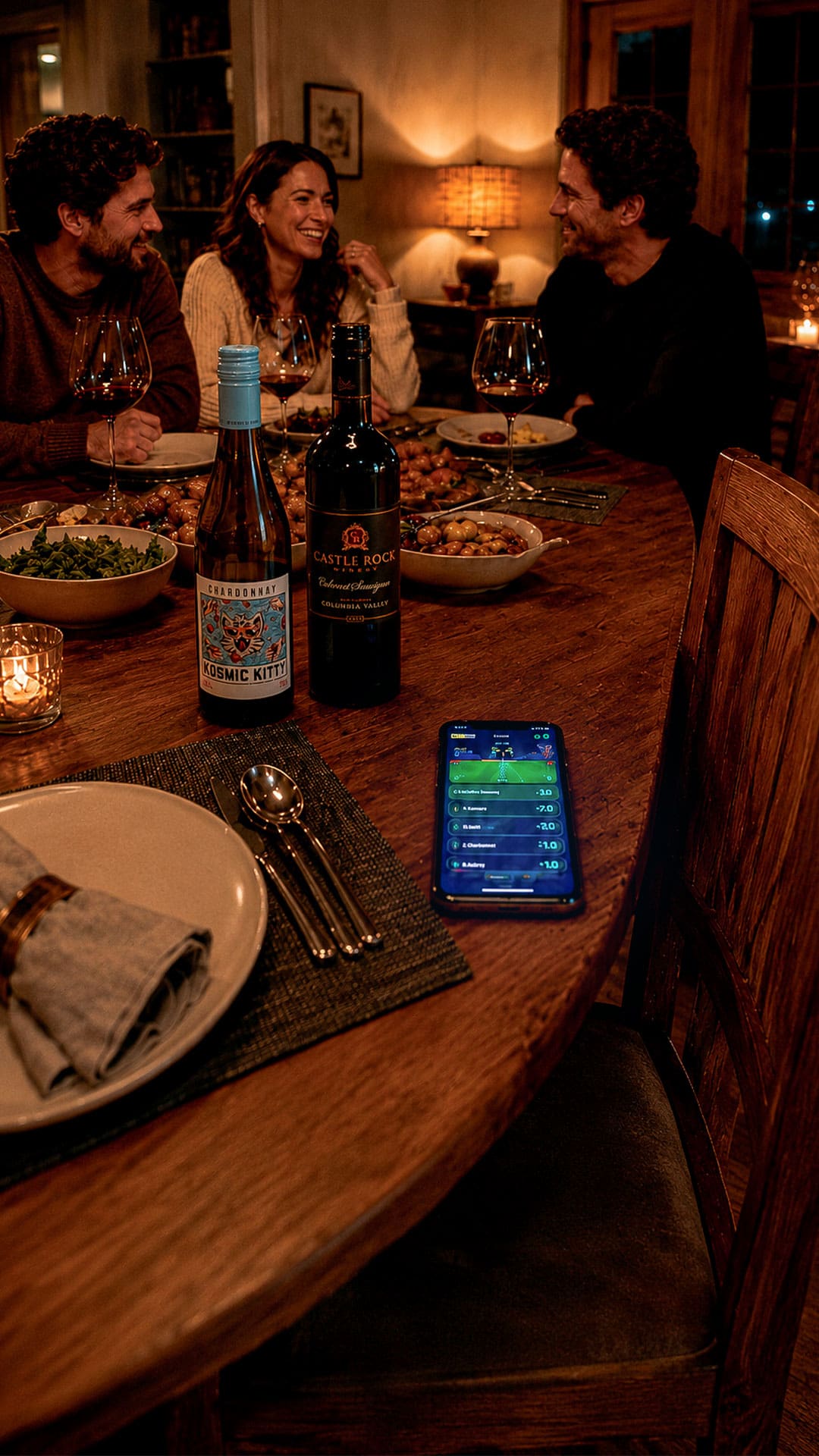
Imagine a dinner table set for four. The food is ready, the wine glasses are poured, and one chair sits empty. Not because someone is working late, stuck in traffic, or feeling under the weather. The chair is empty because that person is sitting alone on a couch, staring at a screen, following a game, tracking a parlay, scrolling social media, or waiting for the next notification.
That image may sound dramatic, but I believe it captures something larger happening in our culture.
The irony is that wine may actually offer one of the best values in today’s entertainment economy. Consumers routinely spend $18 on a cocktail, $9 on a cup of coffee, $20 a month on streaming subscriptions, and $50 or more on a weekend of sports betting. Yet a genuinely good bottle of wine can still be purchased for $11 to $14 and shared among family or friends for an entire evening.
At Castle Rock Winery, we have built our business around the belief that great wine should be affordable and accessible. Likewise, Kosmic Kitty Wines was created to be approachable, authentic, fun, and affordable for a new generation of wine drinkers.
I remain optimistic about wine’s future.
People will always celebrate milestones. Families will always gather. Friends will always share meals. There will always be a place for hospitality, conversation, and human connection.
But as an industry, we need to recognize that we are no longer competing only against other alcoholic beverages.
We are competing for time and attention. We are competing against every app, screen, subscription, distraction, and alternative that occupies a consumer’s day.
Understanding that reality may be one of the most important conversations the wine business can have over the next decade.
Because the greatest threat to wine may not be what’s in someone else’s glass.
It may be the empty chair at the table.
Greg Popovich is the founder and president of Castle Rock Winery, one of America’s largest independent family-owned wine companies. A graduate of Pepperdine University’s MBA program, he built Castle Rock around a low-overhead operating model and today runs the business with a fraction of the staffing typical of similarly sized wineries. Castle Rock Winery and Kosmic Kitty Wines are produced in Santa Rosa, California.