From a selection of 100% Malvasia delle Lipari grapes, hand-picked from bush-trained vines on the north-west side of the island, comes a dry white wine, vinified and lightly macerated in cocciopesto amphorae
November 21, 2025 (Aeolian Islands, Sicily) — The prized Malvasia delle Lipari, but in an unexpected guise: dry and macerated in amphora, then aged in bottle. This is how Eúxenos is born, an elegant, vertical wine in which notes of dried and candied fruit, typical of the variety, move harmoniously within the mineral framework that has always defined the style of Tenuta di Castellaro wines.
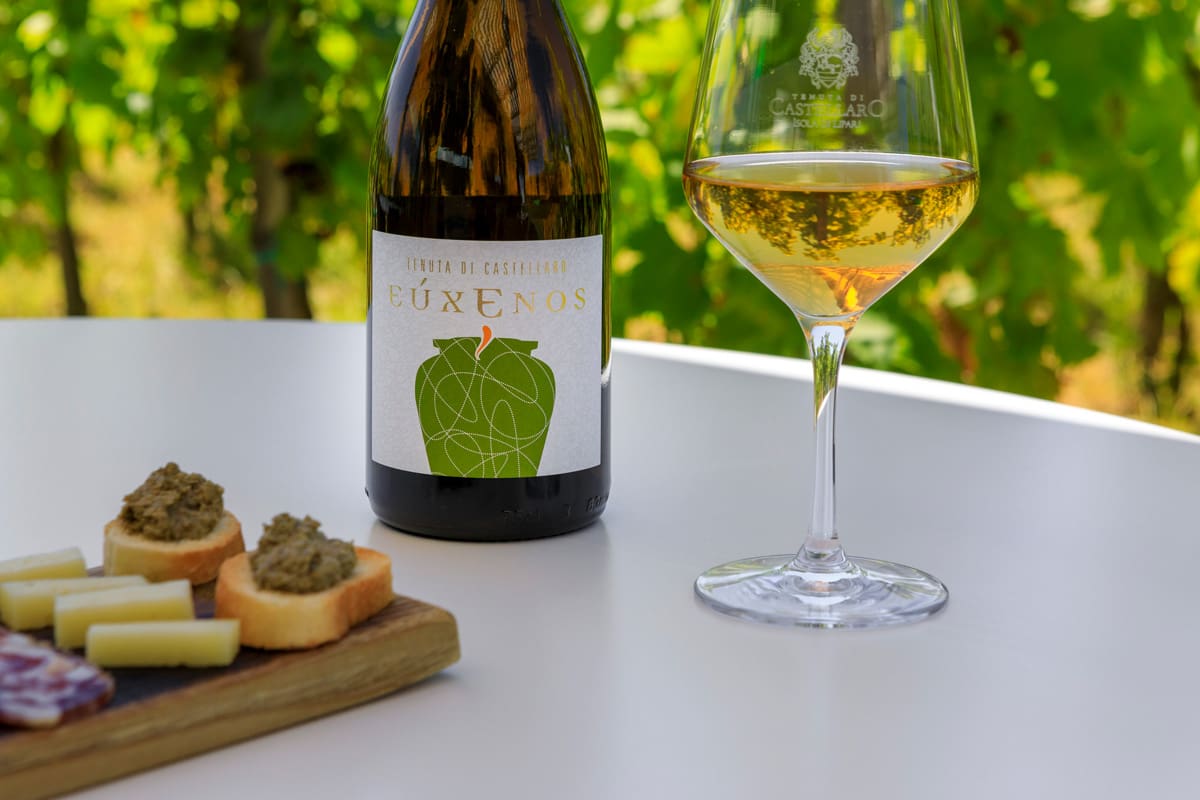
Eúxenos, the latest creation from Castellaro, encapsulates the earth, wind, and sea of the Aeolian Islands, telling the story of a distinctive organic agricultural journey shaped by the volcanic character of the land, the sea breeze, and the traditional bush-training of island vineyards.
“From a selection of 100% Malvasia delle Lipari grapes,” explains winemaker Emiliano Falsini, “hand-harvested from bush-trained vines on the island’s north-west slope, comes a dry white wine that is vinified and lightly macerated. Spontaneous fermentation, without additives or selected yeasts, takes place in cocciopesto amphorae, an ancient material used since Greek and Roman times for storing wine. Here, the natural yeasts on the grape skins guide fermentation, during which the wine remains in contact with the skins for about thirty days. This is followed by eight months of ageing in the same amphorae, before resting in bottle.”
Unlike the better-known sweet version, in this case the Malvasia delle Lipari grapes are not exposed to the sun for drying, but vinified pure to express the most authentic soul of the variety. The result is a full, elegant, and velvety wine—versatile in pairings, with pleasant fruity echoes well balanced by a streak of acidity and a delicately saline texture.
“Eúxenos—whose name in ancient Greek means ‘welcoming to the stranger’—is an invitation to discover this surprising land,” adds Massimo Lentsch, founder of the Sicilian winery. “The fascinating discovery in 2021 of ancient amphorae recovered from the Aeolian seabed inspired the creation of this wine, which marks a new milestone in a journey begun in 2005. That was when the search began, across the Aeolian Islands, for the finest expressions of a white grape variety historically linked to these volcanic soils: Malvasia delle Lipari, introduced to the island, according to ampelographic studies, by the ancient Greeks themselves. Through careful massal selection and re-propagation of this rare and precious variety, the enological project of Tenuta di Castellaro took shape, founded on the belief that with an artisanal yet contemporary approach, Lipari, too, could give life to wines of great value and identity.”
Eúxenos follows in the wake of these intentions and may be described as a form of oenological archaeology of the island of Lipari.
About Tenuta di Castellaro
Where the sun sets sheer over the sea and the millennia-old tradition of bush-trained vines endures, Tenuta di Castellaro rises on volcanic soil as a monument to nature, culture, and architecture. The winery project, deeply tied to the historical and landscape heritage of the area, tells the story of a unique territory: Lipari, the largest of the Aeolian Islands.
With 24 hectares of vineyards producing around 70,000 bottles a year, an innovative state-of-the-art cellar, a wine resort, and the geomineral park of the Kaolin Quarries—cleaned and restored for public enjoyment—Tenuta di Castellaro is a unique and multifaceted reality. It has always embraced a natural approach to viticulture, following organic and vegan protocols.
The wild charm of this unspoiled, remote, and magnetic corner of the world captivated the Lentsch family from Bergamo, who in 2005 decided to embark on a major viticultural and landscape project: to preserve, enhance, and share the beauty of this place, safeguarding its traditions and distinctiveness. From this vision come wines crafted from the island’s native varieties—first and foremost Malvasia delle Lipari and Corinto Nero—true expressions of their territory.